
At the University of Minnesota Twin Cities, students in the College of Continuing and Professional Studies are practicing interacting with clients in a low-risk, realistic setting. With evolving virtual reality (VR) technology available on campus, Master of Professional Studies in Integrated Behavioral Health can put themselves in their clients’ shoes and experience what they’re feeling.
Instructors Eugene Hall and Fiyyaz Karim took Integrated Behavioral Health students to the Virtual Reality Studio in the Health Sciences Education Center, operated by University Libraries.
Several medical school classes, as well as journalism, art, and architecture classes, use the studio for in-class activities.
“We want to support student innovation and creativity, and we want to support the whole student,” says Charlie Heinz, academic technologist and VR program lead, whose role at the studio is to aid instructors who want to incorporate virtual reality into their curriculum.
New horizons in mental health training
Virtual reality and its applications to the mental health field aren’t new, but the sophistication and capabilities of technology are growing rapidly.
Instructors Hall and Karim worked with Heinz to match their class objectives with the best VR options.
Students were able to practice essential clinical skills within lifelike, interactive environments—an experience that powerfully demonstrates how VR can revolutionize trauma-focused therapy.
Instructor Fiyyaz Karim
Hall and Karim’s goals for students were simple: familiarize them with the tools that they could potentially use with future clients—specifically in exposure therapy and cognitive behavioral therapy—and practice their communication skills.
“The extent to which you can customize is fantastic,” says Integrated Behavioral Health student Adys D. “They create such a realistic experience that it’s easy for the client to get absorbed. Increased patient engagement often translates to more effective healing.”
Master’s student Ruibing (Ruby) Z., agrees, adding, “I love how VR is able to simulate different phobia scenarios with [an] adjustable level of intensity.”
AI and virtual reality
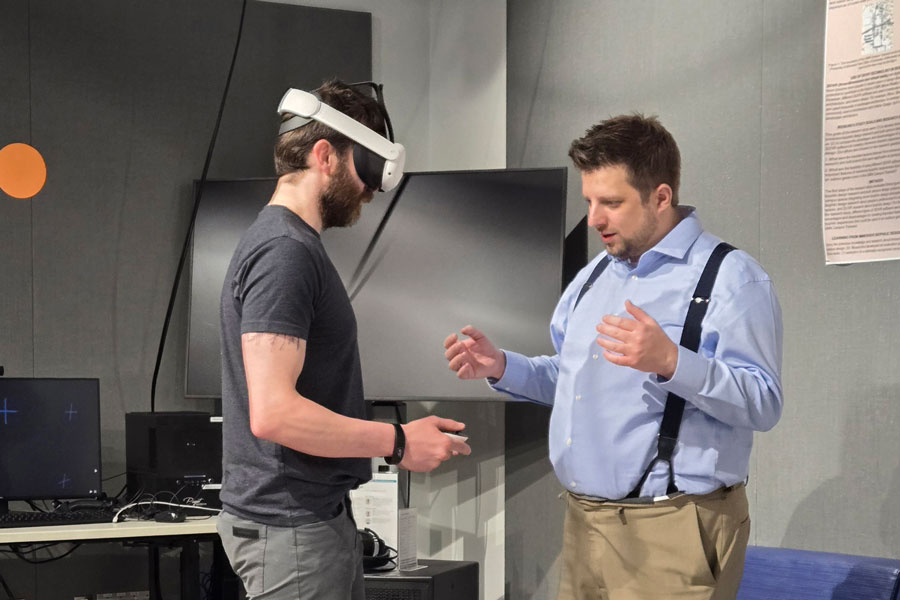
Charlie Heinz instructs a student on using virtual reality tools at the University of Minnesota Twin Cities.
While at the studio, students also had time to explore a mental health practitioner scenario using Bodyswaps, an immersive artificial intelligence platform. Bodyswaps allows the user to interact with an avatar to practice active listening, navigating conversations, or, in the case of mental health practitioners, talking to someone who has had suicidal ideation.
In that instance, after hearing what the patient avatar has to say, students are prompted to give their reaction or response. Then the app flips, with the student now sitting on the couch where the patient was, able to see and hear the avatar speaking with their voice. Users can see their body language and head position, and hear the tone of their voice, pacing, and word choice.
Student Matthew C. says that the platform allows for an experience that can be shared with a counselor. “This can lead to difficult moments, such as a natural disaster or interpersonal violence, becoming a shared event. Being able to share as much in that event as possible to have a frame of reference … is a key that VR has solidified for me.”
Overall, says instructor Fiyyaz Karim, “students were able to practice essential clinical skills within lifelike, interactive environments—an experience that powerfully demonstrates how VR can revolutionize trauma-focused therapy.”
After the experience, student Jace H. says she hopes that using VR “as a more versatile tool for education, occupational services, and training … is expanded as the technology improves and becomes more commercially available.”
For now, the technology is an immersive instructional benefit for students and faculty at the University of Minnesota.
This story is adapted from the College of Continuing and Professional Studies