
Carey Carlock never imagined she’d have so much trouble finding a therapist for her teenage child.
She was a hospital CEO, on the board of a prominent local mental health organization and well connected. Yet the Oak Park mother couldn’t locate a therapist in her community who took her health insurance.
“I found that to just be completely unacceptable,” said Carlock, whose experience led her to change careers and open a new therapy practice in 2021 that now has six locations.
Now, she and others are hoping a recently passed bill will make it easier for people across Illinois to find therapists who take private insurance.
In recent years, many therapists have stopped taking insurance because of what they describe as low payment rates and administrative hoops that can make it difficult to treat patients — a situation that has left many patients either skipping behavioral health care or paying entirely out of pocket. The newly passed bill aims to address those issues by setting into law a formula outlining how much insurers must pay therapists for their services.
“This is an affordability bill,” said bill sponsor Rep. Lindsey LaPointe, D-Chicago. “It’s not affordable when you pay your monthly premium and then you have to pay $250 out of pocket for your monthly therapy.”
The bill also aims to cut red tape. It would bar insurers from requiring therapists to submit more documentation to get reimbursed for 60-minute sessions as compared with shorter sessions; require insurers to cover multiple behavioral health services for an individual patient in one day; and require them to cover services provided by therapists in training who are supervised by licensed professionals. The bill also aims to shorten the time it takes for therapists to join insurance plans’ networks.
The bill passed despite opposition from insurance industry representatives, who worry that it will mean higher costs for all members and who are against what they say is a precedent of reimbursement rates being set in statute.
Gov. JB Pritzker’s office also initially expressed concern about the bill earlier this year, but remained neutral after changes were made to the legislation. The governor’s office will review the final bill before the governor takes action, a spokesperson for the office said.
If Pritzker signs the bill into law, it would apply to about 2.5 million people in Illinois who have state-regulated health insurance plans, starting in January 2027, LaPointe said. Large companies typically have self-funded plans, which are regulated by the federal government, not the state. The bill also would not apply to people with HMOs.
The bill’s passage this fall came after several years of work by LaPointe and advocates for better access to behavioral health care. Thresholds, which serves people with serious mental health and substance use disorders in Illinois, brought the bill to LaPointe, said Heather O’Donnell, who was previously at Thresholds and now is DuPage County Health Department director of behavioral health strategy.
“I think this bill hit home with people,” O’Donnell said. “Elected officials hear from their constituents all the time about how hard it is to find a therapist, psychologist (or) social worker that takes their insurance. Many have their own personal experiences with the issue.”
Previous versions of the bill would have required insurers in Illinois to pay in-network therapists 141% of what Medicare pays for therapy and substance use disorder services. The formula in the version of the bill that passed this fall should get reimbursements to the “ballpark” of 141% of Medicare reimbursements, LaPointe said.
The bill was also changed, prior to passage, so that it would not apply to state employee health plans.
“The reason we carved out state employees is because the original version of the bill to include state employees would have allegedly raised costs for the state employee health plan,” LaPointe said. “We have always disputed that and the reason we’ve disputed that is because behavioral health care spending makes up a tiny percentage of overall health care spending.”
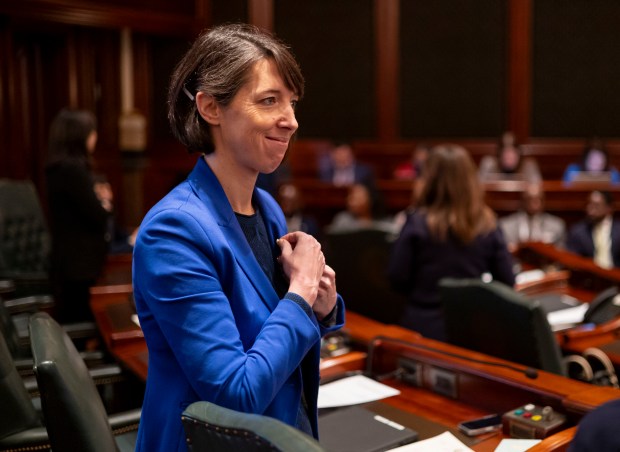 State Rep. Lindsey LaPoint, D-Chicago, at the Illinois Capitol in Springfield on Feb. 19, 2025. LaPointe sponsored a bill to make it easier for people across Illinois to find therapists who take private insurance. (Brian Cassella/Chicago Tribune)
Also, she said, better access to behavioral health care can save money on physical health care in the long run. LaPointe said compromises were necessary to pass the bill.
That carve-out, however, shows part of the problem with the bill, said Laura Minzer, president of the Illinois Life and Health Insurance Council, which opposed the bill. The bill could increase costs for everyone else on state-regulated, private plans, she said.
The council supported the other parts of the bill, but opposed the attempt to mandate reimbursement rates in law, Minzer said.
Insurance industry group AHIP also opposed the bill for similar reasons, and said in a statement it will continue to work with policymakers “to advance solutions that improve affordability and access to mental health and substance abuse care.”
Supporters of the bill, however, say it could make a real difference when it comes to access to therapists in Illinois.
Federal and state parity laws already require insurance companies to cover behavioral health and physical health care equitably — and though those laws were important, more work was needed, said Mark Ishaug, president and CEO of Thresholds.
Primary care doctors were paid about 24% more than behavioral health providers for similar services during office visits, by PPO insurance plans, in 2017, according to a 2019 report from consulting and actuarial firm Milliman commissioned by the Mental Health Treatment and Research Institute.
The newly passed bill could help address that inequity, advocates say.
“It is such a game changer for not only therapists but those seeking services and wanting to use their benefits that they pay into,” said Carlock, with Mosaic Counseling and Wellness. She said her practice already accepts insurance. But the practice accepts insurance in order to help as many patients as possible, not because it’s a good business decision, Carlock said.
 Psychologist Monika Sharma decided to go into practice on her own and no longer accepts private insurance. Sharma is in her office in Lincoln Park on Dec. 4, 2025. (Eileen T. Meslar/Chicago Tribune)
Monika Sharma, a licensed clinical psychologist, owned a group practice for more than 10 years that took private insurance. Last year, under mounting costs and stagnant insurance reimbursements, she closed that practice.
“The payment and reimbursement we got just wasn’t cutting it anymore,” Sharma said. She said she also felt “buried” under the weight of administrative issues related to insurance.
She decided to go into practice on her own and no longer accepts private insurance.
“When I was running the group practice I felt like I got far away from why I entered this field,” Sharma said. “Now it was about playing according to their rules, which I never agreed to in the first place. It’s a system that felt … skewed to favor them and their profits and not favor clients or patients.”
If the newly passed bill becomes law, Sharma said she may consider taking insurance again so she can serve more patients.