
 Photo courtesy iStock
This is the fifth in our 2025 “Health Matters” series focused on health topics in South Snohomish County and sponsored by the Verdant Health Commission. Read past articles in this series here.
Edmonds School District move could ease phone dependence – and its mental health effects
When it comes to discussing cell phones and youth mental health, students at Mountlake Terrace High School have a lot to say. On a recent overcast Tuesday morning, hands sprung up so quickly across the well-lit classroom that humanities teacher Erin Grambush struggled to pick the next speaker.
“They never stop talking now,” she said, as her eyes scanned the classroom. “They are so much more engaged with me, with other students, with the learning.”
That wasn’t always the case. Before the Edmonds School District strengthened enforcement of its classroom cell phone ban this year, the devices pervaded the school, stealing student attention and stirring social anxieties. High schoolers scrolled through group chats under their desks, or played Tetris-like games while teachers lectured. The smartphones’ constant presence had a sobering effect on classroom dynamics, with some students reluctant to speak, fearful of being recorded and potentially mocked on a mobile platform.
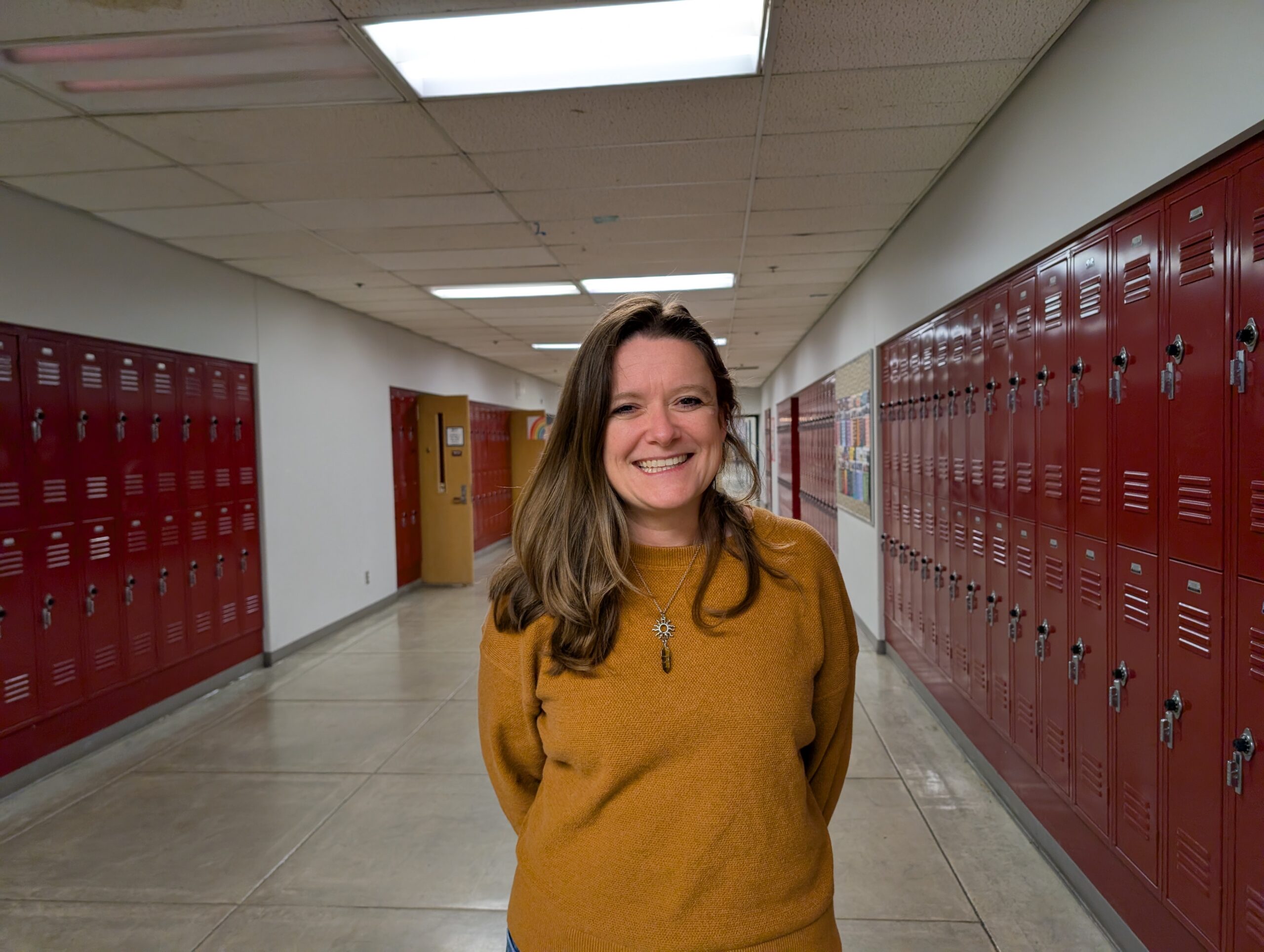 Erin Grambush teaches humanities at Mountlake Terrace High School.
While the district’s policy shift aims to improve classroom engagement and attention, educators are convinced the constant screens also undermined student well-being.
“What does it do to be plugged in 24 hours a day?” said MTHS Principal David Friedle. “We realize they’re plugged in at home all the time. The kids need at least five or six hours when they’re not beholden to how many likes they’ve got.”
Smartphone use has soared among U.S. teens with 95% reporting access to the devices, compared to 73% a decade earlier, according to Pew Research Center. During that same period, adolescent mental health concerns have escalated, leading many observers to examine the potential connections.
In Snohomish County, 28% of 10th grade students surveyed reported having a mental health condition such as depression or anxiety, according to the 2023 data published in Washington’s Healthy Youth Survey. About 30% disclosed feeling so sad or hopeless in the past 12 months that they stopped doing usual activities, and 16% said that they seriously considered attempting suicide.
Diverse and complicated factors are no doubt fueling the youth mental health crisis. Increasingly, though, researchers are linking higher levels of screen time to clear health concerns. In a study published this month in the journal Pediatrics, smartphone use among 12-year-olds was connected to a higher rate of depression, obesity and lack of sleep compared to children without one, according to the analysis of more than 10,000 participants.
The “findings provide critical and timely insights that should inform caregivers regarding adolescent smartphone use and, ideally, the development of public policy that protects youth,” the authors wrote.
What’s happening in schools
 Mountlake Terrace High School Principal David Friedle. (Photo by Kellie Schmitt)
Reducing cell phone use in schools represents one of these policy approaches. The move is gaining steam nationwide, with dozens of states limiting or prohibiting students from using their personal devices in schools.
Well before this year, the Edmonds School District prohibited cell phones in the classrooms. But, without consistent enforcement guidance, individual teachers were often left to manage devices on their own, creating a patchwork of adherence. Last summer, the teacher’s union and school board stepped in and agreed to clearly enforce the no-cell phone policy, a move that dramatically altered the landscape, teachers say. Now, if a cell phone is spotted in the classroom or hallways – they are still allowed in the lunchroom — it is immediately confiscated and stored in the school office for the remainder of the day. Parents must retrieve those phones after school.
Initially, some families resisted the policy shift, many from a safety and communication standpoint, Friedle said. If there is a lockdown, though, students are allowed to take out their phones, put them on silent and text their parents. From the teacher’s perspective, the policy’s new teeth offered a much-needed respite from what felt like a losing battle.
Indeed, enforcing the policy in previous years was exhausting for teachers like Angelo Comeaux, who teaches visual communication, video productions and graphic arts. Plus, it felt like a big responsibility to confiscate someone’s expensive personal property. This year, he’s noticed more engagement in the classroom and less block games or social media scrolling, practices he referred to as “a vortex of distraction.”
“We did see the addiction: They can’t put the phone away,” he said. “The technology is designed to hook them, so we have to step in and say, ‘stop.’ They can’t stop on their own. This is what adults are for.”
Students explore digital complexity
From the high school students’ perspective, the school’s cell policy change created a multitude of logistical frustrations, from restricting their communications with family members to no longer being able to enjoy music while they worked in the classroom. Others lamented that they could no longer use phones for responsible purposes like taking photos of assignments or transferring work from the phone to the computer.
But, as the discussion evolved during that recent Tuesday, the 10th-grade students began to unpack the broader effects of growing up tethered to a device. They described middle school experiences where physical fights were recorded and glorified as online entertainment, and how they avoided the school bathroom for fear of being filmed.
Others detailed the struggle to sustain classroom attention amid so many easy distractions and a reliance on “doomscrolling” as a form of escapism. One student decried the constant consumerism celebrated on social media as a “world of darkness.” Another shared her decision to forgo social apps entirely after experiencing too many friend conflicts, misinterpretations and pressure to respond quickly or risk hurt feelings.
Devices drive mental health concerns
Those nuanced feelings around screens reflect the complexity of the devices themselves. Broadly speaking, digital well-being experts stress the importance of understanding how someone consumes technology and the impact that arises from that specific use. For example, while some apps are intentionally designed to capture attention, other platforms let the user easily control the time they spend. Plus, some uses bestow benefits, such as allowing youth who experience marginalization to connect with like-minded communities.
 Angela Alfieri, behavioral health specialist at Community Health Center of Snohomish County. (Photo courtesy Community Health Center of Snohomish County)
Even amid so much complexity, some mental health implications are clear, said Angela Alfieri, a behavioral health specialist at the Community Health Center of Snohomish County. In the pre-cell phone era, whatever happened in school stayed there. Now people can record and post material online at any time, making cyberbullying a round-the-clock endeavor.
Body image poses another big concern. Short reels can quickly evolve from models showing their “thigh gap,” to videos extolling weight loss tips and, ultimately, disordered eating promotion. Meanwhile, these brief clips can also lead viewers into self-diagnosing mental health conditions, without understanding the criteria and complexity. While focus challenges may indeed reflect an ADHD symptom, these struggles may also indicate someone who isn’t sleeping enough or who is experiencing school stress, she said.
In her practice working with youth, many students share challenges with sleeping. As she digs deeper into the source, students divulge the need to check their phone or the struggle to end a video game.
Adolescents who don’t experience these difficulties are still experiencing the ramifications of a culture that no longer tolerates boredom. Too often, people absently pick up the phone whenever there’s an empty moment.
“Some are so used to having it as a distraction,” she said. “They don’t know what to do with themselves.”
When young people detail frustrations surrounding phone dependency, Alfieri focuses on strategies that can help create more awareness, such as timers. If someone feels down after going online, she’ll ask questions that encourage self-reflection: How can you curate feeds to improve your well-being? Are you looking at things that challenge your mood or pull you down? How can you get more content that’s uplifting?
She also coaches young people on how to challenge their own assumptions about vague messaging and cryptic texts, which can be a source of social anxiety. Instead of reading into something and inferring, approach the messages with curiosity like a detective, she suggests.
Role modeling at home is a key component to helping children find balance. That can be tricky, though, when parents are facing the same urge to constantly check their notifications.
“It’s difficult when parents and guardians are doing the same thing: spending all night on their phones,” she said. “It’s on everyone to grow their own awareness.”
Local families craft policies at home
As districts like Edmonds address cell phones during the school day, families are also grappling with children’s digital well-being at home, too. While there are some recommendations and guidance from organizations like the American Academy of Pediatrics, parents and caregivers often craft their own policies based on what they experience and witness firsthand.
In her practice as a pediatrician, Dr. Sophia Shiau has observed the harmful mental health impacts of social media on her young patients.
“They share more than they should have and it comes back to bite them,” she explained.
That experience has helped educate her own approach to technology and well-being in her family. Instead of getting her middle school-aged child a cell phone, she banded together with like-minded neighbors and purchased high-range walkie talkies. That way, they can communicate with their children as they move about the neighborhood, or play at a nearby friend’s house.
That approach uses technology for communication, but without the added demands of mobile device filled with attention-demanding apps. While Shiau acknowledged the walkie talkies have distance limitations, she has heard of other innovations such as Tin Can phones, which allow children to make voice calls without apps or texts.
Other local families are focused on modeling healthy screen habits themselves, which isn’t always the easiest approach.
“Caregivers being attached to a phone is a real thing,” said Edmonds mom and therapist Julia Jenkins. “Sometimes, it’s the only connection to the real world outside your own walls.”
Yet the mental health impacts of quickly scrolling through reel after reel can lead to mental health implications, she said. People only have so much capacity for stimulation and attention. Draining those buckets with social media can weaken one’s ability to support children’s own stimulating demands. Instead, spending down time engaging in activities like a walk can boost caregivers’ bandwidth to be present and engaged, she said.
Jenkins’ own awareness of tech’s impact on well-being guides her approach to parenting a 3.5-year-old. That doesn’t mean no technology — they still engage in occasional movie nights — but Jenkins gives clear timed warnings when the screen time will end.
“Technology is destined to pull our attention, and kids don’t know how to regulate around that,” she said. “I consider it my job as her parent to hold the boundaries around technology.”
Similarly, Edmonds parent Chelsea Rudd sets clear limits around screen usage for her young children. She reduced her 5-year-old son’s screen time after noticing him becoming easier to anger and less focused. Now that he has just 30 minutes at a predictable time every evening, he’s less fixated on screen and more apt to put together puzzles or play outside.
“We want him to be a little kid for as long as possible, to enjoy going outside, using his imagination and being physically active and know it’s OK to be bored,” she said.
What happens when you restrict phones?
The pressures to provide a smartphone can intensify, though, as kids age into middle schools where phone ownership is increasingly widespread. When he was an administrator at Alderwood Middle School, Friedle recalls the vast majority of students having a smartphone, an estimate supported by national averages. In middle school, group chats circulated that detailed crushes or relationships. Other threads rated student appearances or offered problematic commentary about teachers.
Friedle helped create a strong cell phone ban there two years before the school board’s decision strengthened the district’s overall policy. While it’s hard to gauge the precise impact on students’ mental health and well-being, the data on disciplinary incidents revealed a clear before and after shift, he said. In-person fights often originated from virtual threads, where someone commented about another student, and others forwarded the information via screen shots. The tension culminated in a hallway confrontation.
“It was the foundation of most of the school fights,” he said.
After the policy change, the school community witnessed a drop in incidents of a student “pressing” another, such as asking why they were “talking smack” about someone on mobile chatting apps. While high schoolers tend to experience fewer physical alterations, Friedle hopes that reducing their online consumption will result in more active engagement with peers — and their own lives.
“When your entire universe is based on scrolling, which is passive, you don’t have to do anything,” he explained. “You’re consuming, you’re getting the dopamine hits. Why should you be excited about anything else?”
The cell phone shift during school is admittedly not a panacea for all youth mental health challenges or the clear recipe for academic improvement. The number of students who are receiving F grades is virtually unchanged from last year to this year at Mountlake Terrace High School, underscoring the need for myriad interventions. Nationally, though, experiences in places like Florida demonstrate how improved student test scores came in the second year of the ban, following the initial adjustment. In addition, researchers are finding stricter policies lead to happier teachers and less distracted students.
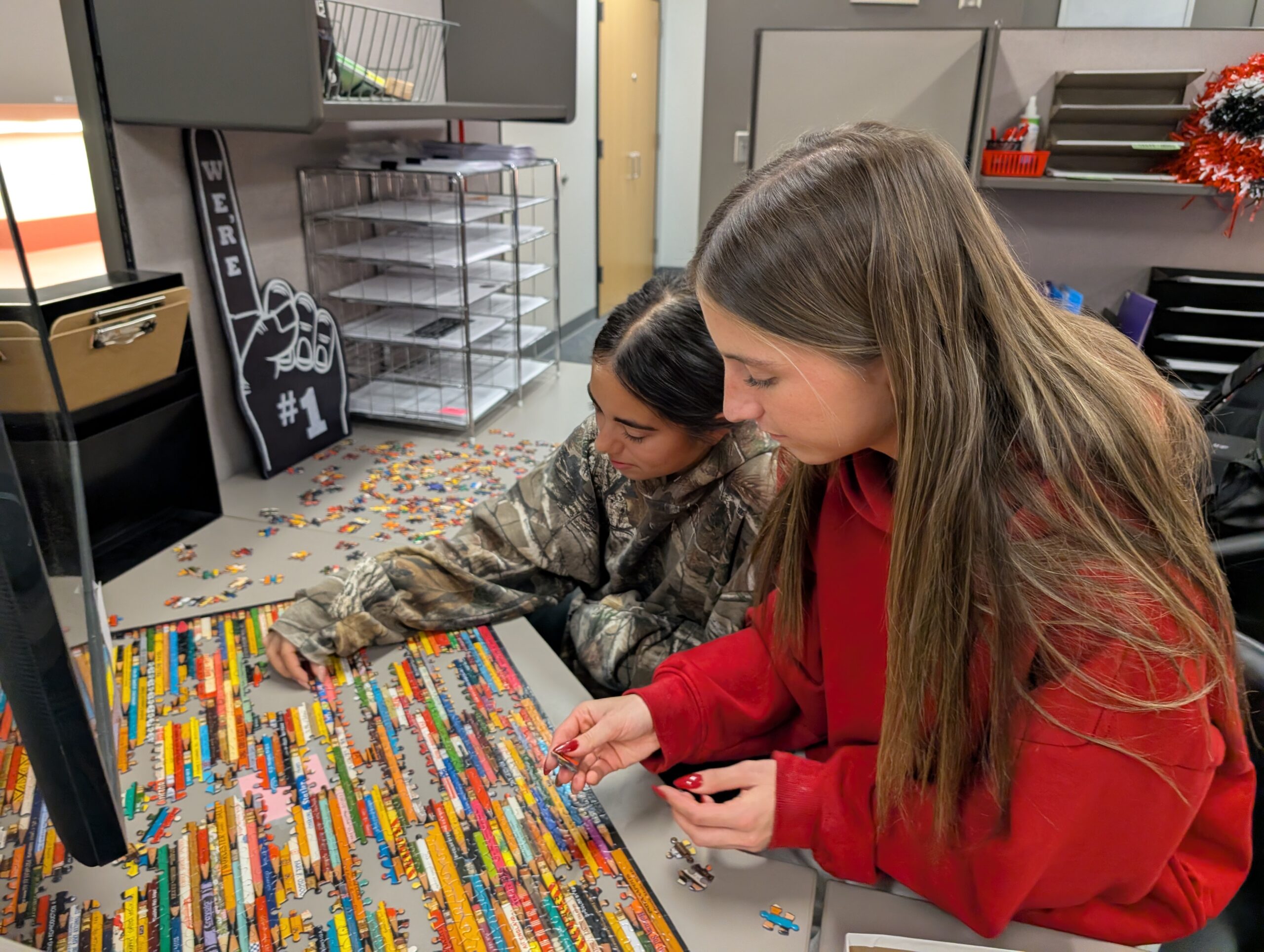 Mia Rheinheimer and Allison Mervin are both seniors at Mountlake Terrace High School.
Time will tell the impact on student performance and well-being locally. Anecdotally, though, a social shift is visible every day as students gather in groups and look at each other’s faces, instead of walking, heads down, silently staring at individual screens.
During a recent free period, a group of Mountlake Terrace seniors gathered in the lunchroom, a place where phones are still allowed. Several had the bright cases resting, screen down, on their laps as they chatted. Senior Nataliya Soumphonphakdy, who did not have a phone in sight, said the school’s policy made her aware just how addicted she’d become to checking her phone constantly. Now, she’s more mindful of her own relationship with technology.
Upstairs near the school’s entrance, fellow seniors Mia Rheinheimer and Allison Mervin worked on a puzzle together. That’s something they probably wouldn’t have done during down time last year, they admitted. Even though the cell phone ban was “annoying” at first, they’ve also grown to appreciate the moments they spend connecting with classmates.
“More people are more social and I’ve gotten closer to friends,” Rheinheimer said, as she looked up from inserting a colorful piece. “High school doesn’t last forever. You want to be close to your friends.”
For more information on teens and screens
The American Academy of Pediatrics has published a free Family Media Plan tool that helps families craft a customized media policy that reflects their own priorities.
Wait Until 8th, an organization that promotes delaying smartphones for kids, offers strategies and approaches for talking to kids about screens and social media.
Common Sense Media offers a guide with specific questions to help parents and caregivers create tech policies that reflect their distinct situation.
Kellie Schmitt is an award-winning health reporter based in Edmonds. She covers health policy, public health and children’s health for a variety of publications including the Johns Hopkins University Public Health Magazine, ParentMap, and USC’s Center for Health Journalism. She has a master’s in science writing from Johns Hopkins University.
This series is supported by funding from the Verdant Health Commission. The My Neighborhood News Network maintains full editorial control over content produced as part of this series.
Start your morning with the latest local news.