
A case that could shape school district budgets around the state will be heard before the Michigan Court of Claims on Thursday.
More than 30 districts and intermediate school districts, as well as over two dozen district superintendents are suing the state, the Michigan Education Association and state school superintendent, challenging new state safety and mental health grant requirements.
Districts such as the Wayne Regional Service Agency, the Oakland, Macomb and Monroe intermediate school districts, as well as the Huron Valley, Traverse City and Romeo individual schools districts are part of the lawsuit.
Oral arguments are scheduled for 10 a.m. Thursday, Dec. 11, at the Michigan Court of Appeals in Detroit.
In the state budget passed in October, lawmakers set aside $321 million in grants for safety and mental health initiatives but districts that opt-in must, “agree to be subject to a comprehensive investigation, must affirmatively agree to waive any privilege that may otherwise protect information from disclosure in the event of a mass casualty event, and must agree to comply with a comprehensive investigation.”
The $321 million in Section 31aa funding, as it is known, can be used to hire mental health professionals, school resource officers, and purchase security equipment once approved by local school boards.
Adam Blaylock, an attorney at Miller Johnson Law Firm, has been consulting with districts around the state on how to interpret the language and what steps to take when it comes to accepting 31aa funding.
He gave an overview of what the arguments may be before Judge Sima Patel.
“The core issue is whether or not the waiver of privilege that is required to be given under 31aa is legal and the plaintiffs are arguing that it is not for a variety of reasons and I anticipate that the state is going to argue that it is,” said Blaylock.
He said the arguments in the case are that the conditions being imposed are unconstitutional and the legislation itself does not meet the requirements of the state Constitution.
“Section 31aa is void for vagueness because its operative phrase – any privilege – is undefined and indeterminate,” the filing said. “Leaving school districts to speculate which privileges – evidentiary, statutory, contractual or constitutional – must be surrendered to remain eligible for funding.”
The motion goes on to specify the language leaves school officials to speculate if privilege is held by the district as an entity or if it requires officials and employees to waive personal constitutional privileges.
The inclusion of the new restrictions is seen as a reaction to the deadly shooting in November 2021 at Oxford High School. An independent report released in 2023 found that only 51 of 143 employees agreed to be interviewed by investigators citing attorney-client privilege.
A “mass casualty event” is defined as any of the following that occur on school grounds or at a school-sponsored event:
– An incident resulting in significant injuries to not fewer than 3 individuals;
– An incident resulting in fatalities;
– An incident that exceeds the normal resources for emergency response available in the jurisdiction where the incident takes place;
– An incident that results in a sudden and timely surge of injured individuals necessitating emergency services
The motion points out the term “mass casualty event” can still be seen as subjective and “significant injuries” is undefined and could cover everything from three students injured in a science lab, to three students injured on a playground to three football players who suffer a concussion.
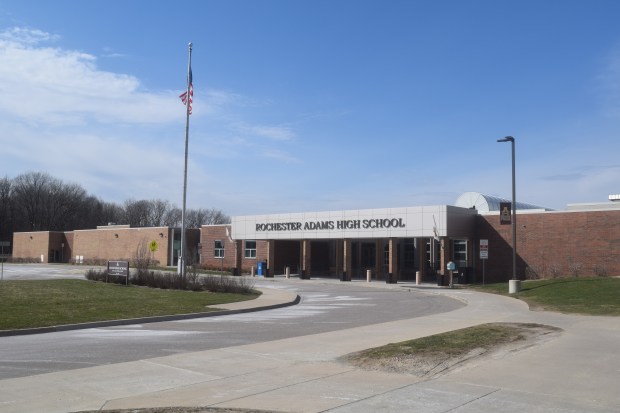 Rochester voted to approve an estimated $2.1 million in state funding, but if they are not happy with the ruling from the Court of Claims, they and others who voted to accept the funds have until Dec. 30 to opt-out.
Photo by Matt Fahr
Districts around Oakland County have voted to opt-in for their share of grant funding, which Huron Valley Superintendent Paul Salah estimated to be $140 per student enrolled in each district.
Rochester schools voted to accept an estimated $2.1 million and Farmington voted to accept $1.2 million.
Depending on the court decision, districts will still have time to decide if they still want to accept the state money. If the language remains in place, they have until Dec. 30 to opt-out of taking the funds.
“My understanding is that the court will issue its ruling on or about Dec. 19,” said Blaylock. “I anticipate that there may be appeals after the initial decision, so I have been telling school districts that they should be prepared all the way up until Dec. 30 to make a decision as to whether or not they are going to ultimately accept the funding or not based on the conditions that are imposed at that time.”
Blaylock said the decision to accept the funding has been a divisive issue.
“I do expect some districts to opt-out based on what the climate is in some of those districts,” he said. “I work with districts around the state and this is one of the most evenly divided issues I have ever worked on.”
LOCAL REACTION
Superintendents around the county have also been critical of the Section 31aa changes.
“The fact that there are lawyers and school districts around the entire state that also can’t make sense of the language tells me that the statute isn’t written appropriately,” said Rochester Superintendent Nicholas Russo.
Salah does not support 31aa funding with the current provisions attached.
“From my perspective as a local superintendent, we are deeply concerned,” said Salah. “We feel the language is unethical and it is unfortunately using school safety and mental health as a bargaining chip. It is completely unacceptable.”
South Lyon Superintendent Steve Archibald explained why their district unanimously voted to accept funding.
“While there are some aspects of this of which we are not completely comfortable, we are less comfortable with passing on approximately one million dollars,” said Archibald. “There are some potential barriers and chokepoints that are going to lead some districts to pass on these dollars.”
“Oakland Schools fully supports the State of Michigan’s intent to strengthen transparency and accountability in the aftermath of school tragedies that deeply affect communities,” the Oakland ISD said in a statement. “However, Section 31aa, as currently written, is overly vague and appears to require districts to waive constitutionally protected privileges, raising significant legal and ethical concerns on behalf of our schools, our teachers and our students.”
“All of that money, $1.2 million, we have it allocated and we are spending it and to lose that funding will be a hardship for the district as far as making some difficult decisions,” said Farmington Trustee Claudia Heinrich.
“Absent those funds, we would have to make a decision on what we would have to support and what would have to be taken away,” said Farmington Superintendent Kelly Coffin.