
Running a small business can be equal parts purpose and pressure. From payroll to the daily “what ifs,” it’s no surprise that many owners carry a mental load that doesn’t clock out. At Nav, we know the importance of managing mental health, especially for entrepreneurs.
We see this first-hand through the business owners we help everyday and from our CEO and chairman, Levi King. After years of priding himself on mental toughness and resilience, Levi had an experience in 2018 that changed the way he felt about mental health.
Levi initially thought he was experiencing food poisoning or motion sickness, as every time he would stand up he’d feel like falling down. “A curveball in the form of a panic attack blindsided me for the first time,” he says.
He is not alone in his experience; many Americans grapple with mental health every day. In fact, one in five adults in the U.S. will suffer from mental illness, which can include depression and anxiety, according to a 2024 study by the U.S. Department of Health and Human Services.
Prioritizing your own emotional well-being is key to keeping both you and your business healthy. Know that when it comes to asking for help, it’s better late than never. To better understand how we can help our customers and show others running a business that they are not alone in the challenges they face, we surveyed small business owners across the U.S. to learn more about their experiences.
We asked a variety of questions in our small business mental health survey, including what aspects of owning a business cause the most stress, when the last time a break was taken that allowed them to completely disconnect from work, the physical and mental conditions experienced as a result of the job, and more. Here are our findings, plus insights on how business owners are engaging in mental health support.
In this study, we set out to gain insight into the mental health struggles facing small business owners. To do this, we surveyed more than 1,000 small business owners in the U.S. from October 9 to October 28, 2025 about their experiences including how owning a business has impacted their personal life and finances. We also asked about the most stressful aspects of being a business owner as well as challenges they are currently facing. Additionally, we asked business owners how they combat this stress and if they have not sought out mental health support, why?
As part of our study, we also wanted to investigate if there is any correlation between health issues small business owners face and the challenges they have faced in their businesses. To do this, we calculated a correlation strength by calculating the percentage of people facing a given business challenge who also reported a given health issue and compared that to those who do not face that business challenge.
For example, a +21 correlation between debt and muscle tension means that people dealing with debt are 21 percentage points more likely to experience muscle tension than those not dealing with debt. We then ranked these correlations from the highest to lowest correlation strength.
Running a business can impact many aspects of owners’ lives because of the immense amount of time and commitment required. We found this to be true for nearly half of owners (48%) as they say they find it hard to be fully present in their life outside of work because their business consumes their attention. Unlike other jobs, owning a small business does not stop when you leave the building. So it can be difficult to focus on your personal life with work responsibilities hanging over your head.
Business owners say they feel the need to shield their concerns from others. Nearly two in five owners say they have to hide their true emotions and project confidence to other people.
Even when business is booming, 37% of owners say they have trouble enjoying success due to thinking about the next challenge. This highlights the importance of a support system in both good and bad times.

However, a third of owners have difficulty finding an outlet, indicating that they don’t know anyone they can talk to about their work or who can relate to the pressure they feel.
“An outsider might have dismissed my ordeal as unimportant; an inevitable side effect of entrepreneurial existence,” Levi says about his first experience with a panic attack. “For me, it was one of those rarest of rare moments — a game-changer so meaningful that life will never be the same.”
Levi’s story reflects what many owners in our study described.
The pressure may look “normal” from the outside, but it can feel overwhelming when you are carrying it on your own. As a small business owner himself, Levi understands how isolating the pressure can feel and how easy it is to believe no one else will understand. His experience is a reminder that owners need people in their corner who can listen, relate, and help shoulder the load. By building that kind of support network, owners take a critical step in protecting both their business and well-being.
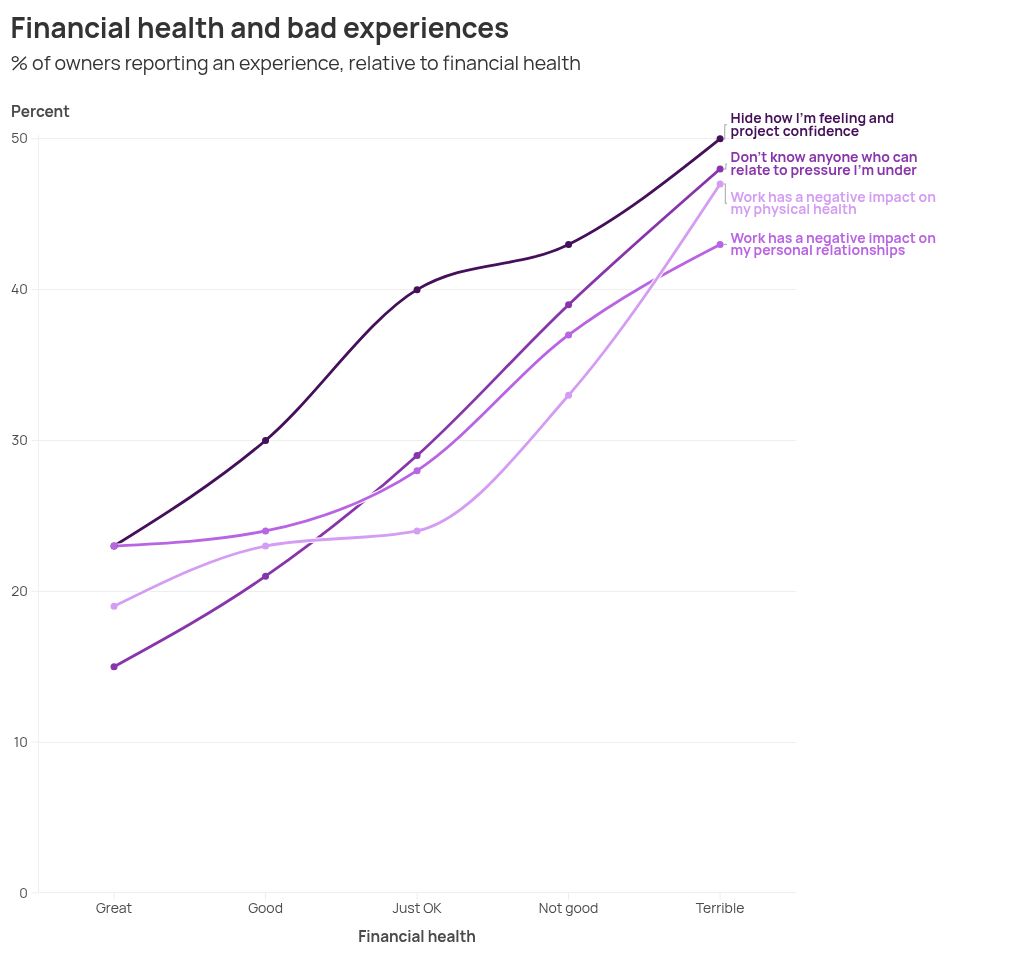
While analyzing responses from our study, we noticed trends between negative experiences for owners and the current financial health of their business. As shown in the table above, there is a steep increase in people feeling they need to hide how they are feeling to project confidence when they say their business is in “terrible” financial health.
Similarly, 48% of those who say their business is not doing well responded that they don’t feel they have anyone to talk to who can relate to their situation. This is compared to the 15% who also believe they lack a support system but say their business is doing “great” financially. Similar trends appear for those who say work has a negative impact on their personal relationships and those who report a negative impact on their physical health.
Small business owners often face unpredictable challenges. When asked to define the most stressful part of running their business, the majority of owners (64%) say finances. Managing revenue and expenses is a crucial piece of the small business owner puzzle, which is likely why cash flow is at the core of owners’ stress.
The second most common stressor among small business owners was market uncertainty, with nearly one in five responding that it was a major concern. From tariffs to demand, predicting the market can be quite difficult and stressful. Rounding out the stressors for small business owners are workload (10%), competition (5%), and employee relations (3%) ranking third, fourth, and fifth, respectively.
With any job, taking time for yourself and using your vacation days can be a helpful way to unwind from work. However, this can be challenging for small business owners, as paid time off may not be an option. With this in mind, we asked owners when was the last time they took at least one week off from work to fully disconnect from the job. Nearly half (48%) say their last break was more than three years ago.

For another one in four small business owners, a full week-long break to disconnect has never happened.
High-stress situations can impact your physical and mental health, and our survey indicated that 65% of respondents attribute some type of physical ailment to being a small business owner. Leading the way for specific ailments is muscle tension, with 55% of owners experiencing some type of discomfort.
Not all health impacts are physical, however, as stress ranks second (53%) for the most common ailments among small business owners. This is followed by two other non-visible health impacts, including fatigue, which is reported by more than two-fifths of owners, and anxiety, which 42% say they experience. Up next are headaches, reported by 36% of owners, followed by digestive issues (27%), depression (20%), and a weakened immune system (15%).

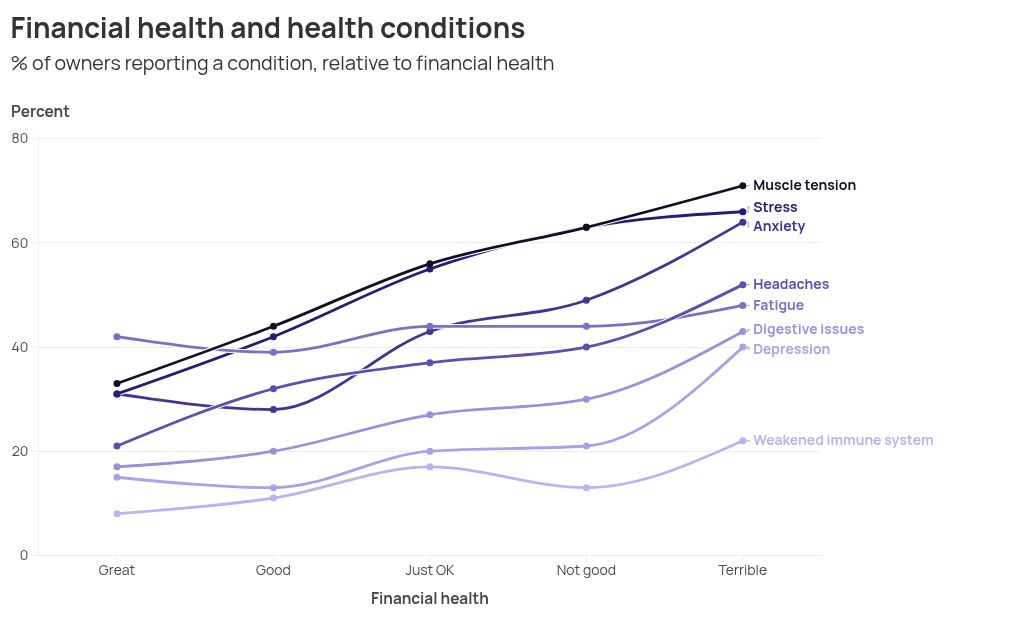
Similar to the experiences mentioned earlier, we found a correlation between the financial health of a business and the health conditions of the owner. Overall, owners who report their business is doing well financially report less impacts to their health, but as a business’s financial health decreases, so does the health of the owner.
While health conditions can happen without any relation to the success of a business, we found that 31% of owners who say their business is doing well financially experience stress, compared to the 66% whose business is not doing well and report stress. Across each health condition, business owners reported the biggest increases in muscle tension, stress, and anxiety in relation to financial health.
Mental health: How many struggle, how many seek support?
Overall, we discovered that more than a third of respondents have mental health challenges directly caused by running their business that warrants seeking some type of mental health support. While owners acknowledge this need for support, only 52% say they have sought it, while 48% have not.
When analyzing trends, we found that younger business owners are more likely than older business owners to seek mental health support. Similarly, women (22%) are also more likely than men (16%) to seek support.
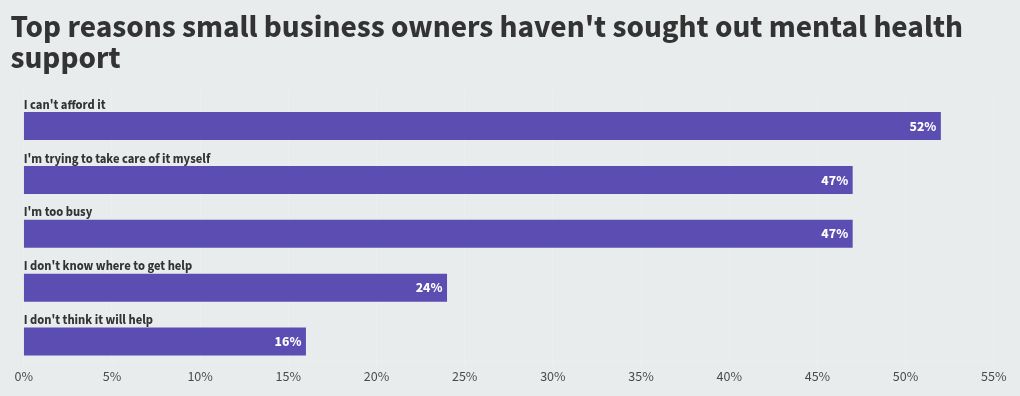
We wanted to understand why many business owners didn’t seek mental health support when needed. Cost was the leading factor with 52% of owners who say they needed help indicating they can’t afford it. For 47% of owners, they say they wanted to handle their issues themselves.
When it comes to mental health, Levi says it can be difficult for others to spot the need for help, citing his own experience.
“On the outside, things looked great — I had a flourishing business, a thriving family, and seemed to be running the gauntlet of middle age with confidence and style. On the inside, however, there were days when I was just trying to keep my head above water,” Levi says. “What made a real difference for me was getting professional help — seeing a therapist, drawing real boundaries, and letting others in. Dropping the idea that I had to be invincible, even with my team, was what finally gave me some breathing room.”
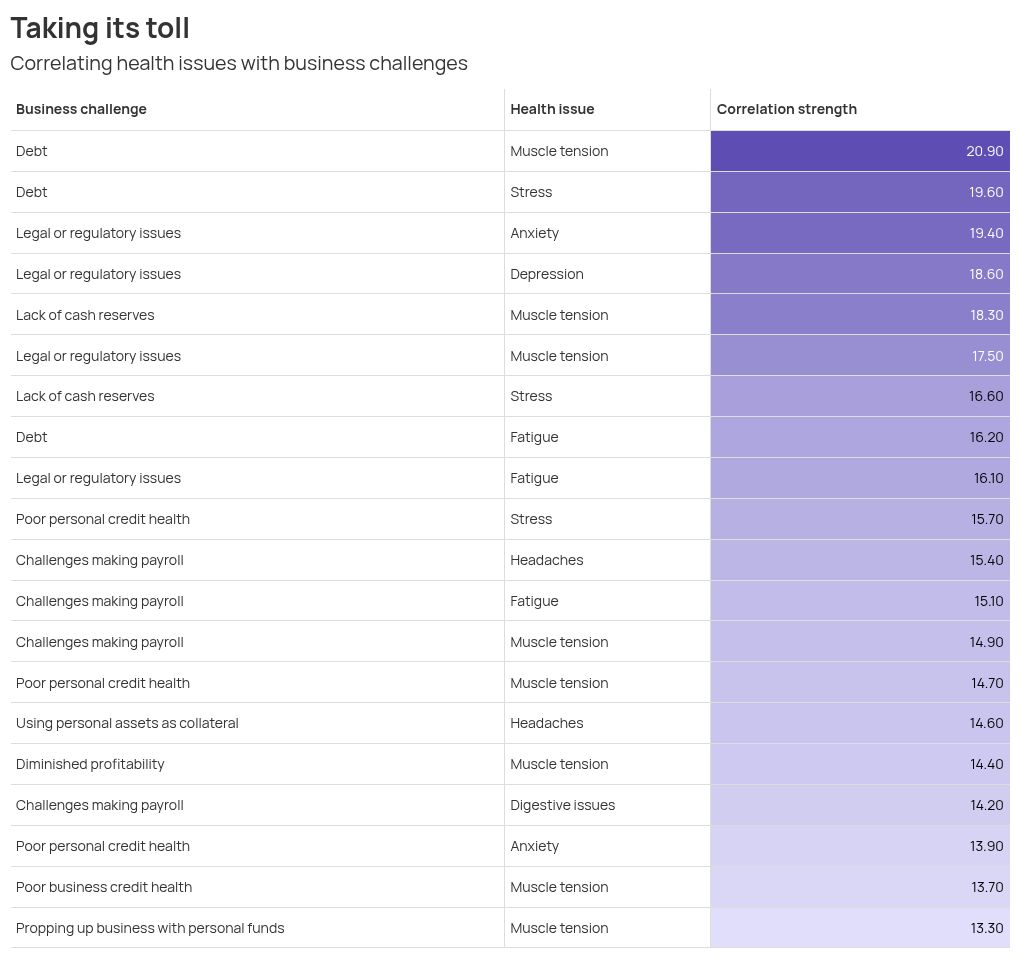
Another trend in our study was the connection between the workplace challenges of small business owners and health issues. To measure the relationship between the two, we calculated a correlation strength by comparing the percentage of owners who report each health issue and what business challenges they have or have not faced.
Leading the way with the highest correlation strength are those who are currently dealing with debt, which has a strong correlation with muscle tension. Similarly, debt and stress are the second highest pairing according to the correlation strength.
The next business challenge nearing the top of the correlation ranking are legal or regulatory issues, which have a strong connection to anxiety and depression in small business owners. We also found that owners dealing with a lack of cash reserves are also likely to experience muscle tension. Muscle tension was also highly correlated with legal and regulatory issues as well.
If you are a small business owner struggling with your mental health, you are not alone. As our study has shown, many owners are coping with stress every day. Taking action to alleviate this pressure can have a strong positive impact.
Our study shows that when the stress becomes too much, a majority of small business owners get active with nearly half (49%) of the respondents turning to exercise to cope. For 46% of owners, simple relaxation and mindfulness help them to feel recharged and ready to take on the next challenge.
Spending time with loved ones was the second-most common answer as more than two-fifths of owners say they connect with friends and family to relieve job stress. Tied for fourth, as nearly two in five owners say they unwind with entertainment or hobbies.

This is followed by taking time off (33%) and enjoying comfort food (29%) respectively.
Surprisingly, nearly one in four owners say their method for dealing with stress is to throw themselves into their work and clock more hours. For 21%, connecting with other business owners is the preferred method of relief, while one in six owners say they talk to a therapist or coach to manage their stress.
In the end, it doesn’t matter how many employees you have, how long you have been in business, or even how old you are — mental health should be taken seriously. Striking out on your own for business requires courage, and so does asking for help.
If you find yourself struggling with the challenges of running a business remember that struggling with mental health doesn’t mean you’re broken or weak.” Levi urges owners to not “tough it out in silence” but rather to “talk to someone you trust, reach for real support, and take care of yourself in meaningful ways.”
At Nav, we offer business tools designed to help lighten the financial and operational load for small business owners. From tracking business and personal credit side-by-side to business credit coaching for one-on-one support, we are here to help lighten your load, both physically and mentally. Remember that your well-being isn’t a detour from success, but is the path forward.
“Treat your mental health like a story in which you’re completely invested versus a side note for another day. I learned the hard way that silence about mental distress can have raucous consequences; together, we can keep the conversation going,” Levi says.