
Psychologists have used AI tools in their work much more in 2025 than in 2024.
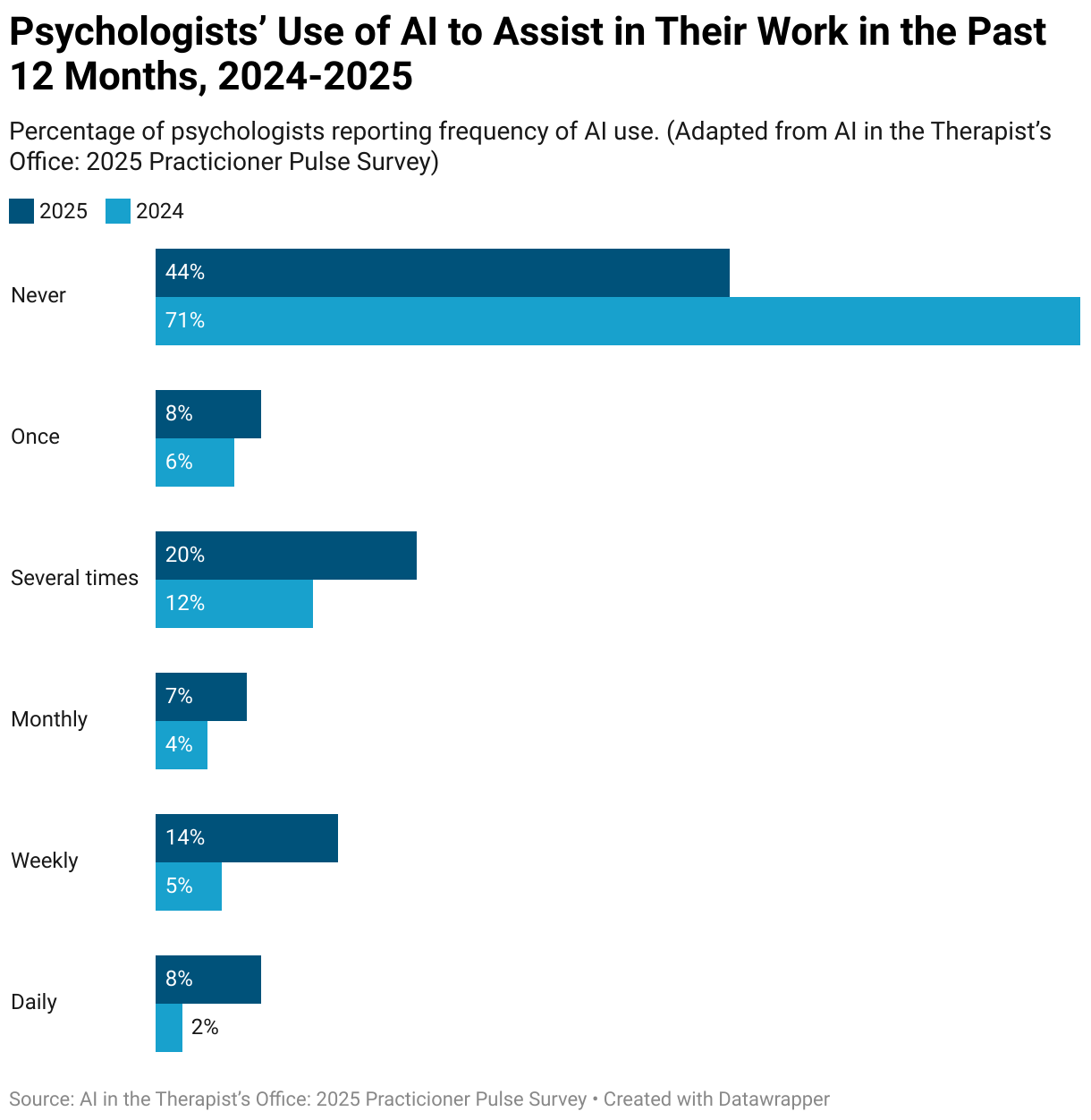
The latest Practitioner Pulse Survey by the American Psychological Association and APA Services Inc. shows that only 44% of surveyed psychologists never used an AI tool in their practices in 2025. Just a year ago, the share of never-users was 71%.
That’s not to say there has been a giant swing in adoption year to year. Only 8% of psychologists reported using AI on a daily basis in the past year; 14% of respondents said they used AI weekly.
“Though few psychologists use AI for clinical assistance, these tools may become an increasingly important part of routine administrative work, such as research and writing, as more experiment with AI,” the survey report states.
AI has continued to capture the attention of many behavioral health organizations and tech vendors that seek to serve them. Many hope to at least offset the cost of AI investments, as well as the companion investments in other tech infrastructure, to make AI adoption possible by leveraging AI’s automation capabilities to generate savings. Venture capital funding continues to favor organizations that seek to pair the latest technology with innovative visions of care. Amae Health, a startup focused on remaking care for patients with serious mental illness (SMI), raised $25 million last month. In August, Positive Development, which is seeking to carve out a non-ABA lane in autism therapy, landed $51.5 million with a plan that includes imbuing its model with AI.
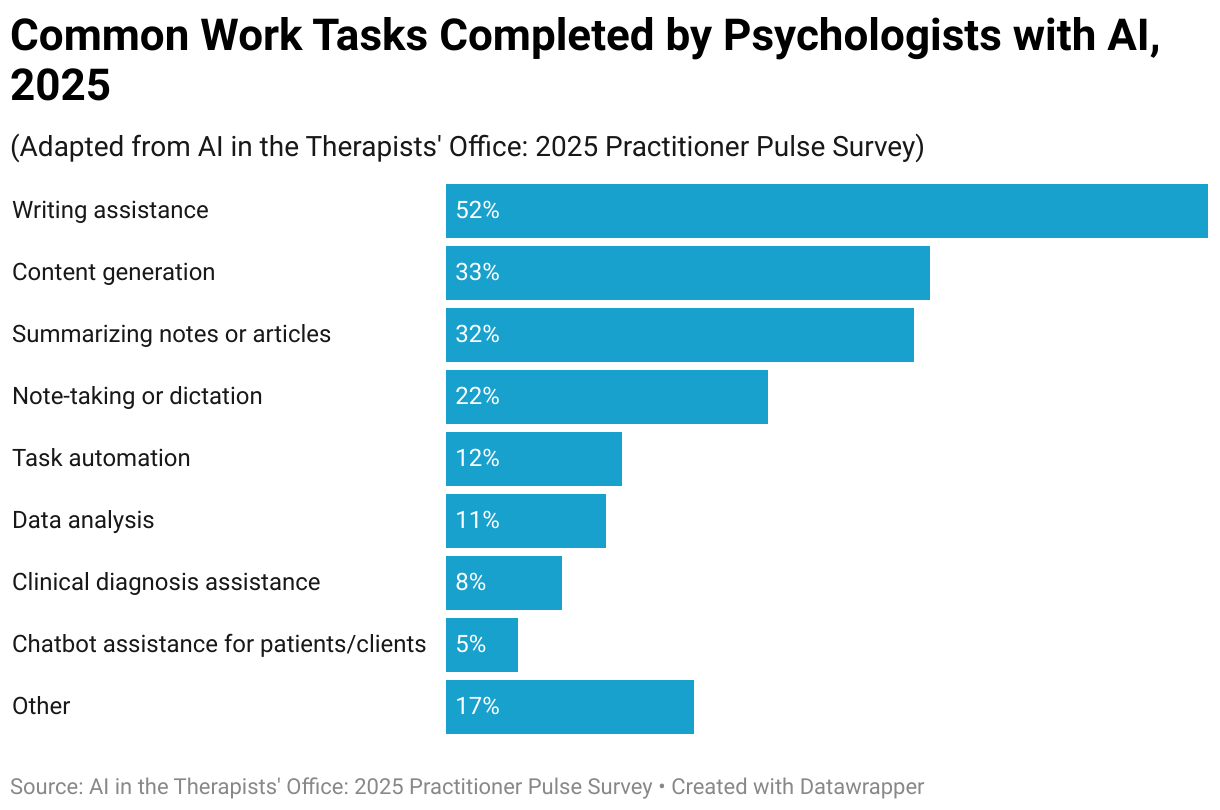
Therapists’ attitudes toward AI tools stand in stark contrast to the steep opposition that ambient listening and similar AI technologies faced just a few years ago. However, interest in uses and perceived benefits are largely concentrated in learning and administrative functions. Only 8% and 5% use AI for clinical diagnosis and patient/client assistance, respectively.
The top uses, according to the report, are writing assistance, content generation and text summarization. Notetaking assistance comes in at a distant fourth.
In 2025, psychologists said the top benefits of AI tools would be improved operational efficiency (42%), research summaries (27%) and patient education (18%). Thirty-four percent responded “I don’t know” to potential benefits.
“Psychologists are drawn to this field because they’re passionate about improving people’s lives, but they can lose hours each day on paperwork and managing the often byzantine requirements of insurance companies,” APA CEO Arthur C. Evans Jr. said in a news release. “Leveraging safe and ethical AI tools can increase psychologists’ efficiency, allowing them to reach more people and better serve them.”
While use has increased, so have concerns. In 2025, a greater share of respondents said they were concerned about the specific risk of such tools. About two-thirds said they are concerned about potential data breaches, social harm, biased inputs/outputs, lack of testing and inaccurate outputs/hallucinations. Figures for those concerns, except for data breaches, were closer to 50% in 2024.
Larger, better-capitalized behavioral health companies often cite AI in revenue cycle management as a key potential benefit. The survey did not make a connection between AI use and help with the administration of taking insurance.
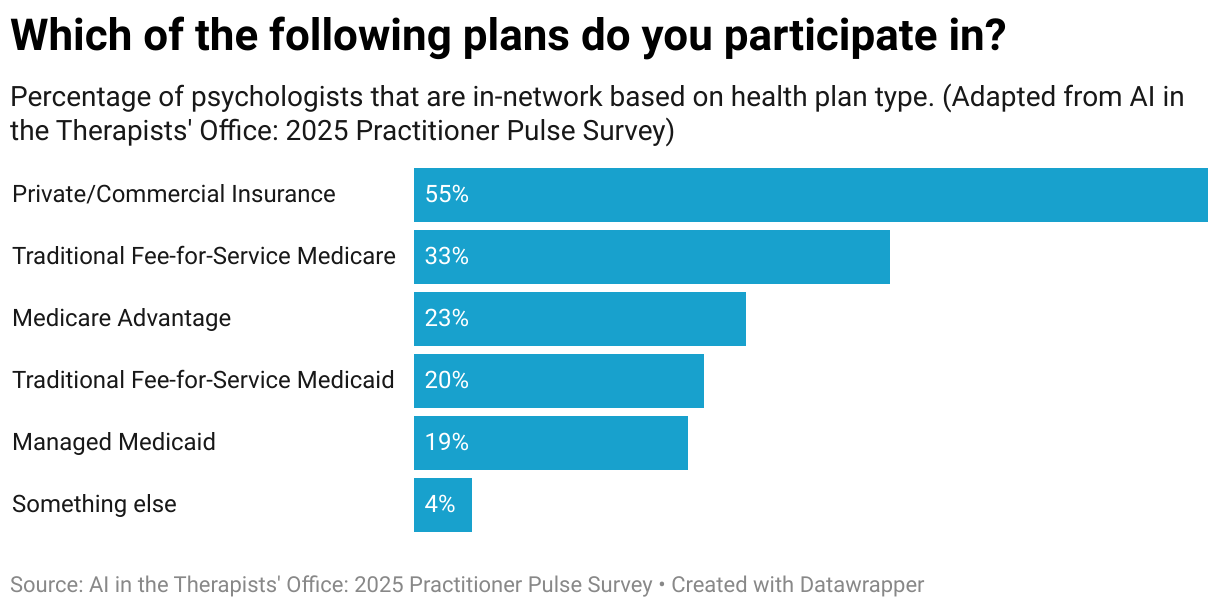
Year on year, there has been little change in the share of psychologists who are in-network with a health plan: 62% said they are in-network with any plan type.
Among the insurance takers, the greatest share (55%) takes private and commercial insurance. The share of the psychologists who take various forms of public health plans falls off.
While a large share (57%) of respondents say that administrative issues are a top challenge to those that do not operate in-network with a health plan, many more (75%) say that the top reason is insufficient reimbursement.
The share of psychologists reporting no openings for new clients continues to decline after peaking in the wake of the arrival of COVID-19 in the U.S. In 2021, 65% of respondents said they had no openings. In 2025, that number is down to 46%. The share of respondents reporting seeing increased symptom severity among patients is similarly declining. In 2021, 65% reported seeing worsened symptoms; 45% said so in 2025.