
A comprehensive new analysis is stirring debate in both psychiatry and public health: does owning a cat during childhood increase your risk of developing schizophrenia-related disorders later in life?
Published in Schizophrenia Bulletin, the meta-analysis reviewed 17 studies from 11 countries and found a statistically significant association between cat ownership and schizophrenia-spectrum diagnoses. Individuals who reported cat exposure—particularly during childhood—had nearly double the odds of developing conditions tied to psychosis and cognitive dysfunction.
The findings don’t prove that cats cause schizophrenia. Still, they build on decades of mounting research into a biological suspect at the center of the conversation: Toxoplasma gondii, a common parasite carried by cats that has long been linked to neurological changes in humans.
The Parasite Shaping Behavior?
Toxoplasma gondii is the leading infectious theory behind the cat-schizophrenia link. Cats are the parasite’s definitive hosts, meaning T. gondii can reproduce only in their intestines. Humans can become infected by handling cat litter, consuming undercooked meat, or ingesting contaminated water or soil.
 Cat feces could be the source of toxoplasmosis. Credit: Unsplash
Once inside the body, T. gondii can enter the central nervous system and persist there, often for life. Some animal studies suggest that the parasite can alter host behavior—rodents infected with T. gondii lose their fear of predators, including cats, increasing the parasite’s odds of transmission.
Human research has been far less conclusive, but there’s evidence pointing to altered neurotransmitter activity, particularly involving dopamine regulation, in people with latent T. gondii infections. Some studies have linked the parasite to elevated risk for psychiatric disorders, including schizophrenia, bipolar disorder, and suicidal behavior.
More than 40 million Americans are believed to carry the parasite, according to the Centers for Disease Control and Prevention (CDC). Most show no symptoms, but questions persist about long-term neurological effects in vulnerable populations.
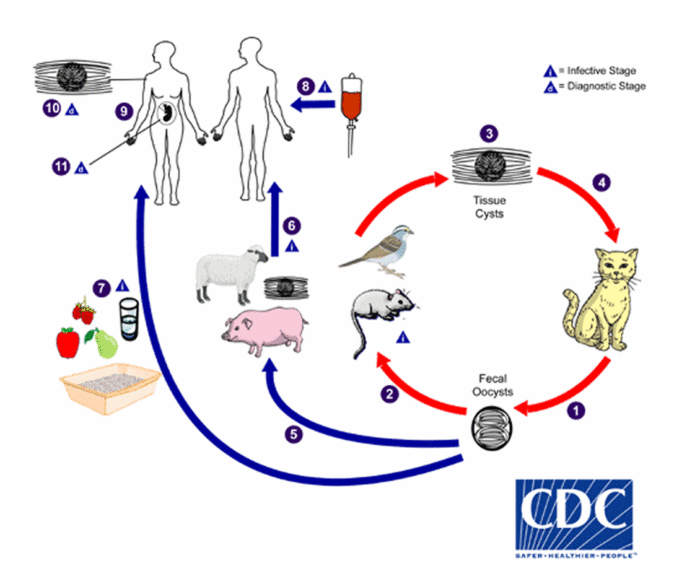 Toxoplasmosis is only known to reproduce in cats (1), but can be spread to humans through intermediate hosts (2, 5, 7) as well. Credit: CDC
The review’s authors noted that cat owners had approximately twice the odds of developing schizophrenia after adjusting for demographic and environmental variables. However, they also acknowledged that many of the included studies were case-control in design, a format limited in proving causation.
Timing May Matter More than Exposure
Not all the reviewed studies agreed on the strength—or existence—of the connection between pet cats and mental health risk. But several showed patterns worth deeper investigation, particularly regarding when a person is exposed.
In one study cited by the review, no meaningful link emerged between early cat ownership (before age 13) and later schizophrenia diagnosis. But narrowing the exposure window to ages 9–12 revealed a significant association, suggesting that certain developmental periods may heighten susceptibility.
 Cat bites scored higher on schizotypy scales. Credit: Shutterstock
Another dataset involving U.S. college students found no link between owning cats and traits associated with psychosis. Yet those who reported cat bites scored higher on schizotypy scales—a pattern observed in other populations as well. This raises the possibility that additional pathogens, such as Pasteurella multocida found in feline saliva, may also play a role.
Research published in PLOS ONE examined cat exposure and mental health markers, reinforcing inconsistencies across regions and study designs. Similarly, a 2023 case-control study from Saudi Arabia found a correlation between childhood cat exposure and schizophrenia diagnosis, though authors emphasized the need for broader, longitudinal data.
This inconsistency doesn’t invalidate the findings but does highlight the need for large, prospective cohort studies that follow individuals over time, rather than relying on retrospective recall or narrow exposure definitions.
Still No Clear Cause—but Growing Concern
None of the studies reviewed prove that cats—or the parasite they may carry—cause schizophrenia. But the clustering of findings around certain time periods and populations signals that more attention is warranted.
The authors of the Schizophrenia Bulletin review are careful to note the limitations of the data, pointing out that results were more consistent in higher-quality studies with better controls for confounders. They conclude that cat exposure should be further explored as a “candidate risk-modifying factor” for neuropsychiatric disorders.
Notably, a large-scale UK study published in Psychological Medicine found no convincing evidence of a link between cat ownership and later schizophrenia. That doesn’t mean the connection should be dismissed—but rather that other overlapping factors may be masking or amplifying potential associations.
Given that schizophrenia affects about 24 million people worldwide, even small increases in risk tied to common environmental exposures could offer insight into preventable pathways for those genetically predisposed.
What This Means for Cat Owners
The research doesn’t call for panic or widespread changes in pet ownership. Cats play an important role in many families and offer social, emotional, and even physical benefits. What this review suggests is not that cats are dangerous, but that some exposures—especially in early childhood—may warrant closer scrutiny.
Simple preventative measures can help reduce toxoplasmosis risk: wearing gloves when cleaning litter boxes, cooking meat thoroughly, and washing fruits and vegetables carefully. Pregnant individuals and people with compromised immune systems should take additional precautions, as T. gondii can pose greater risks in these groups.