
By Marycon Young, Vitals contributor
For years, Jessica Anne battled depression that seemed to always emerge the victor. Its crushing defeat bore a heaviness that left her feeling hopeless and unable to see a way forward. The 25-year-old worked with multiple care teams, tried numerous therapies and medications, and participated in both outpatient and inpatient programs. Nothing seemed to make a lasting difference.
That changed during her stay at Sutter Center for Psychiatry in Sacramento, when psychiatrist Dr. Hammad Khan, introduced her to a promising approach. Known as accelerated transcranial magnetic stimulation, the therapy can deliver results in days instead of weeks.
“I told him I’d already tried everything,” she said. “But Dr. Khan sat with me, explained the research, and said, ‘let’s see if we can help you feel better — even a little.’ That compassion meant everything.”
A Turning Point in Just Days
Traditional transcranial magnetic stimulation, or TMS, delivers short sessions once a day over several weeks. Accelerated TMS condenses that same evidence-based treatment into five days, with 10 brief sessions per day. Each session uses targeted magnetic pulses to stimulate areas of the brain involved in mood regulation. Sutter Center for Psychiatry is the first inpatient hospital in the Sacramento region to provide accelerated TMS through SAINT™ neuromodulation system developed by Magnus Medical.
Clinical studies, including research led by Stanford University, have shown that accelerated TMS can significantly reduce symptoms of depression in as little as three to five days, offering faster stabilization for people who haven’t responded to other treatments.
Building on this work, the Sutter Center for Psychiatry team, including Dr. Khan as co-author, recently published a case study in the journal Psychiatry Research Case Reports.
“We’re able to do in a few days what previously took weeks or months,” he said. “By adjusting both the frequency and type of stimulation, we often see meaningful improvements by day three or four.”
Jessica Anne, whose treatment followed the accelerated TMS protocol prior to the new technology at Sutter Center for Psychiatry, said she began to feel better almost immediately.
“It’s hard to describe, but around day three I suddenly thought, why have I been so sad? I felt like myself again,” she said. “The team checked on me after every session. I felt like they truly cared.”
A Week That Changed Everything
During her inpatient stay, Jessica Anne completed 46 sessions over five days, supported by nurses and technicians who escorted her between treatments and tracked her progress. By the end of the week, she was well enough to leave the hospital and attend a family wedding — something that had felt impossible just days earlier.
“Her transformation that week was remarkable,” Dr. Khan said. “She went from withdrawn and hopeless to engaged, smiling and talking about her future. It reminded all of us why we do this work.”
After discharge, Jessica Anne continued her recovery through a residential program, where she built on the momentum she’d gained. Nearly two years later, she’s thriving working at Oakland Zoo, married and living independently.
“Before TMS, I couldn’t imagine life beyond the hospital,” she said. “Since then, I’ve had no hospital stays and no setbacks. I’m happy and hopeful again.”
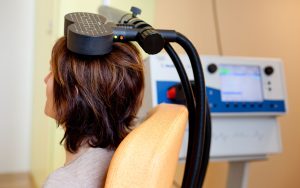
A close-up image of the accelerated transcranial magnetic stimulation, or TMS, treatment.
Dr. Khan and his colleagues are now preparing to expand the accelerated TMS work through new neuro-navigation technology that can more precisely target brain regions linked to mood and emotional regulation.
“The science continues to advance,” Dr. Khan said. “With emerging neuro-navigation tools and data-driven mapping, we’ll be able to personalize treatment even further, helping more patients get better, faster.”
Accelerated TMS is also opening doors for broader access. Unlike traditional six-week TMS programs, the condensed protocol makes it possible for patients who live outside the area to receive treatment within a single week.
“Someone could come to Sacramento, stay for five days, and return home with noticeable improvement,” Dr. Khan said. “That kind of efficiency can change lives.”
Restoring Hope
Jessica Anne hopes her story will encourage others to keep seeking help.
“There’s no harm in trying,” she said. “I went from thinking nothing would work to finally feeling alive again. If my story helps even one person believe recovery is possible, it’s worth it.”