
A significant expansion in structure, programming and community outreach is paving the way for the Center for Health Behavior Research & Innovation (CHB) to help position Syracuse University as a national leader in health behavior research, education and practice.
An initiative of the College of Arts and Sciences (A&S), the Office of Research and the D’Aniello Institute for Veterans and Military Families (IVMF), CHB has a particular focus on the study and promotion of health, well-being and resilience among veterans and military-connected individuals.
Since launching its website and affiliate portal this past summer, 85 affiliates have joined CHB—researchers, educators and clinical practitioners from across the University and from area health institutions. Two new pilot grant programs have been launched and the Veteran and Military Learning Scholars Program student research cohort has been formed.
CHB has hired a dedicated biostatistician to support affiliate projects. It has also established a recognition award for staff who coordinate research initiatives and plans to implement student awards. Additional workshops and research showcases are scheduled for spring.
Building an Ecosystem
CHB is designed to advance translational health behavior research, education and training and provide a collaborative ecosystem for professionals working in the health behavior field, says Joseph Ditre, A&S professor of psychology, licensed clinical psychologist and CHB director.
Health behavior is a broad, interdisciplinary area that examines the many factors, choices and conditions that influence physical and mental health across the lifespan. The center’s purposeful cross-campus, cross-institutional structure makes it a hub for affiliates to share interests, findings and treatments and engage in academic and professional collaborations. Affiliates conduct basic laboratory studies, field research, clinical trials, digital health intervention work, qualitative studies and implement projects.
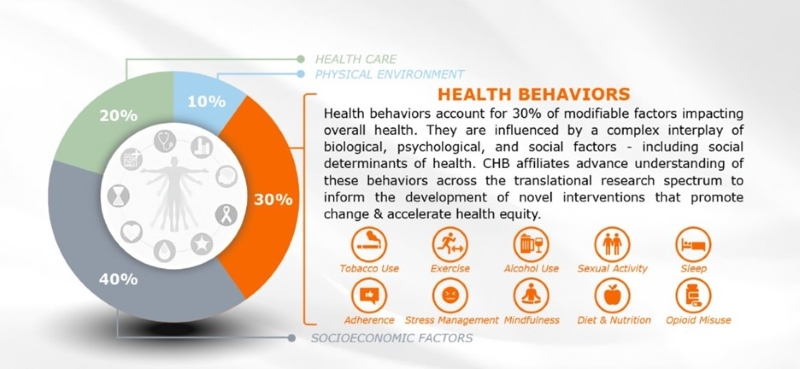 Behavioral health focuses on emotional, psychological and social well-being. It encompasses the study, prevention, diagnosis and treatment of mental and substance-related disorders, emphasizing the equal importance of mental and physical health in overall well-being. (CHB website chart illustration)
Veteran Focus
While CHB operates across a wide range of health behavior fields, a specialized focus on veterans and military-connected individuals complements the University’s commitment to that population, according to Ditre.
“Syracuse University has a national reputation as the best university for veterans and military-connected students. The University has worked with the Syracuse VA for about 30 years, beginning with faculty research collaborations and later expanding to co-mentored training and student placements. Building on that reputation and three decades of partnership, we should also strive to be the best place to learn how to serve veterans,” he says.
Veterans experience higher rates of suicide risk, trauma-related concerns, sleep problems, chronic health conditions and substance use compared to civilian peers. Many also face barriers tied to geography, stigma and complex transitions between military and civilian systems.
“These gaps have real consequences for individuals, families and communities. The University and this center, in collaboration with the IVMF, are uniquely positioned to address them,” Ditre says.
Digital Innovation
Digital innovation is a high priority because technologies like mobile devices, biometric monitoring and virtual reality help researchers collect real-time data from participants and capture their moment-to-moment experiences as well as indicators of health and behavior.
Affiliates have built mobile tools, tested them in trials and worked with community partners to implement check-in platforms and digital interventions that deliver guided exercises or personalized feedback.
“These tools let us reach people who may not engage with traditional services and connect with participants as they go about their daily routines or in settings where traditional care is harder to access. These technologies also help us understand behavior, tailor information to individual needs and deliver support in ways that fit people’s circumstances. For many of the populations we serve, this kind of flexibility is essential,” Ditre says.
Assuring health equity is another key focal point. That means designing studies and programs that are flexible, accessible and attentive to actual conditions and making sure that research benefits and outcomes reach the communities that need them most.
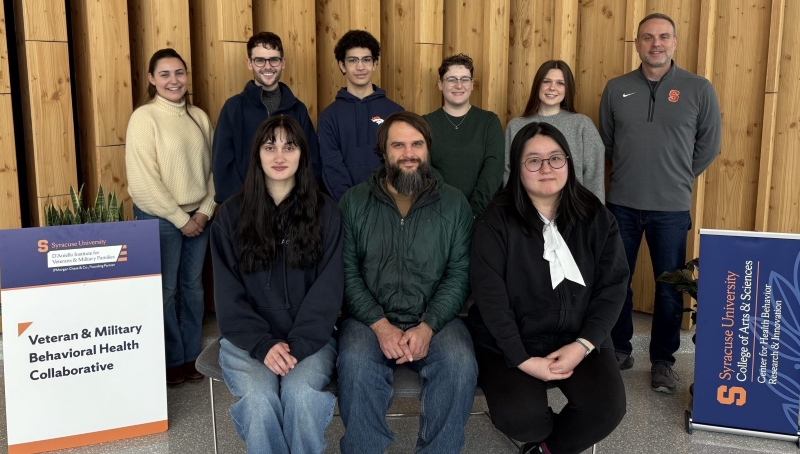 CHB and the IVMF Veteran & Military Behavioral Health Collaborative launched the SU Veteran and Military Learning Scholars Program (SU-VMLSP), a new learning and experiential engagement initiative that provides hands-on research, skill-building and academic enrichment opportunities. (Photo by Ellen M. Faigle)
Grant and Award Applications
Application portals for the new pilot grant programs open Jan. 20, 2026, and close Feb. 12, 2026.
The CHB Collaborative Pilot Grant Program supports cross-departmental and cross-campus projects with external institutional partners. The CHB/IVMF SU + VA Collaboration Pilot Grant Program supports new or expanded Syracuse University and Veterans Affairs collaborations.
The grants range from $500 to $10,000 and the total pool of $50,000 is funded by A&S.
The funds give teams a way to test ideas, build a partnership or generate early data for larger external grant submissions. They also lower the barrier for new investigators who want to connect their work with campus priorities, according to Ditre.
Nominations for the Excellence in Research Coordination Award, which cites excellence in research coordination work, are ongoing.
Future Activities
Future plans include more workshops with VA partners and collaboration with University Academic Affairs and the IVMF on a “Voices of Service” showcase where faculty, staff, students and community partners share veteran-focused research, courses and applied programs.
A neuroscience and health behavior research day, new working groups regarding sleep, substance use, trauma and digital health issues, awards for student work and additional community engagement activities are also planned.