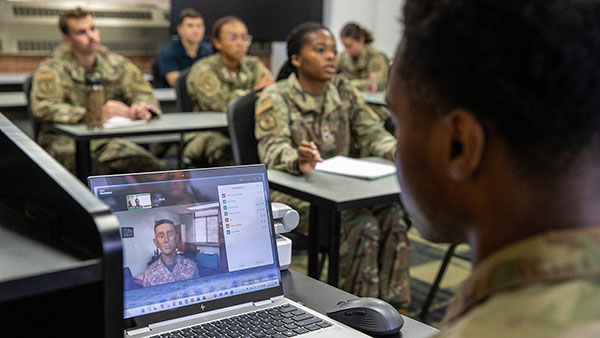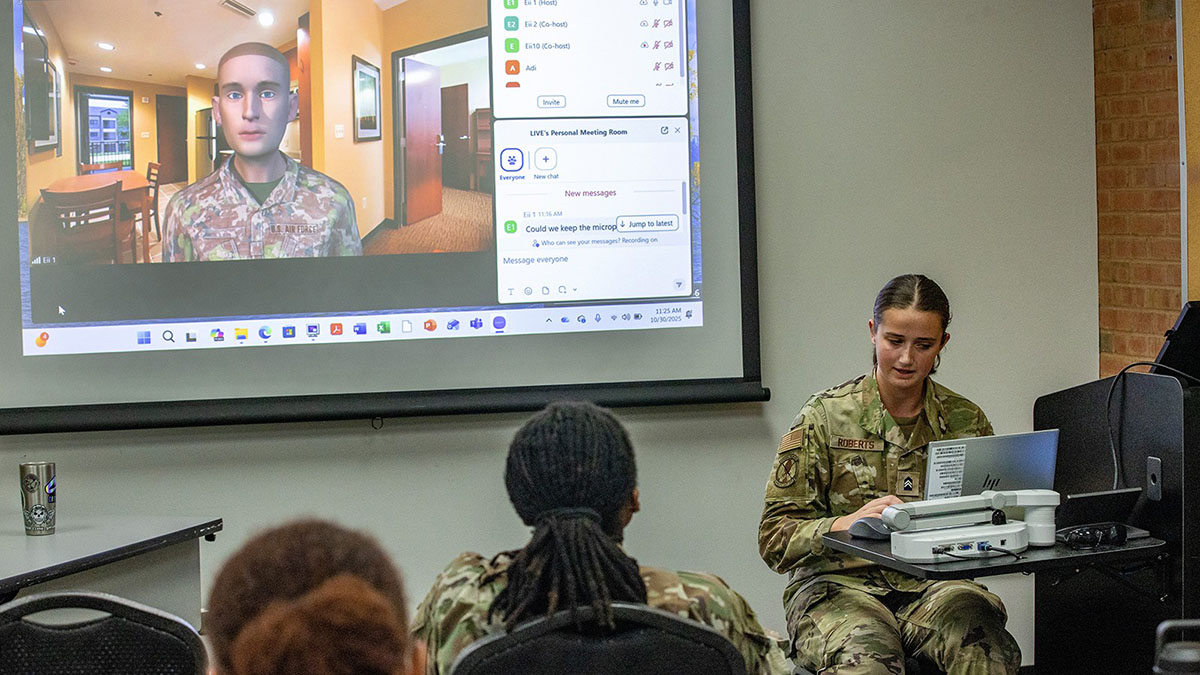
(Above) Cadet Anna Roberts trains to assist someone with a mental health issue, with Cadet Lolade Dawodo observing. (PHOTO 466 Below) Cadet Eric Canady participates in the AI training. (Photos by Russell Bailey)
December 11, 2025
SIU provides Air Force ROTC cadets with innovative mental health training
CARBONDALE, Ill. — Imagine a colleague comes to you, struggling with tough life problems, perhaps life-or-death questions. Thanks to an innovative new mental health training program at Southern Illinois University Carbondale, cadets from Air Force ROTC Detachment 205 will be prepared to help if faced with such situations.
“Our cadets need to be ready to lead in environments of uncertainty and stress,” said Lt. Col. Chay “Mulligan” Derbigny, commander for AFROTC Detachment 205 and SIU aerospace studies director. “This training gives them tools to care for their people and themselves, ensuring they are prepared to thrive as officers, wingmen and guardians.”
Emulating real life
During the training sessions, a realistic, avatar-based character, voiced by a professionally trained, EQ- (emotional intelligence) certified actor, approaches the cadets individually to talk about problems and the cadet must ask hard, even uncomfortable questions to discern what’s going on. Questions such as “Are you planning to kill yourself?” illicit realistic responses, including crying, from the avatar.
“I felt like I was really talking to someone my own age; it was surprisingly realistic,” said Sophia Cantelow, a senior cadet and criminology and criminal justice major from Hoover, Alabama, and one of just 100 students nationwide chosen from her class as a J-100 AFJROTC Character-in-Leadership Scholarship winner. “It just felt like I was talking to a real person with a real problem. You get into the scenario very quickly.”
Derbigny noted that typically, mental health training comes via PowerPoint presentations or written scenarios.
“This new program is a holistic way to learn to deal with issues,” he said. “With this training, real actors and AI put officers in the ‘hot seat,’ forcing them to have difficult conversations about culture, suicidal ideations, task management, sexual assault and a range of other important topics. The more they practice having these difficult discussions, the more comfortable they will become, the easier it will get, and the better they will be able to help the cadets they work with.”
The first training session was held in September, providing next-level interactive training for 60 students who are flight commanders. Col. Charles “Gator” Spaulding from Scott Air Force Base was on hand to facilitate the debriefing that followed, and he, Derbigny and the other cadets provided candid feedback after the role-play exercises.
“My visit to SIU was an amazing opportunity to give back and help build our future leaders,” Spauling said. “Teaching the cadets through the Leader Development Course curriculum from Air University, using avatars and immersive virtual technology, allowed me to provide them with hands-on leadership training that goes beyond traditional instruction. This ‘leadergogy’ approach – blending coaching, improv and virtual immersion – helps leaders practice ethical decision-making, achieve clarity of purpose and lead in crises in ways that feel real and relevant.”
Derbigny said often there isn’t one “right” answer or specific way to handle a crisis. “A lot of it is what not to say. We want to give our personnel the support and resources they need to effectively handle issues.”
Overcoming stigma
Alleviating the stigma with mental health issues is important to Derbigny. Mental health care is complicated in the military, where even taking anxiety medication can disqualify someone from service. The training is designed to help the leaders of tomorrow help those they command as well as their colleagues.
“It’s some of the best training I’ve had in my Air Force career,” said Derbigny, an 18-year veteran.
The cost for the training is approximately $400 per session (with customized pricing options), but thanks to $7,000 in grant monies from SIU’s Wellness and Health Promotion Services, it’s free for participants. The unit of Student Health Services provided funding from the Mental Health Early Action on Campus Act Competitive Grant received during the 2024 fiscal year to cover the cost of the specialized, interactive Air Force ROTC training.
“We designated the funding for military cadets and staff in the Air Force ROTC trainings and activities specifically geared toward the mental health needs of those currently serving,” said Shelly Ridgeway, assistant director of Student Health Services and director of Wellness and Health Promotion Services. “The overall goal of the grant is to raise awareness of mental health conditions, identify students in need and bridge the gap to treatment. Given that some mental health interventions have the potential to impact military careers and the fact that the training and service is so stressful, we hope this innovative approach will provide support to those who underutilize traditional mental health services.”
Derbigny said the partnership and strong relationship between AFROTC and Student Health Services at SIU is unique and much appreciated. Counseling and Psychological Services (CAPS) staff members were also on hand as the sessions wrapped up just in case anyone needed further assistance.
Derbigny said he’s also excited that Student Health Services recently assigned Marquitta Bowman, assistant director of CAPS and herself a United States Navy veteran, as a dedicated counselor for the AFROTC program.
Ongoing project
A second session was held in October, and additional training is planned in the spring for smaller groups with sessions split by class years.
“The idea is to help them get better and different types of hard conversations,” Derbigny said. “The more you practice, the easier it becomes. The goal is to get every single cadet in the ‘hot seat.’”
Paige Rodgers, a first-year cadet and undecided major from Maryville, Illinois, knows firsthand what military life is like, growing up as the daughter of two service members. As she observed her classmates take turns in the “hot seat” during a training session, she reflected on how she might respond to the scenarios they faced.
“In real life, these situations just show up,” Rodgers said. “You do not get a chance to practice, so getting this opportunity to practice tough situations and difficult conversions is extremely helpful.”
Note to editors: Chay Derbigny’s name is pronounced Chay (pronounced phonetically and rhymes with bay) Dur-bi-nay.