
Half of secondary pupils have avoided school because of anxiety in the past year, data suggests.
Top causes of school-related anxiety include being asked to speak in front of the class, fear of falling behind and finding it difficult to sit still for long periods.
The study of 2,000 secondary school pupils found dozens of concerns that were compelling some to refuse to attend. Girls were 1.6 times more likely than boys to miss school because of anxiety.
• My daughter refuses to go to school — I don’t know what to do
The findings, based on pupils’ self-reported experiences, show teenagers have missed school an average of 22 times over the past school year.
The study was conducted by Censuswide, a market research company, and commissioned by Minerva Virtual Academy, an online school, to explore the emotional, social and physical factors that make going through the school gates difficult.
Exams and grades ranked as the biggest concern of pupils (28 per cent), followed by speaking in front of classmates (21 per cent).
Children are also avoiding school because the day-to-day environment feels overwhelming, unsafe and exhausting, and because they worry about how they look.
Pupils experience school as a high-pressure environment, with noisy, crowded and unpredictable classrooms and corridors. They also worry constantly about being judged, making mistakes or falling behind, forgetting instructions, missing homework or being told off.
Others felt lessons were too fast or confusing, that they did not feel able to keep asking when they did not understand, that they felt unsafe because other pupils carried weapons or had argued with teachers.
Children felt particularly anxious at some points of their school lives. Year 13 pupils taking their A-levels were six times more likely than Year 7s to avoid school due to stress.
The oldest pupils recorded an average of 49 anxiety-related episodes in the school year, compared with eight for 11-year-olds. The peak ages for staying away from school because of worries were 13, 16 and 17. Anxiety-related school avoidance was particularly stark in Scotland and the gap widens for pupils from poorer families.
Most pupils said their parents grasped the reasons behind their school-related anxiety: 28 per cent said they always felt understood and 26 per cent said this happened often. However, only 6 per cent of pupils felt their teachers “always” understood their worries, and 11 per cent said this happened often. Most reported that teachers understood only “sometimes” (35 per cent), while the same proportion said they rarely or never felt understood.
Solutions from pupils to make school less stressful included fewer exams, less homework, more understanding teachers, quieter spaces, smaller classes, better action on bullying and being listened to about how they feel.
Hugh Viney, the founder of Minerva Virtual Academy, said: “These aren’t lazy, fragile kids. These are children reacting rationally to environments that don’t make them feel safe, seen or understood. Teachers aren’t to blame. They want to be there to nurture every child but the system is too overloaded and that’s where blind spots appear. We can’t keep telling children to be resilient in systems that aren’t designed for their wellbeing.”
Of those surveyed, 25 per cent said anxiety caused them to feel physically unwell, experiencing stomach aches, nausea or fatigue, while an equal proportion felt depressed, panicked, scared or tearful.
‘She was making herself ill trying to have a normal life’
Ruby Neale, 15, was always considered gifted academically and highly capable, but began struggling when she moved from Year 6 into Year 7 at a selective girls’ private school.
Her mother, Clare Neale, 50, a community engagement co-ordinator from Hertfordshire, said: “We could hardly get her into school at all.”
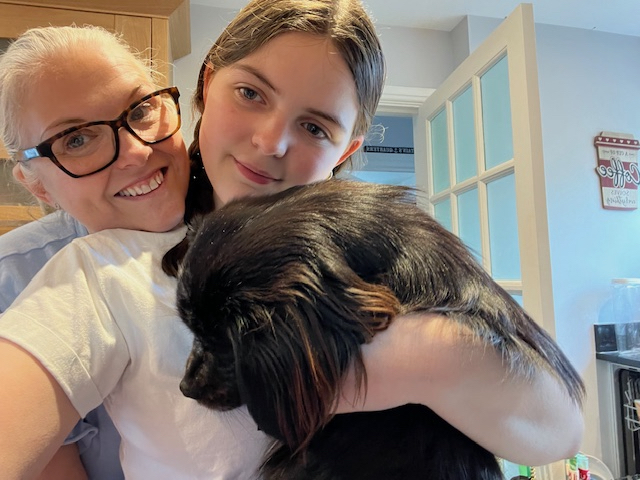
Ruby Neale, who began struggling with anxiety when she moved from Year 6 into Year 7, with her mother Clare
The environment became overwhelming, her mother said, with strict uniform rules, crowded corridors, noisy classrooms and constant pressure, leaving Ruby feeling anxious and exhausted.
“Ruby would be worrying constantly about doing the wrong thing, even when she wasn’t,” her mother said. “She was making herself ill trying to carry on and have a ‘normal’ school life.” Sensory challenges added another layer because one classroom was heavily decorated. Even with accommodations, Ruby struggled to cope.
Anxiety disrupted her sleep and appetite. Battles over attendance strained family life and so eventually she was enrolled in an online school.