
Your support helps us to tell the story
From reproductive rights to climate change to Big Tech, The Independent is on the ground when the story is developing. Whether it’s investigating the financials of Elon Musk’s pro-Trump PAC or producing our latest documentary, ‘The A Word’, which shines a light on the American women fighting for reproductive rights, we know how important it is to parse out the facts from the messaging.
At such a critical moment in US history, we need reporters on the ground. Your donation allows us to keep sending journalists to speak to both sides of the story.
The Independent is trusted by Americans across the entire political spectrum. And unlike many other quality news outlets, we choose not to lock Americans out of our reporting and analysis with paywalls. We believe quality journalism should be available to everyone, paid for by those who can afford it.
Your support makes all the difference.Read more
Half of UK secondary school pupils have avoided school over the past year due to anxiety, a new poll has revealed.
A survey of 2,000 students found 49.5 per cent missed or avoided school at some point last academic year because of anxious feelings.
Most (22 per cent) reported this occurred less than monthly.
However, 5.5 per cent missed school weekly, 6.7 per cent every two to three weeks, and 8.3 per cent once a month.
Fewer than half (47.4 per cent) never missed or avoided school due to anxiety; others were unsure or preferred not to say.
Year 13 pupils were six times more likely than year 7 pupils to report avoiding school due to stress, the survey commissioned by online school Minerva Virtual Academy found.
Female pupils reported they had avoided school an average of 26.4 times per year, compared with 16.7 times reported by male pupils.
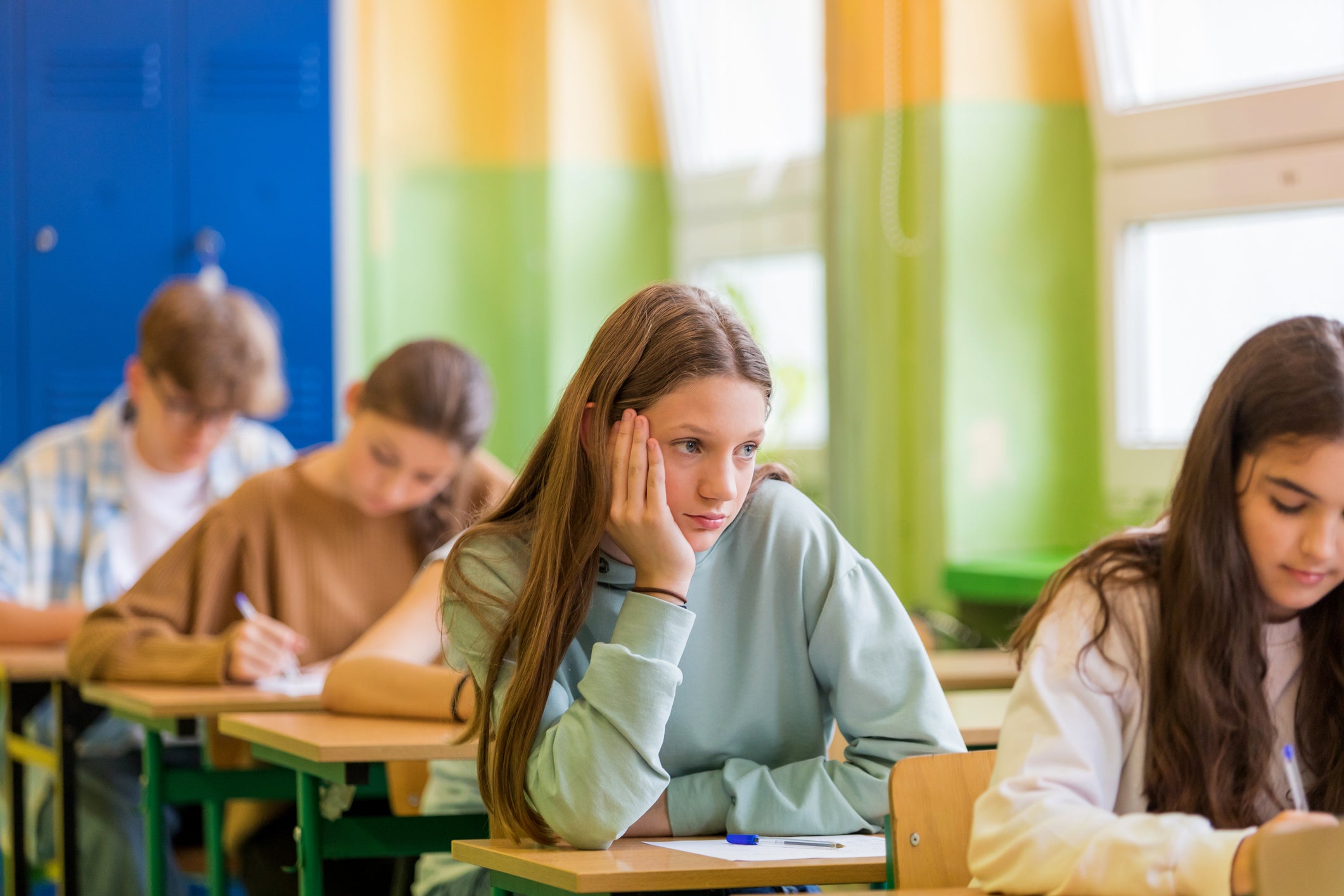 More than a third of pupils surveyed said they felt teachers rarely or never understood their anxiety (Getty/iStock)
The most common cause of school anxiety cited was exam and grade pressure (27.6 per cent), followed by being asked to speak in front of the class (21.4 per cent), fear of falling behind (18.2 per cent), worrying about appearance (18.1 per cent) and not fitting in or having friends (17.6 per cent).
More than a third (35 per cent) of pupils surveyed by Censuswide said they felt teachers rarely or never understood their anxiety.
Hugh Viney, founder of Minerva Virtual Academy, said teachers are not to blame.
“They want to be there to nurture every child but the system is too overloaded and that’s where blind spots appear,” he said.
Schools have been facing an absence crisis since the pandemic, with persistent absence – which means missing 10 per cent or more of classes – soaring to 22.3 per cent in 2021/22. It has since fallen to 17.6 per cent in the latest data but remains significantly above pre-pandemic rates.
Pupils classified as severely absent – missing half or more of their sessions – is still increasing, according to Department for Education figures, reaching 2.3 per cent in 2024/25.
Teaching unions have been calling for more investment in mental health services to help tackle the absence crisis.
The Government has said all schools will be covered by mental health support teams by 2029/30, with an aim for six in 10 pupils to have access to mental health teams by March 2026.