
At the beginning of each shift, Officer Rachel McDonald and social worker Sarah Scafani go over the list of people they need to find.
The pair are one of five officer-clinician teams who make up the Portland Police Bureau’s highly specialized Behavioral Health Unit. They share a patrol car, spending several hours every day trading notes about the people on their caseload, swapping stories about their toddlers and debating the need to wear their ballistic vests every minute of their shift. (McDonald wears hers. Scafani doesn’t.)
“I love this job,” said McDonald, who initially trained as a therapist and then served as a patrol officer for seven and a half years before joining the unit in 2024. “We actually have time to help people.”
But helping the people they are assigned is no easy feat.
“It often feels like a hamster wheel,” said Scafani, a licensed clinical social worker with nearly seven years’ experience on the unit. “There’s barriers on barriers on barriers.”
Across two shifts observed by The Oregonian/OregonLive this year, McDonald and Scafani sought out a half dozen people nearly everyone else was busy avoiding.
There was the man who suffered from delusions and was frequently violent toward his mother. There was the woman known to have a shotgun whose deteriorating mental health had caused her friends to call police. And there was the homeless person who’d lost the flesh off the tip of his finger and was avoiding medical care even though bone could be seen sticking out.
Before leaving the precinct one spring morning in search of several of these people, McDonald realized she had run out of her most valuable deescalation tool: cigarettes. She circled back, asking around until a colleague offered a few. Thus equipped, the two women loaded into their patrol car and set off.
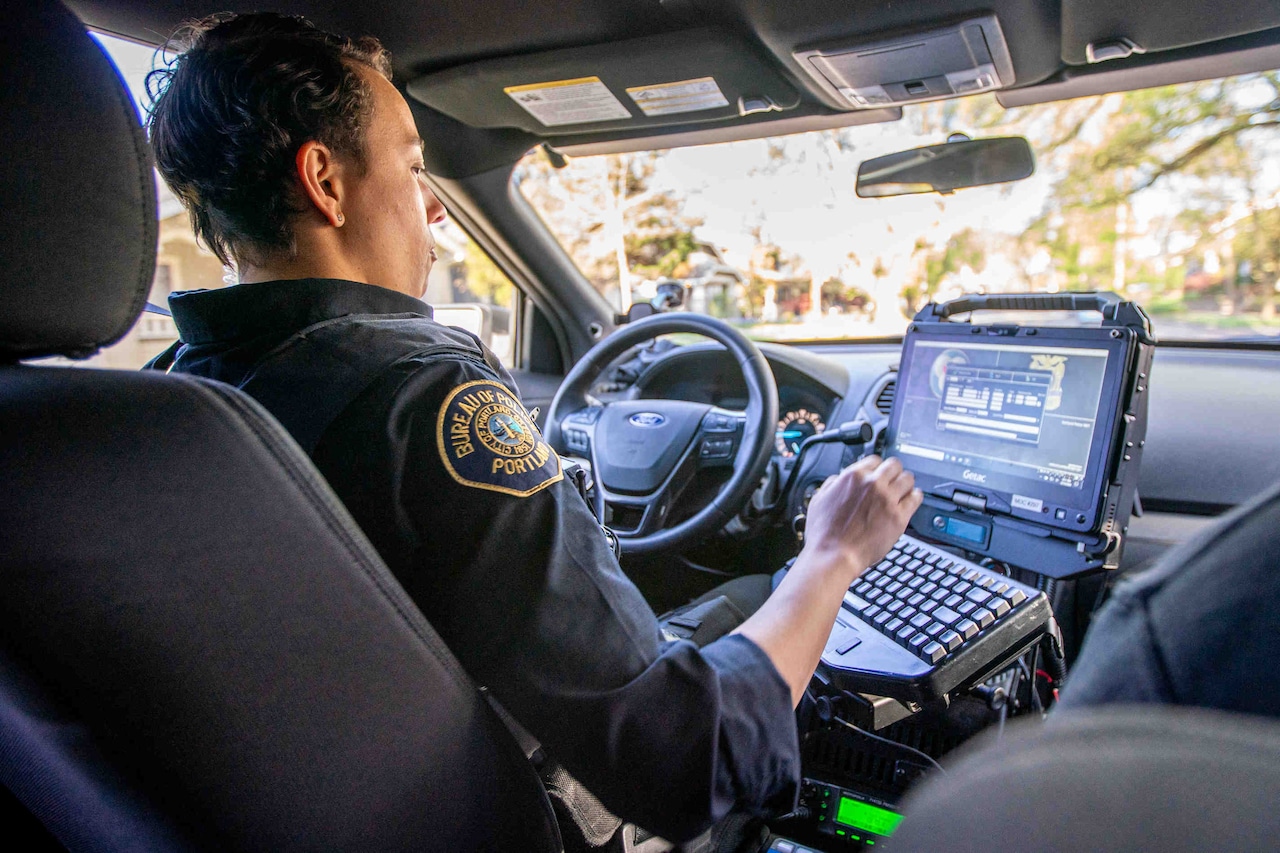 Officer Rachel McDonald, a member of the Portland Police Bureau’s Behavioral Health Unit, works on a built-in laptop inside a police SUV in Portland this spring. The unit pairs officers with mental health clinicians to respond to crisis calls and connect people with support services.Mark Graves/The Oregonian
Scafani, McDonald and their unit are one part of a decade-plus-long effort to overhaul Portland police’s approach to people with mental illness.
Nationally, research shows that people with serious mental illness are nearly 12 times more likely to have force used on them by police. Sued by federal officials for its officers’ own track record of harming or killing people suffering mental health crises, the Portland Police Bureau still is not in full compliance with standards laid out in a settlement agreement signed in 2014.
But while many questions about the effectiveness of that multi-layered effort remain, even critics grant that the behavioral health unit’s co-responder teams seem to be having a dampening effect on the fraught relationship between police and people with mental illness.
Launched in 2013, the behavioral health unit is not large. It had a $4 million budget last fiscal year, which accounted for just over 1% of the bureau’s total budget, according to Sgt. Kevin Allen, a spokesperson for the police.
Everyone on the behavioral health unit’s caseload – the team worked with more than 500 Portlanders in 2024 – has been referred by patrol officers. Most make the list due to escalating behavior, recurring contacts with police or because they may pose a danger to other people.
It’s rarely clear how each day will go or what help the teams will be able to provide. From 2014 through 2024, about 9% of people contacted refused service and 12% of people assigned to the unit’s caseload were not located, according to police data. Another 11% ended up in the criminal justice system and nearly 6% were committed to the state’s mental health hospital for mandatory treatment.
Sgt. Josh Silverman, who oversees the unit, said his officers and clinicians are dedicated to reducing police contacts for the people they aim to help, most of whom are mentally ill or struggling with chronic addiction problems.
“By design, we’re working with folks who have fallen through all of the cracks,” Silverman said. “If there was an easy solution it would have been tried already.”
And options for help are limited. Emergency departments are overwhelmed. Detox beds are few. Inpatient care is hard to find. And even if an officer or clinician believes someone needs help, that person may refuse it or fail to meet the qualifications for mandated mental health care. There’s also not enough housing or shelter to go around. Nor enough attorneys to act as public defenders for people accused of minor crimes.
“We are at the intersection of two nearly broken systems,” Silverman said, referring to the state’s overloaded justice system and fraying social and health care safety net. “If our job is to connect the dots and there aren’t enough dots to connect, that’s a problem.”
Still, nearly 40% of people served by the unit do receive some concrete help, whether that’s a clinician connecting them with a housing counselor or an officer coordinating with their parole officer, according to police. And in 21% of cases, the outcome is marked as “concern mitigated,” meaning the team was able to determine that whatever caused the problem had passed.
McDonald, Scafini and others on their team say they’ll do whatever they can to help. They call family members, often developing ongoing relationships with concerned parents and siblings. Officers reach out to the district attorney or other justice system contacts. Clinicians contact housing providers and sometimes arrange for medical or mental health care.
Much of what they offer is simply time and focus, two things most of the people in their orbit desperately need.
Critics wary of giving police too much credit
The Portland Police Bureau has invested significant time and energy in the past 11 years to improve how officers manage calls involving people with mental illness. But not everyone is ready to declare success.
Among other things, the bureau now requires training in deescalation for every officer. And 130 officers, up from 53 in 2014, received a more rigorous Crisis Intervention Team training. The bureau carefully tracks use of force reports and publishes their records. Officers making the reports must note when someone appears to be mentally ill.
The city has also created Portland Street Response, which allows 911 dispatchers to send unarmed mental health providers to help people who are not believed to be dangerous. After changes in March, Portland Street Response has longer hours, more staff and a broader job description. Responders can now enter public places and transport patients, for instance.
But the efforts have not prevented tragedy entirely.
Just this summer, a man in the midst of a mental health episode died while in police custody. The cause of Damon Lamarr Johnson’s death was determined to be “prone restraint and a heart attack,” according to the Multnomah County District Attorney. A grand jury last month declined to indict the three officers involved in the restraint.
Since 2015, Portland police have shot and killed at least eight people in mental health crises, according to a Washington Post database of police shootings. Portland police declined to say whether any of them, or Johnson, had previously been on the radar of the behavioral health unit.
Meghan Apshaga, a staff attorney for Disability Rights Oregon, which advocates for people with mental illness, said that she would prefer police almost never respond to people with mental illness given the potential for problems. And though she serves on the behavioral health unit advisory committee, she thinks Portland Street Response is a more important part of the institutional change she would like to see.
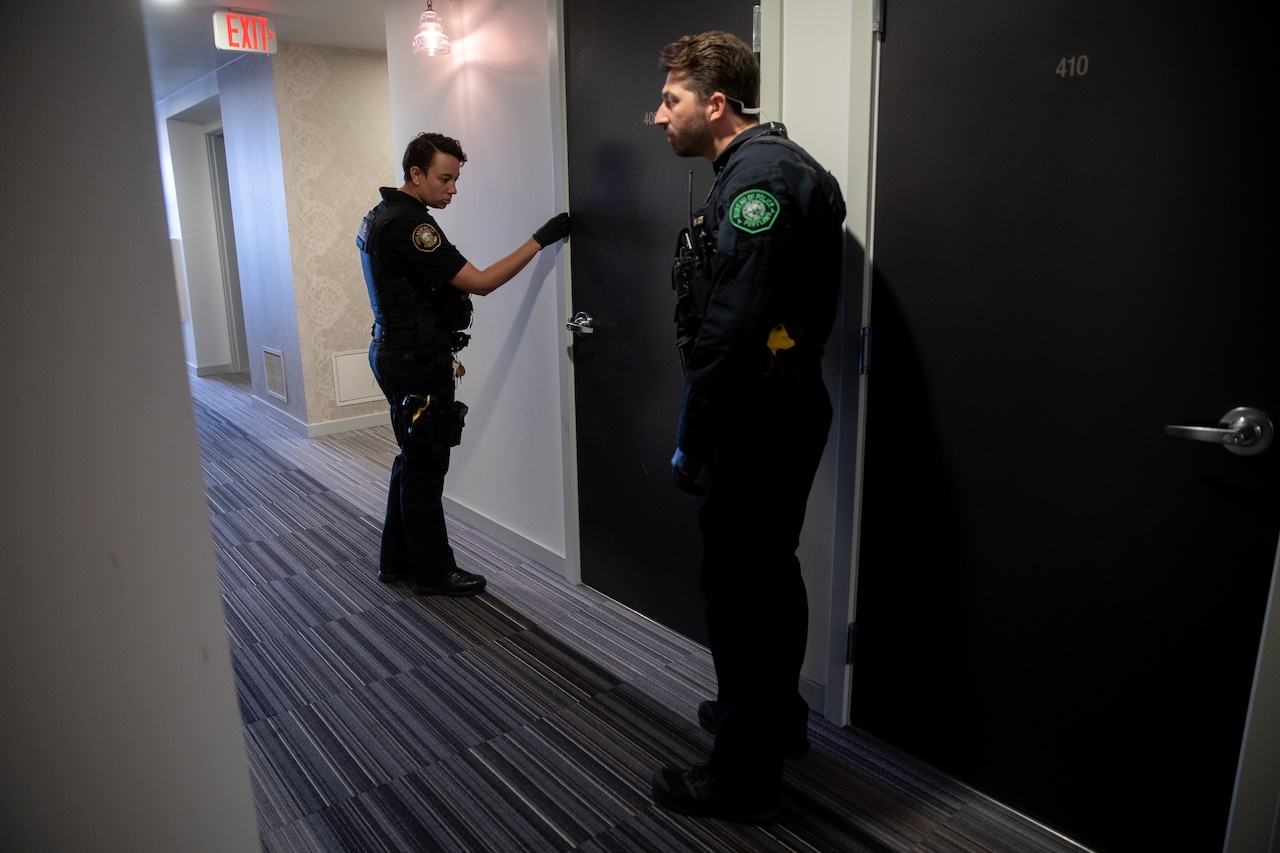 Officer Rachel McDonald, left, and officer Zachary Nell, members of the Portland Police Bureau’s Behavioral Health Unit, check on a woman at the door of a Portland apartment building in May. The woman was reported to have a shotgun and believed she was being stalked.Mark Graves/The Oregonian
Still, Apshaga said, she recognizes there are times when sending a police officer to respond to people with fragile mental health is the only safe option and appreciates that the unit attracts people who like the work.
“The people who are in the behavioral health unit want to be there,” Apshaga said. “They are officers who have a particular interest in working with this population. That’s a great thing.”
Silverman, the sergeant, argues the existence of his team gives patrol officers a proactive option when they suspect mental illness is playing some role in the behavior of the people they encounter. They are no longer stuck shrugging and waiting to get called out again for the same people, often for concerning but non-criminal behavior.
And, over the years, officers have gotten better at making useful referrals, according to police data. While fewer come in now than at the start of the program, more of them are assigned, meaning officers are doing a better job evaluating who qualifies for help.
Local activist Jason Renaud, who runs the Mental Health Association of Portland and has been closely watching Portland police since 1989, remains skeptical. He gives the bureau little credit for improvement on its interactions with people with mental illness. And he doesn’t like that the behavioral health unit’s advisory committee meets behind closed doors.
But even Renaud said he thought Portland police officers are approaching mental health differently now than they were a decade ago.
“I’m pleased about the shift in culture that’s occurring and that’s largely (Police Chief) Bob Day,” Renaud said. “He brings a completely different attitude.”
‘You’re not in any trouble’
Despite the sometimes life and death stakes, a lot of the minute-to-minute work of the behavioral health unit is almost mundane: Navigating traffic, dropping off a food box, checking a new client’s criminal record. It’s the work of paying attention and showing up, not the work of a high-drama cop show.
One April morning, McDonald and Scafani began their shift by conducting a routine check on someone the unit had previously been able to help – a man named Gregory Martin, 53, who talks to his stuffed animals and believes the FBI is after him.
Years ago, when Scafani first met Martin, he’d come to officers’ attention because he frequently called 911 in a panic, threatening to bomb the FBI building or kill himself. Scafani had a different officer partner in those days, and the two worked with Martin to gain his trust. Eventually they were able to get him mental health services and a place in permanent supportive housing, which is an option for people who need significant help to live independently.
“I have mental health problems,” Martin said that morning in April as he stood outside his apartment building chatting with a neighbor. “I was having an episode and they came out. Everybody says I’ve done really well in the past couple years.”
Not every outcome is as happy.
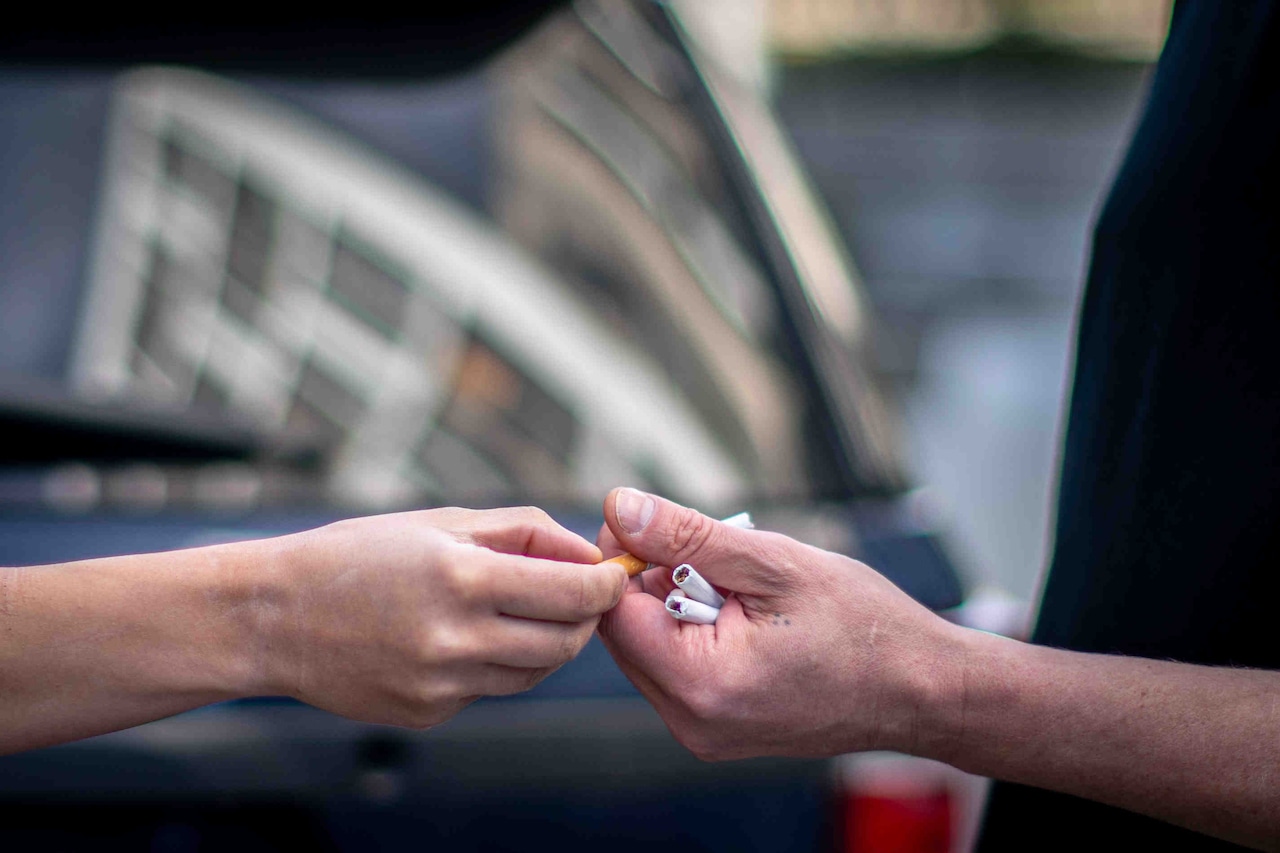 Members of the Portland Police Bureau’s Behavioral Health Unit say free cigarettes, being handed out here in April, and other small gestures build trust with people experiencing mental health struggles.Mark Graves/The Oregonian
Back in the patrol car, Scafani said the work has taught her to set aside her own idea of “what success looks like” and instead focus on helping people get what they need according to their own assessments. Sometimes that doesn’t mean getting them permanent housing and meds. Sometimes it just means a conversation.
In the end, that’s all they were able to offer the man with schizophrenia whose mother had requested a welfare check. The mother already had a restraining order against her son, who’d been violent to her in the past.
McDonald and Scafani knocked on his motel room door. Nothing. When they offered a cigarette, he relented.
But the brief conversation, held through a partially opened doorway, showed Scafani that he didn’t quite meet the qualifications for a medical hold or civil commitment. And he didn’t want anything else from them, other than another cigarette. They gave him one, then gave their card to the motel owners and left.
“You’re really dealing with people where they’re at,” Scafani said.
Within the month, the man had been arrested for violating his mother’s restraining order.
 Officer Zachary Nell, left, Clinician Sarah Scafani, in orange, and Officer Rachel McDonald check on a man reported to be experiencing mental health issues at the motel in Southeast in May.Mark Graves/The Oregonian
On another day, McDonald, Scafani and a back-up officer from their unit arrived in front of a different apartment building to check on the woman whose friends called to say she had a shotgun and an extremely disordered mental state. A second police officer is required if a gun is reported to be present.
Once outside the woman’s apartment door, McDonald and Zachary Nell, the back-up officer on the call, snapped into a focused calm. They shooed everyone else into the elevator well and stood outside the door, ready to react quickly.
Then, a polite knock.
McDonald identified herself as a police officer.
“Hey, you’re not in trouble or anything,” she called through the door, adding, “I’m here with a social worker.”
Scafani joined in. “I just wanted to see if you wanted any resources or anything,” she said.
No answer. Scafani slipped a card under the door and they left.
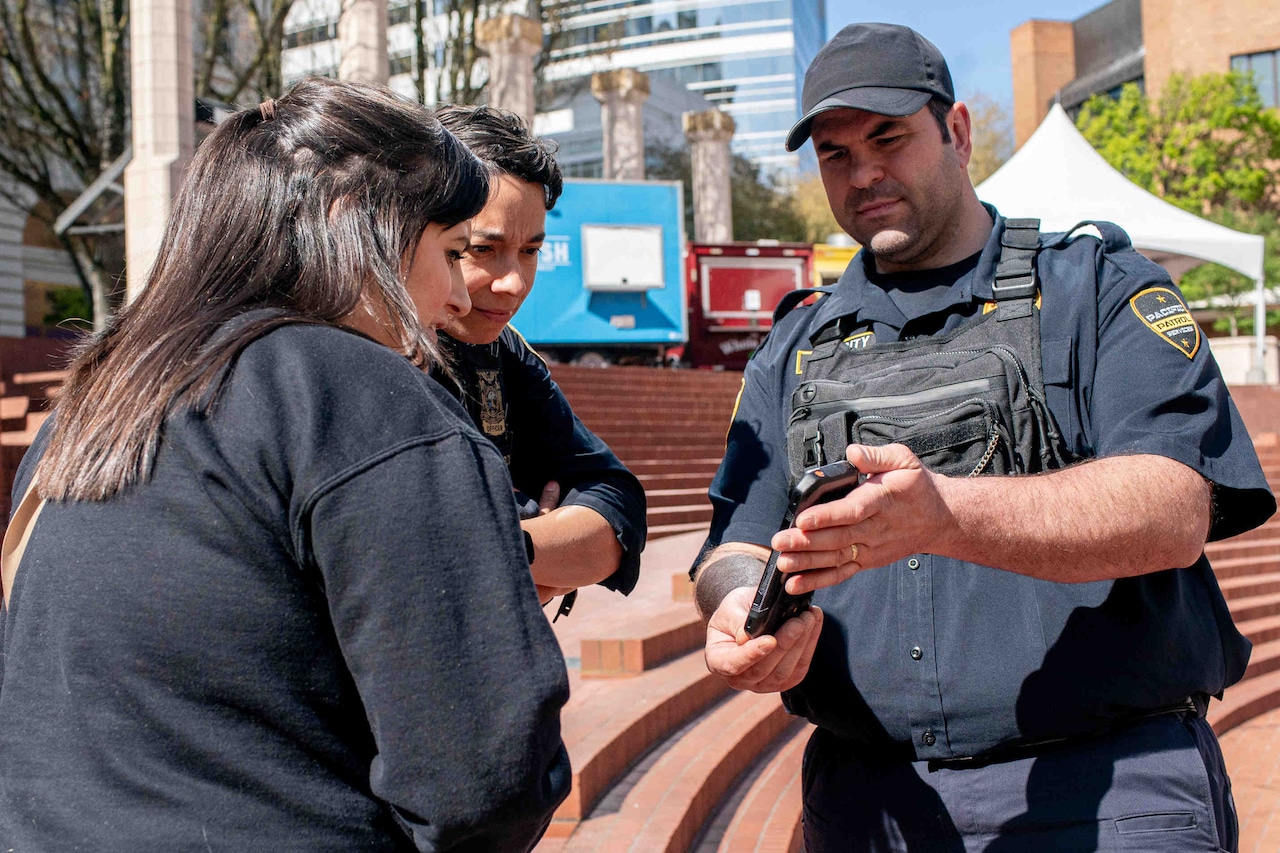 Clinician Sarah Scafani and Officer Rachel McDonald look at a photo on a private security guard’s phone at Pioneer Courthouse Square in downtown Portland. They had been asking after a person they were trying to find who had badly injured his hand and the guard had seen and photographed him recently. Mark Graves/The Oregonian
Sometimes teams make multiple visits before they connect with someone. The woman with the shotgun opened the door the second time the team visited her and she was willing to talk, McDonald said later. Asked if she had a shotgun, the woman said yes but that it wasn’t hers. She happily turned it over to McDonald, who discovered it had been stolen from its owner in 1988. It’s now in the police bureau’s property room.
Despite several other visits, the woman didn’t accept McDonald’s offers to connect her with mental health services. On the third visit, the woman announced she’d soon be moving to Idaho. Shortly after, the 911 calls stopped.
“But we have the gun,” McDonald said. “That’s a win.”
Clinicians with bullet-proof vests
Figuring out how to quantify the wins in this work is difficult, but that doesn’t mean they aren’t happening.
Amy Watson, a professor and researcher at Wayne State University in Michigan, studies what can be done to reduce negative interactions between law enforcement and people with mental illness. She was on the compliance team for Portland’s settlement agreement in 2014 to 2017.
Watson said Portland’s model of following up on internal referrals “makes more sense” than sending officers and clinicians out together as first responders because it deploys police to handle issues that are known to be riskier. And she thinks it’s important that the unit is not considered a stand-alone answer to mental health, but one part of an improved, bureau-wide system.
“They’ve put in a lot of work,” she said of Portland police. “They’ve got some good things going on. I don’t think there’s a law enforcement agency in the country that’s got it in great shape.”
But she said there is limited research on the effectiveness of a co-responder model like Portland’s. And the nature of the work can make the unit’s efforts hard to measure or evaluate.
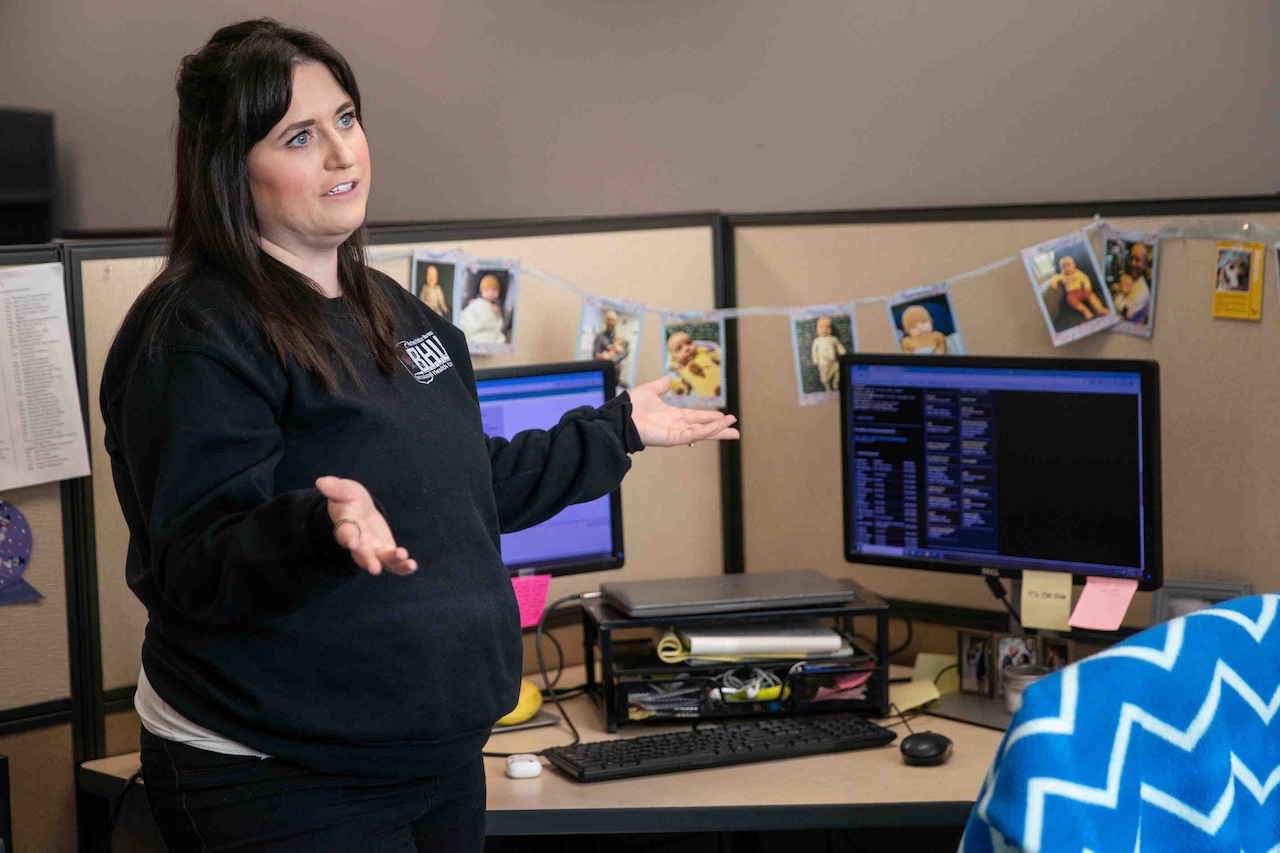 Clinician Sarah Scafani stands by her desk inside the Penumbra Kelly Building in April. Scafani has been with the unit for the better part of seven years.Mark Graves/The Oregonian
That’s especially true when they spend time looking for someone they never find, like the man with the missing fingertip. He did eventually end up at the hospital, McDonald heard later, but not until after he had developed a bad infection. Now, he’s out again, she said, “in the wind.”
Watson said another strength of the Portland behavioral health unit model is that people with mental illness are sometimes sick of social workers and therapists and would rather talk to police.
Scafani agreed.
“There’s a really big misconception that mentally ill people don’t want to talk to police,” she said. “That, in my experience, is largely untrue.”
Scafani and McDonald said they’ve learned to swap in and out of the lead role, depending on how the person they are working with responds.
Silverman, the sergeant, doesn’t believe his unit is the only answer to the question of what police can do better, but he does think it is part of the answer. He said there is simply no one else available to do the work his teams can do.
“We are the only clinicians with ballistic vests,” he said.
And yet, Silverman is under no illusion that even a successful intervention will ensure a long-term positive outcome for every person with whom they engage. There are too many holes and shortages for that, he said. So he keeps his team focused on what is within their control.
“My guiding philosophy is we will not be the weak link,” he said. “We will be really good at the part that we own. And we’re doing a darn good job.”
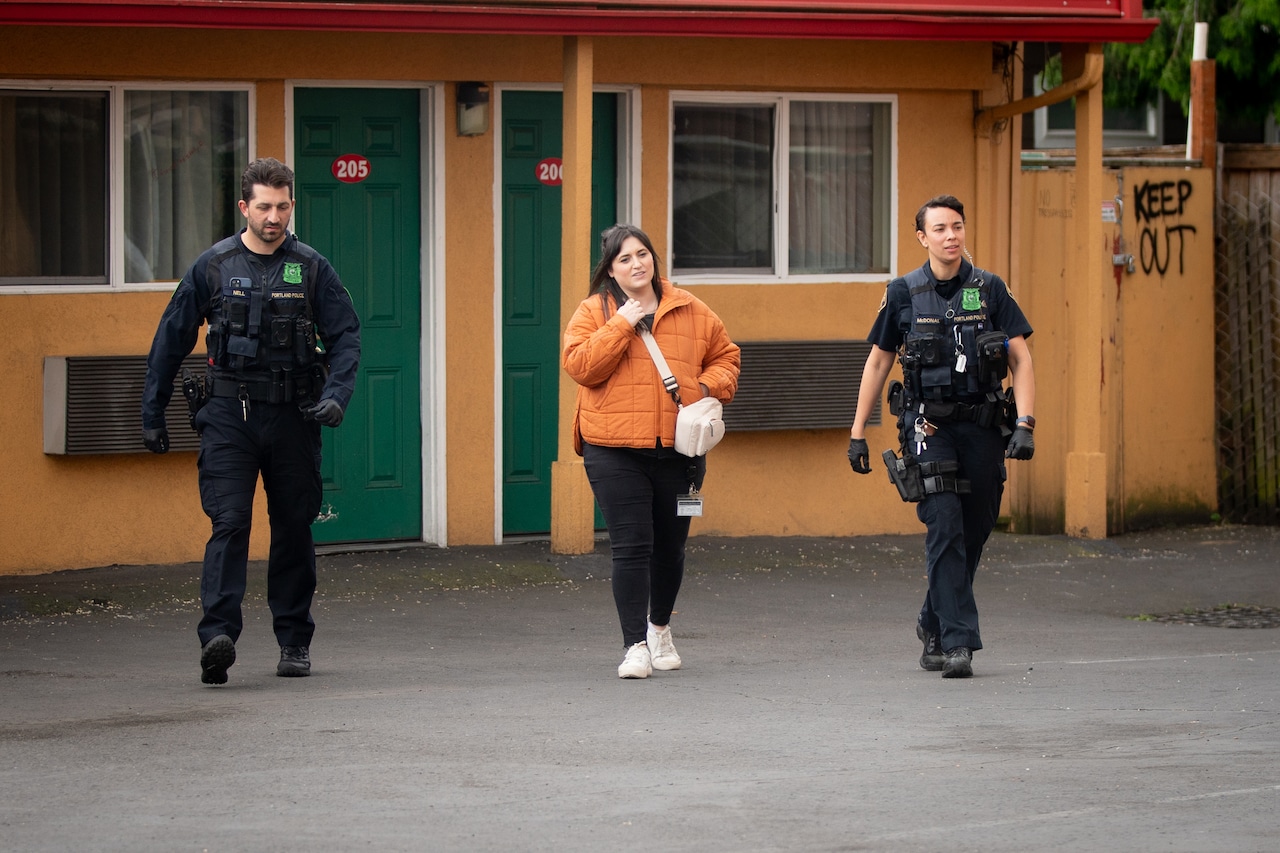 Officer Zachary Nell, left, walks with Sarah Scafani, in orange, and Rachel McDonald after conducting a welfare check on a man who struggles with delusions. “We try to be the glue that holds everything together,” Nell said.Mark Graves/The Oregonian