
When Alexis Murphy talks about weight loss, she does not start with a morning when she stepped on a scale.
Instead, she tells of a childhood marked by abuse and a resulting coping habit that felt “dependable” when little else did. Food became a comfort, an armor and a way to push down emotions she did not have the tools to process yet.
“I would eat until I was full and sometimes eat past that, just to stuff the feelings down,” Murphy said.
For years, her story followed a familiar pattern of determination, progress, disruption and retreat. She could lose weight when she forced herself to, only to gain it back when life grew heavy again. Each cycle left her more discouraged and more convinced that change might be temporary, conditional or linked to someone else’s approval.
She describes herself as someone who has always been “hefty,” even as a child who played soccer and stayed active. She said her family history made it easy to gain weight and hard to lose it. The physical story, she explained, cannot be separated from the emotional one.
Despite the challenges, she got into what she calls the best shape of her life in her early-20s. She danced salsa, found joy in movement and reached a size 12, which was the smallest size she had ever worn.
Then she moved, got engaged and slowly drifted away from the healthy routines that she had adopted.
After the relationship ended, she returned to what she knew.
“I started eating my feelings again,” she said.
By her mid-20s, Murphy’s weight climbed to about 320 pounds. Around the same time, she was diagnosed with pseudotumor cerebri, a condition of increased pressure in the skull that can mimic symptoms of a brain tumor. Her doctors told her weight loss was one of the most reliable treatments she could undergo.
Medications intended to help also brought frightening side effects. The drug Topamax led to cardiac arrest, and Cymbalta left her severely ill with low blood sugar.
She underwent multiple surgeries to address health issues and eventually had a hysterectomy. The sudden menopause that followed came with rapid weight gain, adding to the challenges that she was already facing.
She tried multiple different diets, exercise plans and medications, including a GLP-1 drug. The latter landed her in the hospital and wasn’t a viable path forward.
Then came Colorado.
Murphy moved from Houston and told herself she would make true lifestyle changes. She began by going to the gym five days a week and eating what she believed was right. Instead of losing, she kept gaining, and the familiar feeling of despair settled in.
A hiking accident on the Spring Creek Trail in Steamboat derailed her even further. One day, Murphy fell while crossing a creek where a bridge had washed out and was impaled by rebar. The long recovery kept her from working out and sent her back into old habits once again.
By that time, she reached 312 pounds.
 Alexis Murphy at the beginning of her weight loss path, which included surgery, dietary shifts and mental health support.Courtesy Photo/Alexis Murphy
At that point, Murphy said she stopped believing willpower alone would solve her weight challenges.
What came next was not a motivational quote, or a sudden burst of confidence, but a notice from her employer’s insurance plan that bariatric procedures might be covered the following year.
Murphy had thought about bariatric surgery for a decade but could not afford it. The new coverage made it possible. Her pseudotumor cerebri, however, left her with the fear that complications from the procedure might not be able to be undone.
She went to a doctor expecting to pursue a temporary gastric balloon, just to find out about risks she had not uncovered in her own research. The physician instead recommended a endoscopic sleeve gastroplasty, or ESG.
Unlike traditional bariatric surgery, Murphy said, ESG is done through an endoscope with internal sutures that reduce stomach volume without abdominal incisions. It also offered her another detail that mattered.
“It can be reversed up to a month after the procedure,” she said. “So if I had any complications, or my body rejected it, we could still reverse it.”
She prepared with a monthlong plan that moved from a regular diet to clear liquids. After the procedure, she doubled the recovery timeline her physician recommended, staying longer in each phase, from liquids to pureed foods and to soft foods, before returning to a regular diet.
She also made a decision to treat the procedure as a tool, not a cure.
“Within a year, I lost 140 pounds,” she said.
While the procedure helped, she also said that consistent changes across food, exercise and mental health became part of her routine as well.
She had to address the significant mental trauma of her youth to make her weight loss stick and to avoid repeating the cycle she had battled against for years.
As a young adult, she leaned on alcohol to cope with pain and anxiety.
She decided to choose a job that meant a lot to her, and to quit drinking and smoking at the same time. When stress later tempted her to relapse, she leaned on her mother and decided to begin therapy. Her relationship with therapy, she said, was uneven until she found a therapist she could truly trust.
“It wasn’t until this bariatric surgery, when I fully came to terms with the fact that I needed to deal with not only the physical things that were going on with me, but I needed to heal every single facet of myself,” she said.
That work mattered for weight loss too. Murphy said she once believed she was “committed” because she exercised, or because she ate better, but she was never able to sustain both, and neither addressed the underlying mental wounds.
That meant boundaries, and recognizing which relationships pulled her back toward the old version of herself. She lost friends along the way, and learned to accept that not everyone will celebrate, or support, someone else’s growth in a positive manner.
She found a new community at Rise Up Fitness Center in Craig. While her mother has remained her most consistent anchor, she also found support there through friends such as Becky Smith and Jennifer Hartman.
 Alexis Murphy, right, and her friend Becky Smith. Smith said Murphy’s story is a constant inspiration for her and others, particularly at Rise Up Fitness Center in Craig, which has been a core component of Murphy’s journey.Courtesy Photo/Alexis Murphy
“Alexis has become a different person,” Smith said. “She is still the same goofy girl from years ago, but with confidence and joy. She has transformed herself, which is an inspiration to me. She stopped letting her past dictate her future, and I love that she keeps pushing.”
Murphy’s first dream after surgery was to complete a 5K. She signed up for the Bolder Boulder 10K. On race day, she walked and ran 2 miles from her parking spot to the start, finished the race, then walked back.
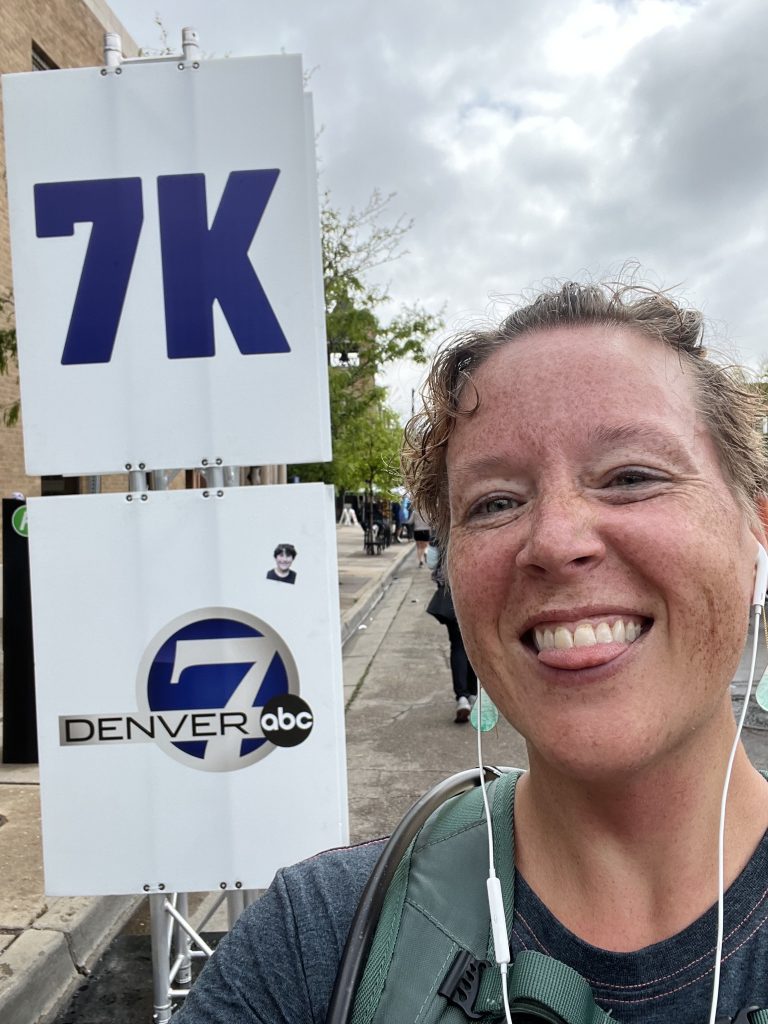 Alexis Murphy after participating in the 2025 Bolder Boulder. The event was a defining moment in her life, providing further motivation to support her weight loss goals and her mental and physical health.Courtesy Photo/Alexis Murphy
When she saw the total distance, she realized she had nearly covered a half-marathon.
“I was crying and sobbing as I crossed the finish line,” she said.
Soon she completed a half-marathon in Steamboat. Then she finished a triathlon and learned how to do a pull-up at CrossFit.
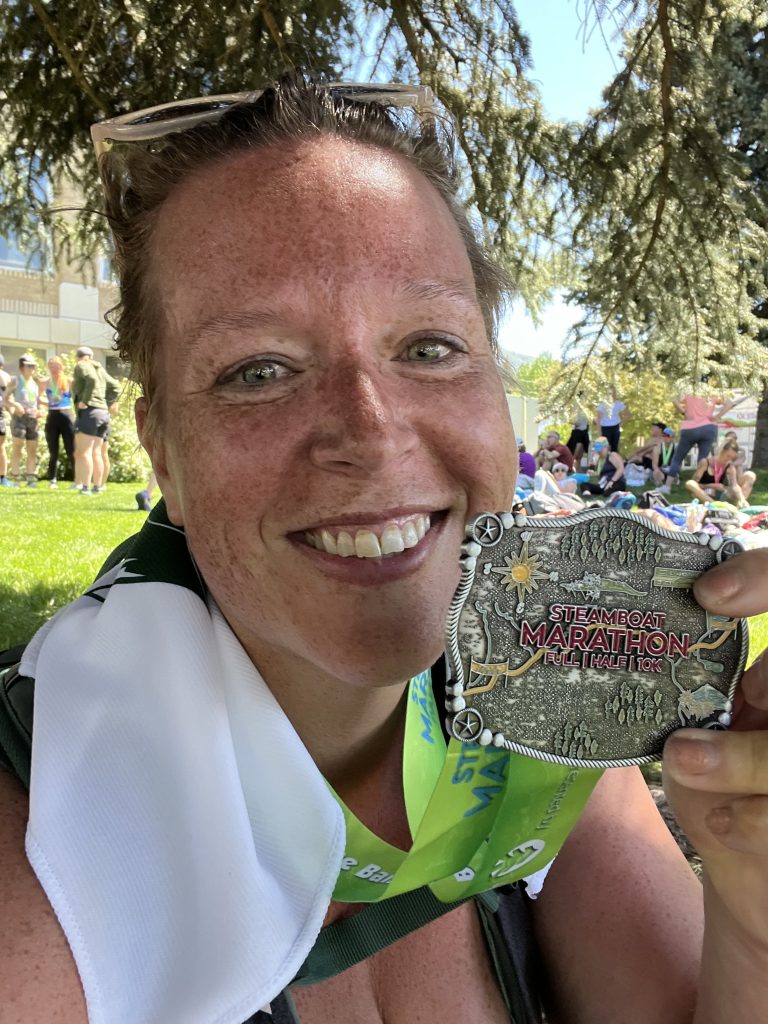 Alexis Murphy poses after completing her first half-marathon in Steamboat. Since that race, she has increased her training with the goal of completing an ultramarathon.Courtesy Photo/Alexis Murphy
Now she is training for an Ironman in June 2026 and has signed up for multiple ultramarathons including a 50-mile race.
Her “casual hikes” once spanned a mile or two. Now, she said, they range from 5 to 10 miles. The change, for Murphy, is not just physical — it is rooted in a new identity and mindset, especially when it comes to eating.
“I don’t think about satisfying a craving,” she said. “I think about fueling my body and what my body needs to be able to do the things that I want to do.”
She still has moments of “body dysmorphia.” She described pulling out “goal outfits” she once saved for an imagined future, only to find them too big. She started this chapter at a size 26. Today, she is a size 6 and sometimes a 4.
 Alexis Murphy, center, stands alongside her mother Kathleen Murphy, right, and friend Jennifer Hartman, left. Both formed an essential support network for Murphy during her personal transformation.Courtesy Photo/Alexis Murphy
Murphy has shared her progress publicly on TikTok and joined online support groups where she mentored people preparing for surgery or navigating early recovery. Her advice has been to listen to your doctors and your body, and not to look for shortcuts that keep the same old habits intact.
Her overall message is to keep “putting yourself first and asking for help.”
For people whose weight is tied to trauma, Murphy said the work is not only physical. She encouraged survivors of childhood sexual abuse who want resources and support to seek help through the Rape, Abuse and Incest National Network.
If she could change one thing, Murphy said, she might have pursued ESG earlier. But she also believes timing mattered. She needed the mindset, the willingness to choose herself and the courage to push through the hard days without quitting.
“When things get hard and they seem impossible, push through it,” she said. “Because when you push through, that is when you gain the greatest perspective and the greatest rewards.”