
The city of Portland accused the Trump administration on Tuesday of trying to leverage a longstanding oversight agreement with the U.S. Department of Justice to paint local police as biased against conservatives.
Attorneys for the city and the Justice Department argued in federal court for an hour and a half over whether the agreement entitles Trump officials to body-worn camera footage, incident reports and other police records related to recent protests against U.S. Immigration and Customs Enforcement.
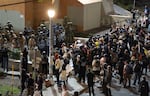
Masked-up federal agents confront the protesters in the driveway of the U.S. Immigration and Customs Enforcement facility in Portland, Ore., on Sept. 28, 2025.
Kristyna Wentz-Graff / OPB
The agreement dates back to 2012 and mostly centers on how the Portland Police Bureau uses force against people in behavioral health crises. But Justice Department attorneys argued that it’s broad enough that police tactics during the protests fall under its umbrella.
“We reserve the right to enforce the settlement agreement and to ensure the protection of civil rights for all individuals that come into contact with the Portland Police Bureau,” said Justice Department Attorney R. Jonas Geissler.
Attorneys for the city of Portland argued, however, that their argument is a smokescreen for getting records it wouldn’t otherwise be entitled to. City Attorney Robert Taylor called it a “nakedly political” maneuver.
“This is the court’s opportunity to send a message to the U.S. Department of Justice that this settlement agreement is not a political football,” Taylor said.
The Justice Department is specifically looking for records that show “viewpoint discrimination” and has demanded records in writing to the city on Oct. 3 and on Oct. 29. Among the requests are records related to the arrest of conservative influencer Nick Sortor and an alleged assault of a journalist from right-wing outlet The Post Millennial.

Conservative influencer Nick Sorter, center left, takes images from atop the U.S. Immigration and Customs Enforcement (ICE) facility on Oct. 7, 2025, during a visit by U.S. Homeland Security Secretary Kristi Noem.
Eli Imadali / OPB
City attorneys treated those demands as typical requests for public records. Those can spend months in a queue before they are produced. Some records — like those involving ongoing civil lawsuits — are often not available under the state’s public records laws.
Sortor recently notified the city that he plans to file a $10 million civil rights lawsuit.
The hearing made for strange bedfellows. Most court appearances over the settlement agreement’s lifespan have been a complex drama, at times pitting city attorneys and the rank-and-file police union against mental health advocates and the Justice Department.
This time, the Justice Department found itself facing off against all the other stakeholders.
Anil Karia, who represents the police union, said Portland police were “confused” by the Justice Department suddenly re-inserting itself in the agreement. The department in recent years had been more hands-off, particularly after the 2024 appointment of an independent monitor. In April, President Trump wrote in an executive order that his administration would review all consent decrees — like the one in Portland — to ensure they do not “unduly impede” law enforcement.
Juan Chavez, an attorney with the Mental Health Alliance, told OPB he was “flabbergasted” that the Justice Department idly deferred to the independent monitor after a man in a mental health crisis died in police custody last summer, yet are being proactive now.
“One conservative grifter gets his feelings hurt and it’s all torpedoes being fired,” Chavez said. “It highlights where the Department of Justice’s priorities are now. They’re not with Portlanders. They’re with people who have flown here from elsewhere to dunk on our city, and that’s truly reprehensible to me.”
Geissler accused the city and other attorneys of “political grandstanding” for saying the Justice Department was motivated by Sortor’s arrest.
“There is nothing in the record that indicates the Department of Justice would use its resources to help an individual in their civil suit against the city,” Geissler said.
Settlement has been invoked in protests before
There is precedent for the settlement to expand beyond its initial focus on behavioral health and police use of force.
The city was brought to heel by the settlement agreement over its crowd control policies in 2020. That year, social justice protesters and police clashed repeatedly following the murder of George Floyd by a Minneapolis police officer.
Those protests drew national attention with images of demonstrators and riot gear-equipped police confronting each other in the streets of the city’s downtown, under clouds of tear gas and other chemical munitions. The protests also led the city to pay more than $3 million to settle excessive force claims by protesters.
The settlement was used to prescribe policy changes, and the bureau conformed. Perhaps the most visible change is that officers have been wearing body cameras since 2023.
“Certainly,” Geissler told Simon at the Tuesday hearing, “the parties did not have to allege that all members of the public who were involved in crowd control [in 2020] were in some way under the influence of a mental health crisis.”
Protests rebooted in June 2025, setting the stage for several court hearings like Tuesday’s that questioned how well local police are enforcing the law.
Following the Trump administration’s aggressive immigration enforcement operations across the country, persistent protests were staged outside the ICE building in the city’s south waterfront on a near-nightly basis. Attendees often stuck to heckling federal law enforcement, but confrontations turned physical at times.
Rather than declaring riots and firing tear gas to break up the crowds, Portland police have more often let protesters demonstrate — even if the activity blocked traffic or violated other smaller city ordinances. Instead, the police relied on a tactic of having bicycle cops make targeted arrests, with riot police on-call in case the situation escalated. Portland police have made more than 70 arrests at the protests.
Federal law enforcement, on the other hand, hardly changed their playbook from 2020. Officers from agencies like U.S. Customs and Border Protection and the Federal Protective Service have indiscriminately fired chemical munitions and shot pepper balls at protesters, sometimes hitting Portland police.
Trump, in late September, called Portland “War ravaged” and attempted to deploy members of the National Guard into the city. Conservative influencers began flocking to the protests, as well, many of whom cheered the federal officers’ crowd control tactics.
Sortor and other influencers claimed the Portland police coddled or even sided with the protesters. He made multiple appearances on FOX News after his arrest and said Portland had a “pattern and practice” of “ordering their police departments to go after people like me.”
Portland police’s tactics came under significant scrutiny in late October, when the city and state of Oregon sued to block Trump from deploying the National Guard.
Ultimately, after a three-day hearing where several PPB officers testified, U.S. District Court Judge Karin Immergut ruled that local police had the situation under control and that the National Guard deployment was unwarranted.
Entitled or playing politics?
Much of the hearing Tuesday revolved around whether the Justice Department was making a good-faith argument for the police records.
At various times, Judge Simon wondered aloud how the police records related to the ICE protests could be relevant to police use of force against people in mental health crises, and whether the Trump administration itself has practiced “viewpoint discrimination” during the protests.
One example, Simon noted, was how the U.S. Department of Homeland Security allowed conservative media outlets into the ICE building but refused others.
Taylor and fellow Portland city attorney Heidi Brown argued otherwise. They contended the Justice Department acted only after Sortor was arrested and the Trump administration failed to get the National Guard deployed.
Brown, in court filings, noted that Sortor tweeted after his arrest on Oct. 2 that U.S. Attorney General Pam Bondi called him and promised an investigation. Assistant Attorney General Harmeet Dhillon tweeted that Portland should “buckle up.”
Dhillon then sent the first of two demands on Oct. 3 for police records related to “viewpoint discrimination.”
Judge Simon pressed Geissler, the Justice Department attorney, about the specifics of Sortor’s communication with Justice Department leadership. Geissler contended that was irrelevant to their arguments.
“Our briefs have relied upon the clear case law and the text of the settlement agreement itself,” Geissler said. “We’re not trying to attempt political grandstanding or point-scoring.”
Simon, at the close of the hearing, said he planned to issue a ruling in writing but did not specify when.