
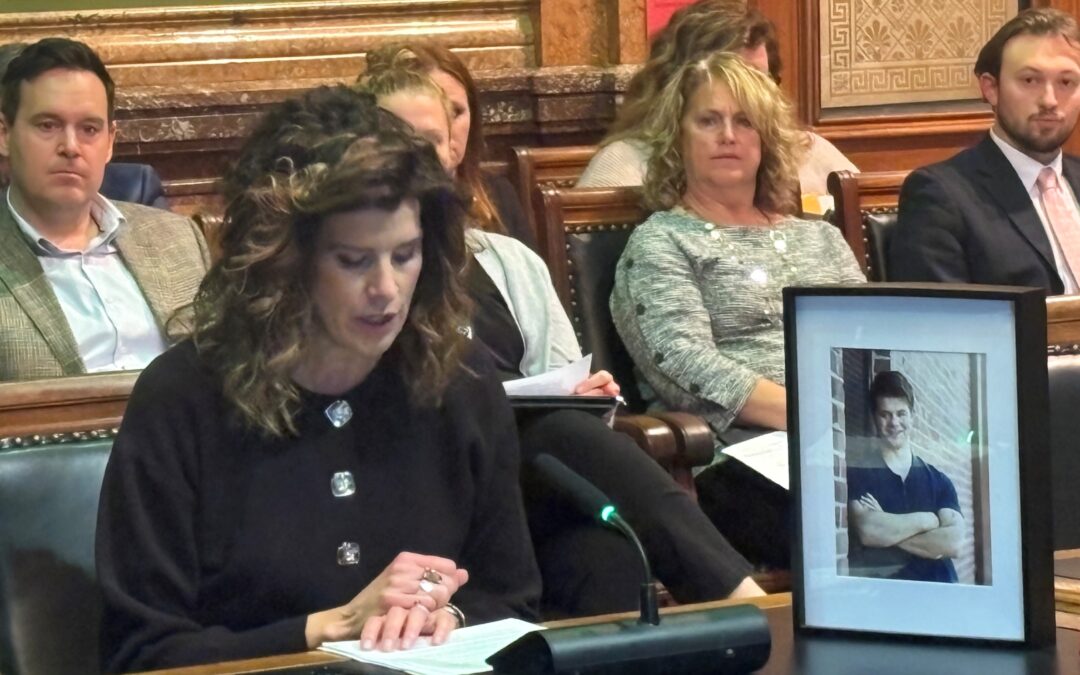
 Mary Neubauer of Clive testifies before legislative committee on Jan. 6, 2026 with a photo of her son Sergei beside her. (Photo courtesy of Dave Price, Gray Media)
A legislative panel is examining how to expand access to Iowans who need intensive, recovery-oriented mental health services outside of a hospital setting.
Representative Gary Mohr (like “more”) of Bettendorf is chairman of the temporary committee, which met yesterday. “Many of you are going to think as a result of today we’re going to come out with a grandiose, multi-million dollar plan. Don’t plan on it. Some of you expect us to come out with virtually nothing and maybe one of two recommendations. Don’t count on it,” Mohr said.”We’re going to get as far as we can moving this issue forward.”
Mohr and other lawmakers heard testimony about the lack of “subacute” mental health care services and learned there are only 30 slots available in Iowa today for adults who need those services after hospitalization for a mental health crisis.
Mary Neubauer of Clive told lawmakers her adopted son Sergei was diagnosed with depression, anxiety and PTSD after abuse he suffered as a child in Russia. Neubauer said after Sergei attempted suicide and was hospitalized a decade ago, she and her husband found the kind of programs he needed next in Arizona and California because there were none in Iowa. After Sergei committed suicide in 2017, Neubauer has been an advocate for action in Iowa.
“We’re Iowans. We’re Midwesterners. We pride ourselves of how we take care of each other,” Neubauer said, “and we haven’t been doing the best job of that in terms of mental health care here in Iowa.” Neubauer said there’s growing demand, world-wide, for high-quality, comprehensive mental health recovery services and there’s a chance for Iowa to position itself as a go-to place for that kind of care.
Officials from two key agencies suggested there are some regulatory changes that might improve the business model for these intensive, sometimes months-long treatment programs. They said some insurance companies limit coverage for these services to just 10 days — because of a reference in state law that could be changed — and there are professional requirements for employees that make it hard to fill all staff slots.