
LA GRANDE – Welcome to Your Life Matters, a special project from the Elkhorn Media Group where we embark on a journey of compassion, understanding, and hope. In this space, we aim to shed light on a topic that often lingers in the shadows: suicide and mental health awareness. Here, we believe in the power of conversation to break down the stigma surrounding mental health and create a supportive community for those who need it most.
Each month, we’ll share personal stories of resilience, expert insights, and practical strategies to navigate the complexities of mental health. Our goal is to foster empathy, dispel myths, offer resources, and provide a beacon of hope for those who may be struggling.
Following a hiatus, Your Life Matters returns with another examination of mental health and crisis trends in the La Grande area. Specifically, we reached out to La Grande Police Chief Gary Bell for another discussion on recent calls for service, an examination of the law enforcement perspective as related to crisis calls, as well as following up on some concepts discussed by Bell and others during a League of Women Voters Union County town hall in October 2025.
Unlike most of our segments, we weren’t able to speak in person or remotely this time. Instead of attaching an audio interview, we’ve written up a text Q&A with Chief Bell.
The full interview Q&A is as follows:
(EMG = Elkhorn Media Group)
(GB = Gary Bell)
______
[EMG] Starting off by looking at local data, during the October meeting, it was noted that the La Grande/Union County dispatch center had received 347 mental health calls for service by October 23. If you can disclose it, how many additional mental health calls has the center received as of the latest count?
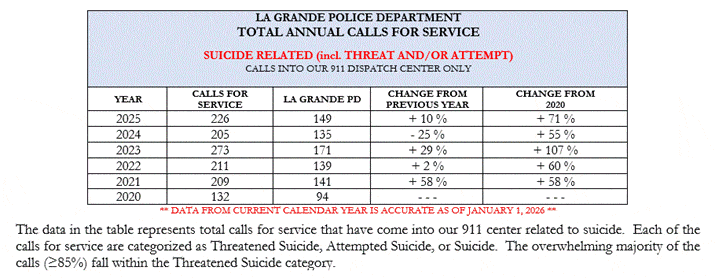
[EMG] The 347 calls in October were actually down compared to the reported 540 on the same date in 2025, a reduction of 22%. How do current mental health calls for service compare to 2024 numbers of the same time frame?
[GB] The table above shows that CY 2025 saw a 12% reduction in total CFS related to mental health. This is a good thing and continues trending in a positive direction.
[EMG] Similarly, the dispatch center reported 151 suicide related calls for by September 1st, 2025. If you can disclose it, how many additional suicide-related calls for service have been reported as of the latest count.
145 Suicide related calls for service were reported by September 1st, 2024, a 4% increase. How do current suicide related calls for service compare to 2024 numbers of the same time frame?
[GB] The table above shows that the total CFS for CY 2025 were up 10% over CY 2024.
[EMG] Something you had mentioned during the October public meeting was that police as an institution simply aren’t designed to act as mental crisis responders but are often made to act in that role regardless. Generally, how has the LGPD adapted to the increasing number of mental calls in the community?
[GB] While law enforcement is not inherently designed to be the primary responder to mental health crises, LGPD has adapted by emphasizing de-escalation, training, and collaboration. Our officers receive ongoing training in crisis intervention and trauma-informed response, and we prioritize slowing situations down, using communication over enforcement whenever possible. We also work closely with our mental health providers, emergency medical services, and dispatch to route calls appropriately and connect individuals to services rather than defaulting to arrest. While the demand continues to grow, our focus remains on safety, compassion, and using law enforcement resources in a way that best supports individuals in crisis and the broader community.
[EMG] Another thing that was mentioned was that, due to issues with drug decriminalization, an atmosphere of apathy/callousness to open air drug use set in. Given the relationship between drug usage and some of the more extreme mental cases observed by law enforcement and social services locally (again, based on discussion from the November meeting), is it possible that, locally, this apathy may have spread to mental cases as well? As in, those suffering from mental instability, or who are in frequent contact with those suffering, may be indifferent and more resistant to intervention?
[GB] Locally, we have observed that repeated exposure to open drug use and recurring mental health crises can contribute to a degree of normalization or fatigue among some individuals and their social circles. In some cases, this can present as indifference or resistance to intervention, particularly when prior efforts have not led to lasting change. That said, this is not universal, and many community members still seek help and want meaningful support. From a law enforcement perspective, this reinforces the need for consistent engagement, clear accountability where appropriate, and strong partnerships with behavioral health and social service providers to reduce harm and re-establish pathways to care.
[EMG] While we may have touched on this in previous discussions, for those that may be unfamiliar, what process do LGPD officers follow when a call for service is subsequently identified as predominantly mental rather than criminal in nature?
[GB] When a call is identified as predominantly mental health–related rather than criminal in nature, LGPD officers shift their response accordingly. The focus moves to scene safety, de-escalation, and assessment, rather than enforcement. Officers work to stabilize the situation through communication, determine whether the individual meets criteria for voluntary or involuntary evaluation, and involve medical or mental health professionals as appropriate. Whenever possible, individuals are connected to services, family, or care providers instead of entering the criminal justice system, with arrest used only when legally required or necessary to ensure safety.
[EMG] Similarly, what is the process for responding to suicide calls for service?
[GB] Suicide-related calls are treated as high-priority and handled with a safety-first, crisis-focused approach. Officers work to secure the scene, establish communication, and de-escalate the situation while assessing immediate risk. When appropriate, medical personnel and mental health professionals are requested, and officers evaluate whether the individual meets criteria for voluntary or involuntary mental health evaluation. The primary goal is to preserve life, reduce harm, and connect the individual with appropriate care and support, rather than pursue enforcement.
[EMG] Does the process differ between calls that are identified as suicide related during the initial call vs those that are identified as such after an officer has already been dispatched?
[GB] The core response does not change; suicide-related calls are treated with the same level of urgency and care regardless of when that determination is made. If suicide risk is identified after an officer has already been dispatched, the response is immediately adjusted, including updating responding units, requesting additional resources such as medical or mental health support, and shifting focus to scene safety and de-escalation. The priority in all cases remains preserving life and connecting the individual to appropriate care.
[EMG] While data and procedure provide tangible factors to examine, poor mental/mental instability and how it factors into criminal acts, drug usage, and community decline is, of course, an extremely complicated and multifaceted issue. In your personal experience working in and overseeing the La Grande Police department, what are some of the more important things for the public to keep in mind when addressing these issues?
[GB] In my experience, it is important for the public to recognize that mental health, substance use, and criminal behavior are deeply interconnected but not synonymous. Most individuals experiencing mental health crises are not violent, and lasting solutions rarely come from enforcement alone. Progress depends on early intervention, accessible treatment, personal accountability, and sustained community support. Law enforcement plays a necessary role in maintaining safety, but meaningful improvement requires coordinated efforts among families, service providers, local government, and the broader community, along with patience and realistic expectations about change over time.
[EMG] As always, what services or contacts would you recommend locally for anyone that is struggling or may know someone who is?
[GB] Anyone who is struggling, or who is concerned about someone else, should consider reaching out early. Locally, Center for Human Development at 541-962-8800 and other regional behavioral health providers are key resources for mental health and substance use support. For immediate crisis assistance, the 988 Suicide & Crisis Lifeline is available 24/7 and can provide guidance, support, and local referrals. If there is an immediate safety concern, contacting 911 remains appropriate so responders can ensure safety and connect individuals with emergency medical or mental health services.
[EMG] Is there anything else you would like to add or want the public to know about?
[GB] I would emphasize that these challenges are not unique to La Grande and cannot be solved by any single agency. Our officers are regularly placed in situations that require compassion, patience, and sound judgment, often under difficult circumstances. Continued progress depends on strong partnerships, open dialogue, and community involvement. We remain committed to adapting, improving, and working collaboratively to support both public safety and the well-being of those in our community.
Join us next month as we speak with Greg Borders, Chief Clinical Officer for Lines for Life. Our previous interview can be found at https://elkhornmediagroup.com/your-life-matters-part-19-mental-trauma-and-peer-support-among-wildland-firefighters/
Remember, you are not alone, reach out for help by calling the Suicide & Crisis Lifeline at 988. The 988 Lifeline provides 24/7, free and confidential support for people in distress, prevention and crisis resources for you or your loved ones, and best practices for professionals in the United States. Local resources also include New Directions Northwest in Baker County- 541-519-7126, and Center for Human Development in Union County – 541-962-8800, option 6.