
Happy new year, y’all — I hope you enjoyed the holidays and are looking forward to making 2026 your best year yet.
It’s hard for me to believe that the regular season is over and it’s already time for the playoffs — I’m so grateful to you for reading my column all season long, for being so supportive of this new endeavor, and for being so encouraging while I was working my way back from my injury. Thank you.
This column has been a really special opportunity for me to focus on mental health in a hopeful way — I have loved learning about amazing organizations and people doing innovative things to help make mental health support more normalized, accessible, and impactful. I hope you have too. (Reach out to my friends at The Citizen to share your feedback with me any time.)
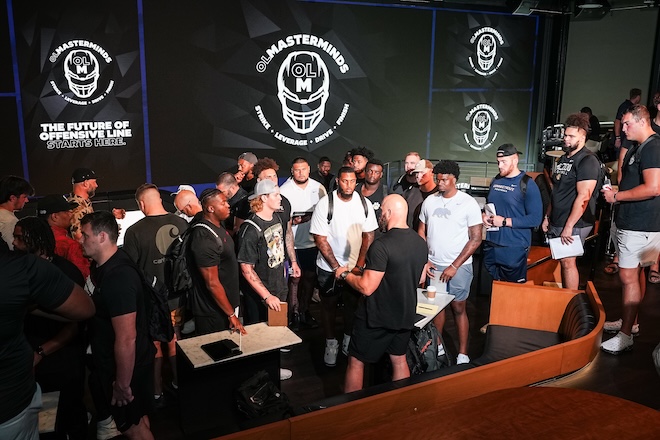 Lane Johnson and the football team as his alma mater, the University of Oklahoma.
For this final column, I wanted to share something really special with you — insight from my own mental performance coach, Brian Cain. Brian is an international bestselling author and arguably the sports world’s most sought-after speaker and mental performance coach. I met him through my trainer, Gabe Rangel, who I wrote about in this column a few weeks ago.
Brian’s clients include coaches, athletes, and teams at the Olympic level, in Major League Baseball, the NFL, NBA, NHL, UFC and on The PGA and LPGA Tour. His resume boasts a list of Hall of Fame athletes including four MLB Cy Young Award winners, a Heisman Trophy winner, eight UFC World Champions, World Series and Super Bowl champions and over 1,000 professional sports draft selections.
When I say this guy changes lives, I don’t say it lightly: He has dramatically improved my mental health and my performance on the field. And while Brian works with the world’s top athletes, the coaching he offers can help anyone — in parenting, the workplace, relationships. See what he has to say to y’all here, then check out his podcast, books, and website for more.
Interview has been edited for clarity and length.
Thanks so much for all you’ve done for me and so many of my friends, Brian. If you were talking to someone who’s not a professional athlete, where would you start?
Well first I have to say that the best part about being a mental performance coach and working with people like you, Lane, is how much value I get from learning from elite athletes — so thank you. Now, one of the first things I would say to anyone is that fear and confidence are not mutually exclusive — you can have fear and be confident at the same time. And you’re a great example of that. Philly-born UFC star Sean Brady is an example of that. And the UFC world champion for 10 years, Georges St.-Pierre, is also an example.
Most people look at athletes like you and think oh they must be bullet-proof, they must be superhuman. And, yes, you’re all exceptional at what you do — but you’re also human! The difference is that you know that mental performance is trainable. You understand a couple key things: that confidence and fear can live at the same time, and that motivation comes after movement begins. That’s a big, big mistake that people make — especially around this time of new year’s resolutions. People think I don’t feel motivated, so I can’t get started. No! You’re gonna feel motivated when you get started. But you will need to be like a rocketship taking off: You’re gonna have to use more fuel at the start. So know that going in; know that it’s the start that stops most people.
“Man, that one conversation where you helped me shift my mindset from what I couldn’t control to what I could control, it didn’t just save my career — it saved my life.”
You’ve helped me see that fear doesn’t have to hold me back — it can be fuel. Elaborate, please.
Fear sharpens your senses. Fear allows you to go to a level you can’t get to without it. And fear is what keeps you humble in the preparation process so that you can be confident in the performance process. The best athletes I’ve been around have a level of what I call humble confidence. You are all so humble in day-to-day life, but you have the confidence to know that when you are prepared, you’ll be at your best. To bring it back to fear, fear drives you to prepare, it drives you to want not to let people down. Fear surfaces around things that we care about — and it’s good to care! It can be a very healthy motivator. It’s important to be able to look at fear and change your relationship with it to say that means I care, that means I’m passionate about what I do but I still have to go act and execute.
And I think this takes us to our next point which is you do confidence, you don’t feel confident. And doing confidence comes down to what I call B-F-S:
Your body language, your focus, your self-talk. Anyone from my three-year-old daughter to a 30-year Major League Baseball player can feel that if you carry yourself small, you’re gonna start to feel small. You’re going to start to get that increase in cortisol, that decrease in testosterone.
There’s a phenomenal TED Talk by social psychologist Amy Cuddy from Harvard on presence. In her book, Presence, she talks about the power of body language and expansion and what that does for you. So when you’re walking in to take that SAT test as a high school student, you gotta walk into that room big — you gotta pull your shoulders back, put your eyes on the horizon, and walk in there big. However prepared you are, that’s how prepared you are — but let’s walk in and give it our best by having big body language. And that then brings us to my next key principle: focusing on what you can control, versus what you can’t.
Yes! Talk more about that.
Ok, I’ll start with an example. An NFL player confided in me that he wasn’t sure he wanted to play football anymore because he thought he had some mental health challenges. I said, Let’s see if it’s mental health, or mental performance. I told him to grab a piece of paper and draw a line down the center. And I wanted him to list on one side everything he can control, and on the other side everything he can’t control. I did this with you, too, Lane. This player lists the stuff he can’t and the stuff he can. And I said, What percentage of the time are you focused on the stuff you cannot control? And he realized it was 95 percent! I told him You don’t have a mental health issue — you have a focus issue. You’re focused on the things you cannot control: the media, what’s gonna happen at the end of the year, if you’re gonna get a contract extension, the fact that your team’s not winning, what your coaches think, what the other players’ wives think. You can’t control any of that. You can’t control what your teammates do, you can only control how you play.
The guy goes out and plays, he’s one of the best offensive lineman in the next six weeks, and he’s got a two-year deal with another team and he’s made probably $20 million in the last two years! He’s gonna be an All-Pro this year and sign a life-changing free agency in this off season! It’s been three years since that first conversation; we talked yesterday and he said, Man, that one conversation where you helped me shift my mindset from what I couldn’t control to what I could control, it didn’t just save my career — it saved my life.
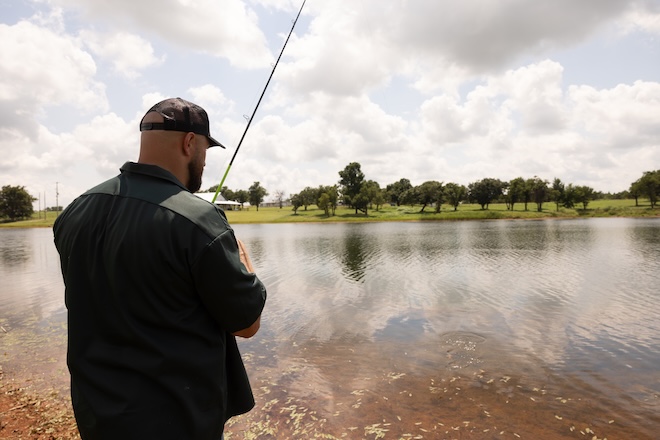 Lane Johnson enjoying the great outdoors
That’s profound.
That’s the power of focus. ’Cause where your focus goes, energy flows. So if you’re focused on something you cannot control, you’re basically throwing your energy into a drain. If you focus on what you can control, you’re putting more energy towards a productive focus.
I know no one likes to hear this, but I truly believe that the biggest challenge to anybody’s focus, whether you’re a high schooler, a parent, or a pro athlete, is getting pulled out of the present moment with our phones. With every one of my clients, I ask what’s one of the biggest inhibitors to you being present with your spouse? They all say: my phone. I’m on my phone in bed, on my phone at dinner.
So set some boundaries for yourself and honor them! Such as no phone in bed. That’s the Bobby Witt Jr. rule. I’ve coached Bobby since he was a freshman in high school — he won the Major League Baseball batting title two years ago, and he’s arguably the best player in baseball not named Judge or Ohtani, and one of the biggest things we worked on two years ago was hey, man, no phone in bed. Because the compound effect of no phone in bed is I go to bed earlier, I get better sleep; when I get better sleep I wake up more refreshed. When I’m more refreshed I have a better attitude. When I have a better attitude, I actually play better. When I play better, everything else will kind of fall into place. I’m more resilient, I can handle more stress and pressure.
1 percent of your day is 14 minutes and 24 seconds. You make a 1 percent better plan, and you invest 14 minutes and 24 seconds of your day into some area that you want to improve.
Talking about phones and distractions brings me to mindfulness. Tell folks how you’ve helped me and others embrace it.
I think we first have to define what mindfulness is. To me, mindfulness is mind-fully-in-the-moment of what I’m doing. Anybody who has ever read a book and read three pages and gone I have no idea what I just read, that’s obviously not mindfulness — that’s mindlessness. And the way that we train present moment focus, also called mindfulness, is through meditation. The simplest thing is if you close your eyes, and inhale for 6 seconds, hold for 2, and then exhale for 8; we call that a 6-2-8 breath. Trevor Zegras on the Flyers, during the national anthem he will do 6-2-8 breathing.
But mindfulness doesn’t have to be passive, sitting down, breathing — mindfulness can be I’m present with reading, mindfulness can be the way I play with my children, mindfulness can be I’m walking. An exercise in mindfulness for me is working. Like this interview, just being completely connected to what I’m doing.
You’re always doing one of two things: You’re either training discipline or distraction. Am I training discipline by being totally connected to what I’m doing, or am I training distraction by being on a Zoom call, music playing, checking email when I’m not talking? That’s training distraction. You’re either training what I would call deep work, or shallow work. One of my favorite books, Deep Work, is by Professor Cal Newport — it’s about structuring your environment to facilitate deep work versus shallow work.
These are all such practical tips — anyone can do them. Can you share some of the other key mindsets we talk about in our work?
Well, you know I embrace compete don’t compare. Comparison is the thief of all joy! When you learn to just compete with yourself, to be the best version of yourself and give everything you have to win that day, everything else takes care of itself. But when you play the comparison game, you’re gonna lose all the time. And working in the world of professional sports, it can feel like your whole job is a comparison! Did I beat that guy? Am I bigger than that guy? Am I faster than that guy. You know firsthand that it causes a lot of mental health stress among players in the NFL. The world around you is gonna do that, but you can’t do that. You have to just compete with yourself to be the best version of you.
Love that. I know you have more for us — go on …
Another one that’s so important is this idea of execution over expectation. People set the wrong types of expectations. Expectations around behavior? Ok. Expectations around how I’m gonna get said outcome? Out of your control. So set the expectation the right way, around the behavior and what you can control. Setting an expectation that you’re gonna get a certain outcome is just gonna create more pressure than it is good.
And of course, there’s the one you articulated so well to me, Lane: Action alleviates anxiety. Every player I’ve worked with in college football or the NFL has said when we play those late Sunday night games, at 7 o’clock, 8 o’clock, sitting around all day, drives me crazy. That’s why structure is so important. The structure of your daily routine allows you to get into action more quickly. It allows you to get started more quickly with less friction up front. So the more routine-oriented you are, the easier it is to get started, and as you get started you get that action going, it alleviates the anxiety and you get into a better place.
You know I’m a big proponent of structure and routine — to the point where I sat down this past weekend and I time-blocked every block on my calendar for the entirety of 2026. My calendar is time-blocked with no open space, until January of 2027. And the reason I do that is because I want to be really intentional with my time. I do four things: fitness, family, coach, and create. So this interview would be considered creation. And if it’s on my calendar, it’s literally color-coded for when I’m going to sleep, when I’m exercising, when I’m with my family, when I’m coaching, when I’m creating. Because if I don’t put it on there, then I’m gonna fill it with something and I don’t want to fill it with, something that is a request of someone else — and I want to fill it with the intention that I become the best version of me and what I want to do, like being a present parent to my three-year-old and two-year old.
That’s the power of focus. ’Cause where your focus goes, energy flows
For 2026, I want to stop traveling and saying yes to everything, so that I can say yes to my kids at home. Because every time you say yes to something, you’re saying no to something else. I get excited easily and end up saying yes to things — but then I’m like, aw man, I shouldn’t have said yes to that but I can’t go back on it now. So I use an affirmation — affirmations help you create the mindset that you want in advance, so that you become that person — and the affirmation I’ve created is to say, I say no upfront to create more time affluence. Strong affirmations create the mindset that you need in advance until that mindset becomes a part of your identity and who you are.
I’ll share this one with you too: On November 23, 2023, I got sober. And the affirmation I had to send to my own mental performance coach was I’m a loving and serving husband and father and a world-class mental performance coach who doesn’t drink alcohol. I sent that to him every day. With each passing day it was like a hairline filament that turned itself into a strong cable. When I first started saying that upfront I’m like eh, that’s not me. That’s not me. And then over time, it was like any other set of reps: strength training relies on consistency. Now, two-plus years later, that’s me. And it was the best decision I’ve ever made. I sleep better, I eat better, I’m more present. I just stopped poisoning myself. It’s not like my drinking was egregious — but it got to a point where it didn’t serve me anymore with two kids. I wanted to be a better version of me and not run out of time.
And there are only two ways to get ahead: say no to this, or say yes to that. Tom Brady shared that one time with me. Someone asked him, What is it you know now that you wish you knew when you were drafted out of the University of Michigan? And he said find out what’s good, find out what’s bad — do more good, less bad.
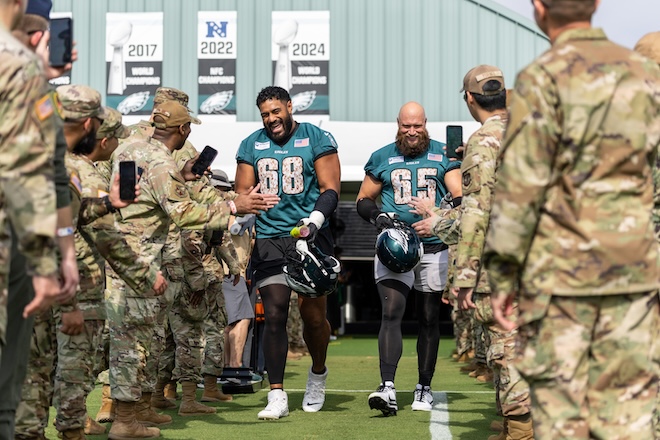 Jordan Mailata (left) and Lane Johnson greet service members.
Wise words, man. Let’s talk about the idea of always be growing. You know I like to have a white belt mentality, a beginner mindset that I can always be growing, that we’re never done, no matter how old we are.
And you know I agree: You’re either going through the motions, or you’re growing through the motions. And we want to be growing through the motions. And the way that happens is that one word: intention. Why am I doing this? One strategy I know you use for this is a success checklist— a list of behaviors that you will do or not do and hold yourself accountable to those, by creating KPIs or a scoreboard around that behavior. Anyone can do it. For example, did I make my bed? Did I have breakfast with my kids? Did I tuck my kids in at night, did I participate in bathtime, did I meditate today, did I journal today, did I make two outgoing sales calls today — whatever the behavior that you want, put it on a checklist, and you increase awareness, and awareness is the first step to growth.
The second thing I would say is that a lot of people talk about getting one percent better. One of my books is actually called One Percent Better. And it’s on this concept: We have to get out of the clouds and into the dirt. Meaning: I can’t just say I want to get better, I gotta get one percent better. Look, 1 percent of your day is 14 minutes and 24 seconds. So as we charge into 2026, we all know resolution are short and they die, so where do you get started? You make a one percent better plan, and you invest 14 minutes and 24 seconds of your day into some area that you want to improve. It could be walking. It could be reading. It could be meditating. It could be journaling. It can be 14 minutes and 24 seconds with your kids without your phone. It can be 14 minutes and 24 seconds sitting with your spouse without your phone. It can be 14 minutes and 24 seconds of organizing your house or your office or your life. It could be 14-24 of calling people who you love who you haven’t talked to or have fallen out of relationship with. Whatever your 14-24 is is up to you to decide, but if you want to grow, it has to be intentional, it has to be measurable, and it you have to get started. So let’s get started by getting 1 percent better.
Thanks so much for all of this, Brian. Is there anything else you want to add?
Yeah, I just want to say that your openness and sharing your experience has impacted so many people, me included. Folks look at you, Lane, and see a behemoth of a man, a Hall of Fame-destined football player — and you openly talking about your mental health challenges and the strategies that you’ve used to work through those challenges has saved more lives than we’ll know. Your commitment to meeting with the families of fallen soldiers, it’s just — you use your platform for good, to make a difference in the world. And as good of a player as you are — and you are arguably one of the greatest offensive linemnen of all time — you’re an even better human being. I wish more professional athletes and people in positions of influence would pay attention to what you’re doing and I wish more people had the selfless heart that you have to make an impact in the world.
That means so much to me — thank you for your encouragement and guidance. And as we head into the playoffs: Let’s go, Birds!
 MORE FROM LANE JOHNSON’S SEASON OF STRONG MENTAL HEALTH
Photo courtesy of Lane Johnson.