
Lucio Vasquez / Houston Public Media
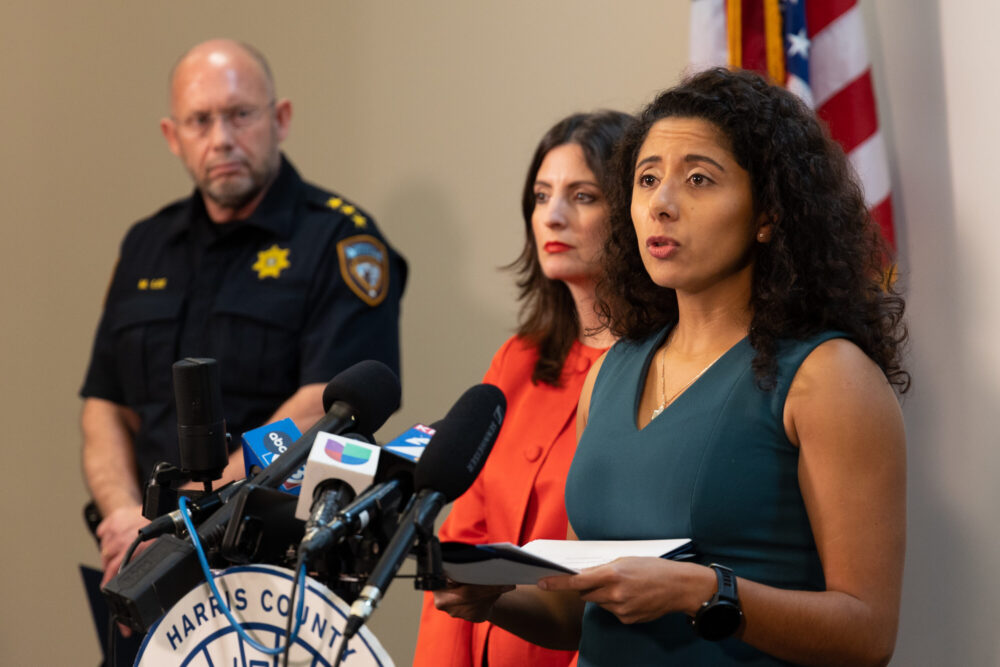
Harris County Judge Lina Hidalgo speaks about the expansion of the county’s Jail-Based Competency Restoration program at the Harris Center for Mental Health and IDD on Feb. 9, 2023.
Harris County commissioners on Thursday directed some of the county’s top criminal justice officials to work on bolstered initiatives to divert more defendants away from jail and into mental health treatment programs.
The commissioners’ vote directs the county’s Criminal Justice Coordinating Council to return before the 2027-2028 county budget season with funding proposals on mental health diversion initiatives.
The council — which is composed of elected officials, public defenders, and some of the county’s top law enforcement officials — previously discussed expanding front-end mental health diversion through the county’s diversion center during a December meeting. They also discussed exploring a mental health expansion pilot with the district courts, according to documents obtained through a public information request.
Sign up for the Hello, Houston! daily newsletter to get local reports like this delivered directly to your inbox.
Harris County Judge Lina Hidalgo’s motion came before commissioners unanimously approved a $7 million proposal to hire more than 100 additional detention officers for the county jail — a move needed to maintain a state-mandated ratio of detention officers to inmates. About 300 inmates in the custody of the Harris County Sheriff’s Office who were outsourced to a private jail facility in Mississippi were recently returned to the county after one of its outsourcing contracts ended — shaving about $4 million off the county’s costs.
Before commissioners approved the funding request, Hidalgo raised concerns about a staggering number of pre-trial defendants in the jail being flagged for mental health conditions, echoing a sentiment shared during a public comment portion of the meeting earlier in the day. She said the money the county has saved by ending outsourcing contracts should be used for mental health initiatives.
“What I would like to hear is yes, it’s awful what’s happening to these families, yes, we have too many people in the jail who have mental illness who, by being in the jail, are being put at risk unnecessarily, and we are going to see how we can use some of the savings to keep those people out of the jail,” Hidalgo said.
Seventy-three percent of inmates in the jail are currently taking psychotropic medication, according to county data, while 77 % have been flagged with mental health indicators.
The discussion on Thursday also came as a second lawsuit was filed in federal court this month against Sheriff Ed Gonzalez, asserting a Harris County Jail inmate suffered from delusions and was unable to advocate for himself before dying inside the jail.
Sheriff’s office assistant chief Phillip Bosquez said that the Harris County Jail is the largest in the country to maintain a correctional health care accreditation, and far exceeds the minimum standards set out by the state.
The jail has, however, remained out of compliance with the state’s minimum jail standards since last year. A recent state inspection found deficiencies with fire control panels and issues with providing timely medical services to inmates.
“We never shoot for the minimum standard,” Bosquez said. “And so, these thousands of inmate patients that are here, they get better care than they get in the community. They come in in various states, and our medical and mental health professionals stabilize them and get them up and going.”
The newly approved funds for additional detention officer positions will go to cover supplemental required supervision areas, he said.
In continued efforts to alleviate jail overcrowding, Harris County District Attorney Sean Teare and other county officials have touted diversion programs aimed at steering low-level offenders away from incarceration.
RELATED: The Harris County Jail population has declined this year. Will the trend continue?
Commissioners in the past have discussed building a new mental health-focused facility to alleviate jail overcrowding and address medical health needs in the jail. Last year, they authorized another feasibility study that would address the jail’s aging infrastructure and capacity issues.
“The jail is stuffed full of people, and it will be for the foreseeable future,” Jesse Dickerman, an interim county administrator, said. “I don’t think we have come up with really good, right now, things to do to make the jail a much better place. I think we think of them more realistically as medium and longer-term solutions — new facilities that better handle people with mental health issues.”