
ROCHESTER — During the third day of a civil trial between Dr. Michael Joyner and Mayo Clinic, the president of Mayo Clinic Platform faced questions about calling Joyner mentally ill as he dealt with complaints about Joyner from corporate partners.
Dr. John Halamka, who was hired to run Mayo Clinic Platform in January 2020, was called to the stand by attorney Samantha Harris, who represents Joyner in his case alleging retaliation by Mayo Clinic.
Joyner, an anesthesiologist and physiologist who has worked at Mayo Clinic since 1992, filed the case against Mayo Clinic in response to two disciplinary actions that he believes were “weaponized” retaliation for his speaking out about MITRE Corp. repeatedly trying to access private patient data via back channels.
MITRE, a nonprofit with interest in defense, aviation, cybersecurity and health care, was not involved with Joyner’s federally funded research into convalescent plasma treatment of COVID-19 during the worst of the pandemic. Mayo Clinic did formally sanction MITRE for its actions in September 2020.
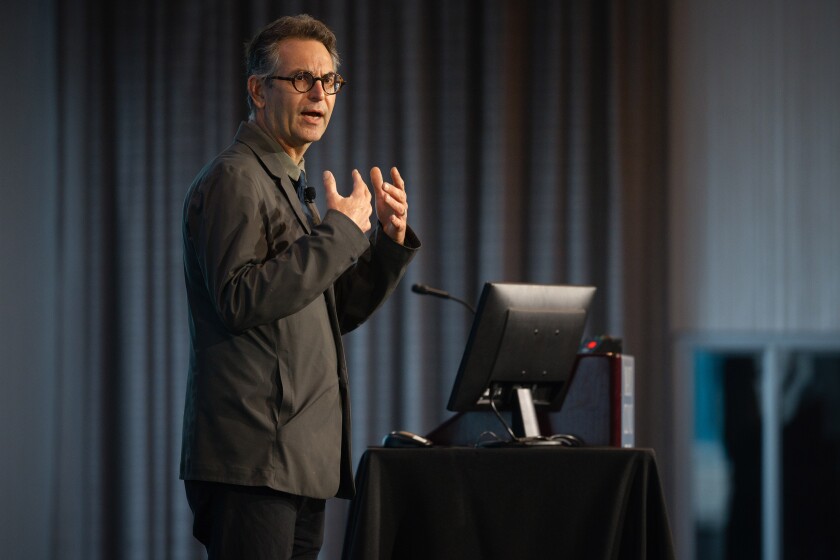
Dr. John Halamka, president of Mayo Clinic Platform, speaks during the Mayo Clinic 2024 AI Summit on Monday, July 8, 2024, at the Hilton Hotel in downtown Rochester.
Joe Ahlquist / Post Bulletin
Denying retaliation, Mayo Clinic counters that Joyner was punished for repeated unprofessional behavior toward coworkers and companies working with the Clinic.
The Olmsted County jury trial in Judge Kathy Wallace’s Third Judicial Court room started Monday. The case is expected to take about 10 days.
As the COVID-19 pandemic progressed, Halamka began to work with two groups — COVID-19 Healthcare Coalition and The Fight is in Us.
His efforts with those groups were not part of his duties at Mayo Clinic. However, many of the members of those coalitions, like MITRE Corp., Epic, the Lasker Foundation and the Gates Foundation, were interested in Joyner’s nationwide Expanded Access Program (EAP) for Convalescent Plasma. When representatives of those groups or Mayo Clinic colleagues were frustrated by Joyner, they often messaged Halamka about the issues. Halamka was not involved in Joyner’s EAP project, nor was he part of Mayo Clinic’s human resources.
“All of this information was inbound to me as a convener and a facilitator,” he testified on Wednesday.
While Halamka said such complaints were sent to him weekly, a blizzard of messages hit his email inbox and phone on Friday, June 19, 2020, set off by a 3:40 a.m. Joyner text sent to MITRE’s then-Chief Digital Health Physician Brian Anderson about MITRE attempting to access private patient data.
“It would be a grave error for you, John H., MITRE or the coalition to attempt to hijack our data,” wrote Joyner to Anderson in the early morning text. In turn, Anderson texted Halamka, whom he considers a mentor. His text to Halamka was that “Joyner is crazy” and that he felt unsafe due to this “personal threat.”
Joyner then sent a similar “grave error” email to Halamka, Mayo Clinic CEO Gianrico Farrugia and Dr. Scott Wright at 5:51 a.m. with the subject line, “whatever is up at FDA.”
By the end of the day, dozens of Mayo Clinic doctors and administrators were discussing Joyner and his message via email, text and telephone.
Halamka sent an email to Farrugia at 6:32 a.m. with the lead line of “something above my pay grade and an area that is controversial for me to even mention.”
He then wrote that in his first few months “serving as a diplomat for Michael Joyner” that he had come to believe Joyner suffered from “some variant of oppositional defiant disorder or mania.”
With Halamka on the stand Wednesday, Harris, Joyner’s attorney, asked if Halamka was a psychiatrist, and he responded no. However, he said, as an emergency room physician he is trained to deal with people who are having emotional challenges. His observations about a patient could lead a psychiatrist to make a mental illness diagnosis.
In his message to Farrugia, Halamka wrote that he had changed his diagnosis of Joyner to borderline personality disorder after witnessing symptoms such as unstable relationships, shifting self-image, impulsive and self-destructive behaviors, extreme mood swings and explosive anger.
Harris asked Halamka if he had seen Joyner behave impulsively, such as racing cars or gambling.
“The impulsive behavior I was referring to is making threats to individuals. … The term ‘grave error’ is not a typical English sentence that I or many of my colleagues would use in writing,” he answered.
Halamka ended his 6:32 a.m. email to Farrugia by writing, “I will keep you informed, but from my years of treating borderline personalities I know that you can never fix them.”
Joyner’s attorney asked Halamka if he believed this was a professional and respectful way to discuss a colleague.
“Brian (Anderson) used the term ‘crazy,’ not a term I would use, because that does not feel objective and respectful,” he said. “I believe he had borderline personality disorder and that is an objective statement.”
Farrugia forwarded Halamka’s email about Joyner to Mayo Clinic’s then-Chief Administrative Officer Jeff Bolton at 7:04 a.m. with the additional message, “Did not take him long.” Bolton responded, “And a very accurate diagnosis. Now what do we do, especially as his work becomes more and more important?”
The broader discussion among Mayo Clinic leaders on June 19, 2020, about Joyner went beyond the “grave error” email to include his demand that week for more money. Joyner said Mayo Clinic was asking him to lead a for-profit startup creating an injection treatment in addition to the EAP research, thus he needed more compensation. Mayo Clinic disputes that and states Joyner wanted money from the federal grant to fund EAP or he would walk away from the lifesaving research he was conducting.