
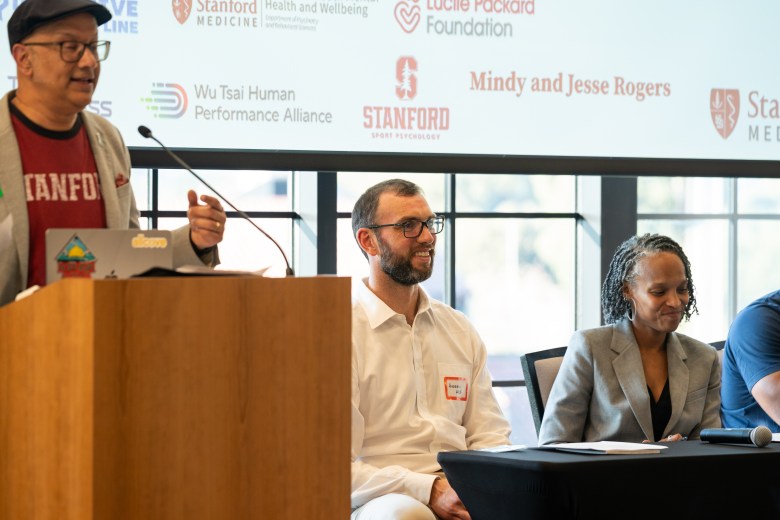
 Stanford Football general manager Andrew Luck, center, at “Youth Sports and Mental Health: A Super Bowl 60 Panel Discussion” at Escondido Village Building C on Stanford’s campus on Feb. 4, 2026. Photo by Seeger Gray.
Editor’s note: Resources for any person who is feeling depressed, troubled or suicidal are listed at the bottom of this article.
Solomon Thomas, Dallas Cowboy defensive tackle and former Stanford Cardinal, wants to “reverse the script” around mental health.
Thomas wasn’t always open with his emotions, he said, but after his sister died by suicide, he and his parents founded the Defensive Line Foundation, a suicide-prevention nonprofit that hosts workshops in an effort to destigmatize mental health and save young lives.
“I’m learning how to live, learning to be unapologetically myself, feeling my feelings because I’m feeling them for a reason, knowing it’s okay not to be okay. … I’ve learned all these things through my journey in mental health,” Thomas said during a Wednesday panel at Stanford that focused on mental health in sports.
The National Football League and Stanford University hope the message will break through.
With the region preparing for the biggest football game of the year this Sunday, the university hosted about 100 parents, students, coaches and athletes for a panel that was hosted by Stanford Medicine, the NFL and local mental health leaders among many others to amplify a message – local young people are not alone.
“These meetings are the meetings that save lives,” Thomas said.
Event organizers used the upcoming Super Bowl as a catalyst to discuss the intersection between sports, well-being and stigmas surrounding mental health and suicide-prevention. The NFL has amplified its efforts over the past year to bring attention to mental health challenges among football players, holding panels with mental health experts before several games earlier this season as part of the league’s second annual Raise Awareness for Mental Health Campaign. The issue has also attracted more media scrutiny, with ESPN conducting a survey last year that found that about half of the players who played in the 1988 season reported feeling depressed in the prior 12 months, compared to a quarter of men their age.
The issue holds particular resonance in Palo Alto, which is currently in midst of its third youth suicide cluster, a period in which numerous deaths occur over a short period of time, according to Stanford health experts. A student death earlier this week amplified the need for discussion with school leaders and community advocates.
And just last week, Stanford University announced a settlement with the family of Katie Meyer, a star soccer player who died by suicide after learning that she would be facing discipline from the university. As part of the settlement, the university plans to launch an initiative focused on mental health and well-being of student-athletes at the Wu Tsai Human Performance Alliance, according to Stanford.
Speakers at the Wednesday event acknowledged the toll that the recent deaths have had on the local families, schools and the community at large.
“We also gather today in shared grief,” said Dr. Shashank Joshi, a psychology professor at Stanford University. “We have communities in the NFL, at Stanford, in Palo Alto, around the Bay Area, that have lost young people to suicide. And these losses touch each of us, neighbors, teammates, parents and friends. We acknowledge those individuals today and honor their lives behind the headlines.”
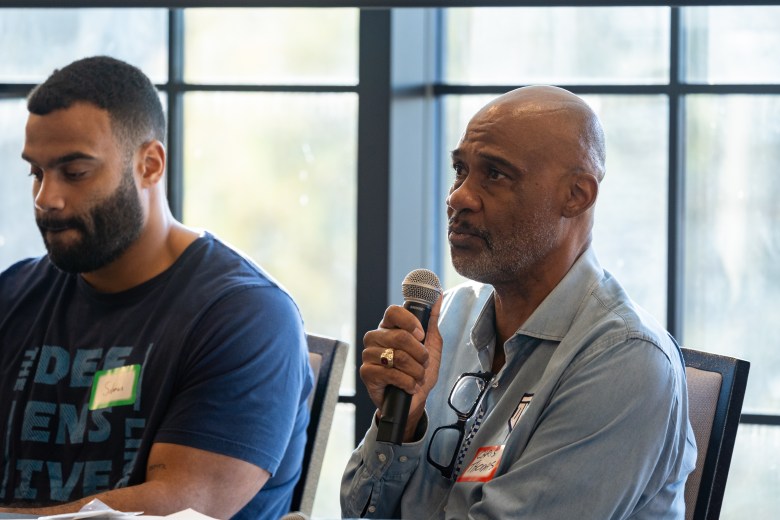 Chris Thomas, co-founder and CEO of The Defensive Line, speaks next to his son Solomon Thomas at “Youth Sports and Mental Health: A Super Bowl 60 Panel Discussion” at Escondido Village Building C on Stanford’s campus on Feb. 4, 2026. Photo by Seeger Gray.
More than a dozen speakers, including Stanford Football General Manager and former NFL quarterback Andrew Luck, 49ers linebacker Curtis Robinson and local athletes, spoke about the importance of asking for help, building community and sensitive media coverage.
Robinson, who lost a college teammate to suicide, said one way to support others is to be a good listener and trusted teammate in an environment that can be judgemental.
Today, local coaches and athletic leaders like Luck are trying to change the typical locker room experience.
“Psychological safety and the ability for our young men, especially in the locker room, to come in and feel a sense of belonging … is core and critical to where we think we need to go,” Luck said.
In conversations with Stanford University and Castilleja High School athletes, panelists recommended that people treat mental health like physical health and that students give themselves “grace” under pressure.
Katy Zhen, Castilleja tennis player and rising Stanford University freshman, said her increased competition level and training took a toll on her mental health. The fact that she was playing a solo sport only amplified the pressure of losing a match, Zhen said, so she decided to take a step back and reduce her expectations.
“That’s when I started really doing the best and playing the best I had in a really long time. … I was just doing it because I enjoyed it, and I wasn’t obsessing over my performance,” she said.
Throughout the panel event, volunteers offered students and parents information about local mental health resourcing such as teen center allcove Palo Alto, suicide media toolkit the Heard Alliance and the Trevor Project, a suicide hotline for LGBTQ+ youth.
The event was an opportunity for athletes and youth alike to show vulnerability.
“We’re here to use that moment to speak openly, to reduce stigma and ensure that young people know they are never alone, and if you’re worried about yourself or a friend, that there’s no shame in talking it out,” Joshi said.
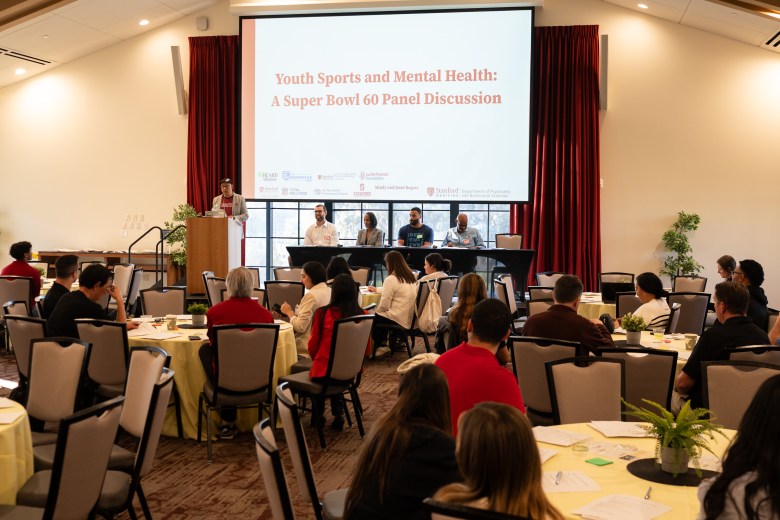 “Youth Sports and Mental Health: A Super Bowl 60 Panel Discussion” at Escondido Village Building C on Stanford’s campus on Feb. 4, 2026. Photo by Seeger Gray.
Help is available:
Any person who is feeling depressed, troubled or suicidal can call 988, the mental health crisis hotline, to speak with a crisis counselor. In Santa Clara County, interpretation is available in 200 languages. Spanish speakers can also call 888-628-9454. People can reach trained counselors at Crisis Text Line by texting RENEW to 741741
Most Popular