

Introduction
Among a range of duties, the Department of Behavioral Health and Developmental Disabilities (DBHDD) operates five state psychiatric hospitals, provides evaluation and treatment for individuals under the jurisdiction of the court system to determine their competency to stand trial and provides community-based services to Georgians living with mental health conditions, substance use disorders and developmental disabilities.
Governor Kemp’s proposed Fiscal Year (FY) 2027 budget proposal provides DBHDD with almost $1.7 billion in state funds, including about $1.67 billion in state general funds and about $10.3 million in tobacco settlement funds.[1] The proposal decreases DBHDD’s state funding by $27.5 million, or almost 2%, below the original FY 2026 budget. That decrease is largely driven by the statewide reduction in the employer contribution rate for the State Health Benefit Plan; DBHDD’s services and supports for Georgians are not impacted. Notable programmatic funding increases would expand supportive housing for individuals with serious mental illness as well as move more individuals with developmental and intellectual disabilities off of the almost 8,000-person waiting list for home- and community-based services.
Proposed Budget Reflects State’s Desire to Exit 2010 Settlement Agreement with Department of Justice
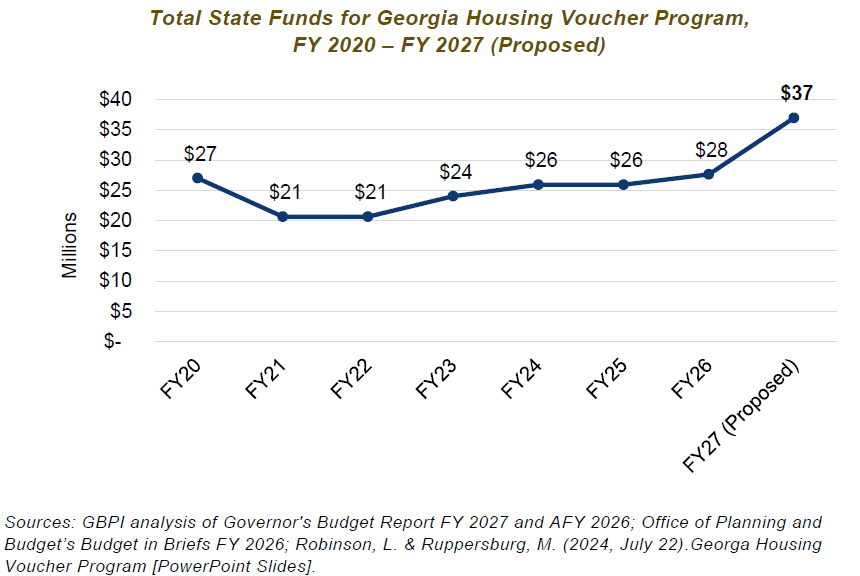
At the January 21, 2026 joint appropriations committee hearing, DBHDD’s Commissioner Tanner announced that the state has filed a joint motion with the Department of Justice and Independent Reviewer that seeks to end the behavioral health provisions of the 2010 settlement agreement.[2] The 2010 settlement agreement was intended to address an earlier lawsuit brought against the state that found, in violation of the Americans with Disabilities Act and the Supreme Court’s Olmstead decision, individuals with mental illness and developmental disabilities were unlawfully segregated from society and held in the state’s psychiatric hospitals rather than being provided community-based services.[3] Among the settlement agreement’s provisions was the requirement that Georgia provide supportive housing and wraparound services to 9,000 individuals with serious and persistent mental illness at risk of or currently experiencing homelessness.[4] If approved, the joint motion will release Georgia from the existing behavioral health provisions (but not the developmental disabilities-related provisions) and be replaced with one single provision to house 537 individuals in supportive housing.[5] The proposed FY 2027 budget includes $9.3 million to fund 404 additional Georgia Housing Vouchers slots to help meet that new provision. Investing state dollars in cost-effective strategies like supportive housing can relieve pressure off hospitals and jails, improve child welfare outcomes and allow struggling Georgians to break the cycle of homelessness.[6] Regardless of the future of the 2010 settlement agreement, it is critical that Georgia continue moving toward a future where Georgians with mental health conditions and developmental and intellectual disabilities can live with dignity and autonomy in their own homes and communities.
Budget Highlights
Amended Fiscal Year 2026 Budget
$21.6 million increase to provide one-time $2,000 salary increases for full-time DBHDD employees
$20.7 million increase (non-DBHDD line item) for the Georgia State Financing and Investment Commission to fund a 40-bed forensic restoration facility at East Central Regional Hospital in Augusta[7]
Georgia’s judicial system is experiencing an increase in both juvenile and adult defendants found incompetent to stand trial due to mental health concerns; this new facility would allow DBHDD to expand its jail-based restoration program in order to help move Georgians out of jail and receive the evaluation and treatment needed to stand trial[8]
Fiscal Year 2027 Budget
$45.5 million decrease to reflect a reduction in the employer contribution rate for the State Health Benefit plan for DBHDD employees
$9.3 million increase to add 404 additional slots for the Georgia Housing Voucher program in order to achieve compliance with the 2010 settlement agreement
$5.5 million to expand home- and community-based services for individuals with intellectual and developmental disabilities, including annualizing the cost of 150 existing and adding 100 new slots for the NOW/COMP waiver programs
Currently, there are 4,505 individuals enrolled in NOW services, 9,789 individuals enrolled in COMP services and 7,891 Georgians on the ‘planning’ list[9]
$5.3 million increase to support the ‘988’ hotline, a free and confidential number for Georgians experiencing suicidal ideation or other mental health concerns, as well as funding to support the mobile crisis services dispatched for those Georgians who reach out and need in-person support
The 988 hotline staff handles an average of 1,000 calls, text or chats with Georgians per day; however, the hotline saw concerning increases in rates of call disconnections and calls re-routed to out-of-state counselors in 2025[10]
Endnotes
[1] Governor’s Office of Planning and Budget. (2026, January). The Governor’s Budget Report, AFY 2026 – FY 2027. https://opb.georgia.gov/budget-information/budget-documents/governors-budget-reports
[2] Georgia Department of Behavioral Health and Developmental Disabilities. (2026, January 21). DBHDD announces joint filing requesting release from 60+ provisions of 2010 Olmstead settlement agreement. [Press release]. https://dbhdd.georgia.gov/press-releases/2026-01-21/olmstead-settlement-release-request
[3] United States Department of Justice. (2010, October 19). Justice Department obtains comprehensive agreement regarding the state of Georgia’s mental health and developmental disability system. [Press release]. https://www.justice.gov/archives/opa/pr/justice-department-obtains-comprehensive-agreement-regarding-state-georgia-s-mental-health
[4] Dong, H. (2025, February 7). Overview: 2026 fiscal year budget for state housing programs. Georgia Budget and Policy Institute. https://gbpi.org/overview-2026-fiscal-year-budget-for-state-housing-programs/
[5] Georgia Department of Behavioral Health and Developmental Disabilities. (2026, January 21). DBHDD announces joint filing requesting release from 60+ provisions of 2010 Olmstead settlement agreement. [Press release]. https://dbhdd.georgia.gov/press-releases/2026-01-21/olmstead-settlement-release-request
[6] Corporation for Supportive Housing. (2025, October 16). Supportive housing evidence briefs: Summary of outcomes. https://www.csh.org/wp-content/uploads/Evidence-for-Supportive-Housing-Brief-CSH-2025.pdf
[7] House Bill 973, as passed by the House.
[8] Tanner, K. (2026, January 21). Department of Behavioral Health and Developmental Disabilities budget overview [Testimony for Joint Appropriations Committee starting at 18 minutes]. https://www.youtube.com/watch?v=PaNTtq8ks94
[9] Ibid.
[10] Miller, A. & Grapevine, R.. (2026, January 28). When suicidal calls come in, who answers? Georgia crisis line response rates reveal gaps. KFF Health News. https://www.nytimes.com/2019/03/22/health/memory-forgetting-psychology.html