
Macomb County Community Mental Health officials have been deploying their Mobile Crisis Team more often for those, especially children, in a mental health crisis in the past couple of years due to a rising need and reduced stigma.
“More and more people are in crisis, and we have seen an increase in calls to our call center,” said Elizabeth Vutci, director of Community and Behavioral Health Services for Macomb CMH. “More people are in crisis based on things that have been occurring, whether it’s in the world or in your personal life. People are needing more support. The stigma is being reduced … so people are reaching out more or seeking that support more than they would have in the past.”
Part of the increase can be attributed to CMH “doing a lot of outreach in the community to make people aware and to let people know we are here to help and support them,” she said. “Advocacy groups have been doing a lot work, too, to reduce the stigma, to make people aware, do outreach to people so they feel comfortable in getting the help.”
Vutci said the COVID-19 pandemic had an impact.
“Some people saw a huge increase in anxiety; some kids experienced an increase in behavioral difficulties,” she said. “Schools may have seen that same thing. There wasn’t anybody who wasn’t untouched by some of that. This is what the world looks like in post-COVID. COVID led to a lot of isolation for people.”
Vutci said people being on social media “could contribute to anxiety.”
“Social media can skewer your thinking because you feel you’re trying to keep up with somebody, and you’re not able to,” she said. “And that may make you feel anxious or depressed. Social media definitely can have an impact on a person’s mental health.”
 Elizabeth Vutci, director of Community and Behavioral Health Services for Macomb Community Mental Health
MACOMB CMH PHOTO
The teams are separated into those for children and adults. They respond to people who request it over the agency’s 24/7 Crisis Line at 586-307-9100, which is available all day and night, every day of the year.
The Crisis Line received 19,443 calls last year, a 7.6% increase from 18,065 in 2024, according to CMH officials.
Callers who wish to consider whether they receive a visit from a crisis team are referred to it. The teams that go for a visit consist of a CMH case manager or therapist, and a “peer or parent-support partner,” someone who has experienced crisis themselves but are trained to work with those in crisis, Vutci explained.
“It’s always a two-person team that goes into the community,” she said. “We will go to wherever the person is in the community. For children, it may be in school or in the community at the family home or grandma’s home.”
The Children’s Mobile Crisis Team started in 2016 while the adult unit started 18 months ago, Vutci said.
In both the child and adult units, if there are multiple people involved, such as a child’s parent or adult’s spouse or boyfriend or girlfriend, the team may separate the two people to try to defuse the situation and “work through whatever the issue is with both of them,” she said.
The mental-health experts “resolve the immediate crisis and assist and develop a safety plan or crisis plan for those individuals,” she said.
For example, a child may be given a “sensory activity” or talk to someone on the phone or write in a journal, or sometimes “the child goes and spends the night” elsewhere to allow the situation to “calm down,” she added.
CMH experts follow up with the people and continue to offer resources them, such as walk-in intake services.
In a “pretty rare” amount of time, law enforcement is contacted to respond and/or the person can be committed to a mental facility.
Among the best statistics in the state, MCCMH’s Children’s Mobile Crisis Team received 467 calls, 61% of which resulted in deployment. Of those, only 4% resulted in hospitalization and/or placement change.
The children’s unit received 467 calls last year and responded to 61% of them. In 2024, 506 calls were received, and it was deployed 70% of the time. In 2023,, there were 402 calls and a 68% response rate, according to CMHCMH.
The children’s unit last year had one of the best rates in the state for 4% hospitalization of children who are subject to a Crisis Team visit, officials said.
The mobile unit has increased the hours it can be deployed. The unit previously could be deployed 8:30 a.m. to 9 p.m. Monday through Friday and 10 a.m. to 6 p.m. Saturdays. Since last April, the unit is available around the clock every day of the year.
“We expanded it as part of our ongoing efforts to better serve the community,” Vutci said.
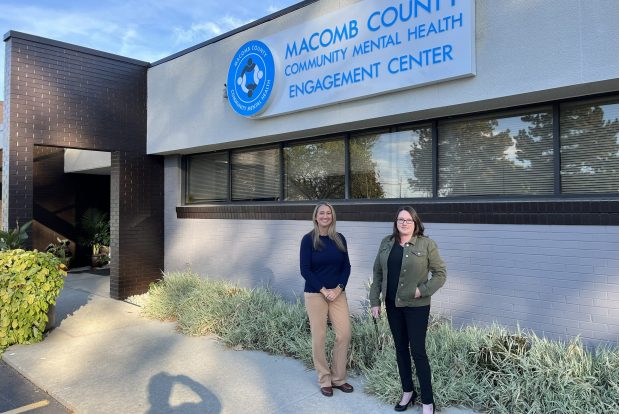 Nicole Gabriel, left, director of the Office of Substance Abuse in Macomb County, and Community Corrections Director Barbara Caskey stand in front of the county Engagement Center in Sterling Heights when it opened last fall for those in crisis due to substance-use disorder.
JAMESON COOK — THE MACOMB DAILY
For those whose behavior is due to substance abuse, CMH last year opened the Substance Use Engagement Center at 38300 Van Dyke, Suite 101, in Sterling Heights. It is a short-term facility that provides a “supervised, supportive setting for individuals with substance use disorders” and serves as an alternative to an emergency room or jail, CMH says. Those who are accepted can have a meal and take a shower, officials said.
Macomb CMH also offers walk-in mental-health services for people who are in crisis and need to speak to someone immediately. Evaluations are available 8:30 a.m.-3 p.m. Monday through Friday at: MCCMH North, 43740 North Groesbeck Highway, Clinton Township (open until 5 p.m. Wednesdays), and MCCMH East, 25401 Harper Ave., St. Clair Shores.
Same-day or next-day appointments also are available for those facing a mental health crisis. Call 855-996-2264) between 8 a.m. and 8 p.m. Monday through Friday to schedule an appointment. For more details, visit Macomb County Community Mental Health.