
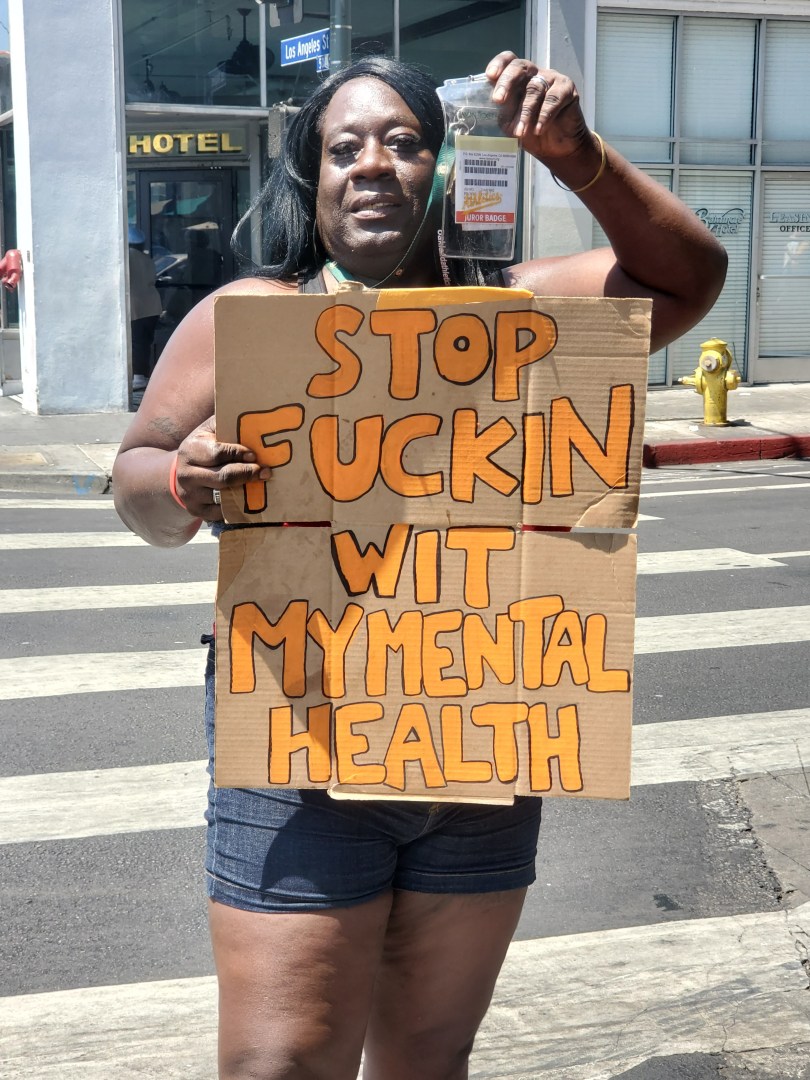
 A tenant from a Healthy Housing building danced at the “Love Rally” as she protested her landlord. (Photo: Mike Dickerson)
On a spring afternoon in Los Angeles, the kind where the sun lingers just a little too long over the sidewalks, an emergency call comes in. Someone is yelling in distress. A neighbor is worried. The situation is tense but not violent. For decades, this moment would have followed a single, unquestioned path: police dispatched, lights flashing, guns visible, authority arriving before understanding. In countless cases, that response escalated fear instead of calming it. For many Angelenos, especially Black, unhoused, disabled, and mentally ill residents, a call for help too often became a moment of danger. But this time, something different happens.
No sirens cut through the air. No squad car pulls up. Instead, a van arrives quietly. Two responders step out — clinicians trained in trauma-informed care, dressed in plain clothes, speaking gently. They introduce themselves. They listen.
They are not there to control the situation. They are there to care. This is not a pilot imagined in theory, nor a promise buried in a policy memo. This is Los Angeles in real time, a city experimenting with a radical idea that activists have been demanding for years: What if public safety didn’t begin with punishment? What if crisis response centered on dignity instead of domination?
To understand why this shift matters, it’s important to name what came before. For decades, the United States treated mental health crises not as medical or social emergencies, but as disruptions to be managed with force. Police departments quietly became the country’s largest mental health responders, not because officers wanted that role, but because no alternative infrastructure existed. The results were devastating. Nationally, people with untreated mental illness are far more likely to be injured or killed during encounters with law enforcement.
In Los Angeles, reporting has shown that nearly one third of LAPD shootings since 2017 involved someone experiencing a mental health crisis. These were not hardened criminals; they were people unraveling under pressure, trauma, psychosis, grief, addiction, or despair. Activists have long argued that this outcome was not a tragic accident, but a predictable consequence of asking armed officers to do the work of clinicians.
You cannot shout someone back into stability nor weaponize empathy. You cannot arrest trauma away. Yet for years, city leaders treated these deaths as unfortunate but inevitable the price of maintaining “order.” Community organizers refused that framing.
In 2024–2025, Los Angeles launched the Unarmed Model of Crisis Response (UMCR), a pilot program designed to divert certain emergency calls away from the LAPD and toward trained mental health professionals and peer responders.
The idea wasn’t radical because it was new, cities like Eugene, Oregon had been doing this successfully for decades. What made it radical was that Los Angeles, the nation’s second largest city with one of the largest police budgets in the country, finally chose to listen. The results were immediate and striking.
In its first year alone, more than 6,900 calls were diverted away from police.96% were resolved without any police involvement. Only about 4% required LAPD backup, usually due to safety escalation. Nearly one in five callers were connected directly to services, not jails. Response times averaged around 30 minutes, often faster than traditional psychiatric teams.
These numbers matter because they dismantle a myth that has shaped public safety for generations: that without armed authority, chaos will follow. Instead, what transpired was calm. What transpired was connection. What transpired was the quiet, revolutionary act of believing that people in crisis are still people not threats to be neutralized.
This Is Not “Soft.” It Is Smarter.
Critics often frame unarmed crisis responses as naive and too gentle for a city as large and complex as Los Angeles, but the data tells a different story. An unarmed response isn’t about being soft; it’s about being precise. It’s about matching the response to the reality of the situation. When someone is experiencing a panic attack, a psychotic episode, or emotional collapse, the presence of a gun does not increase safety, it increases fear.
Activists have been clear: police are trained to command compliance, not to regulate nervous systems. UMCR teams are trained differently. They know how to slow breathing, read body language, identify triggers, and stay present through emotional volatility. They don’t arrive with the goal of ending the call quickly. They arrive prepared to stay, sometimes for hours, because healing does not operate on dispatch timelines.
This distinction reveals something profound: much of what we call “public safety” has been structured around institutional convenience, not human need. UMCR challenges that at its root.
This transformation did not emerge from City Hall enlightenment. It came from pressure.
For years, grassroots organizers, abolitionist thinkers, disability advocates, and mental health workers demanded alternatives to policing. They testified at council meetings. They organized mutual aid, documenting harm. They forced officials to confront stories the city preferred not to see. Groups like LA Forward and community advocates reframed the debate entirely. Instead of asking “how can police respond better?” they asked the more dangerous question: Why are police responding at all?
That question shifted the conversation from reform to reimagination. When UMCR finally received a dedicated line item in the city’s 2025–26 budget, it marked more than funding — it marked ideological movement. The city was no longer merely experimenting, it was acknowledging that activists had been right. Still, organizers warned that a pilot is not justice. A pilot can be canceled. A pilot can be defunded. A pilot can be politically convenient without being permanent. Scaling became the next battleground.
Advocates argue that true transformation requires more than one program. It requires a continuum of care, a system that connects prevention, response, and long-term support. That’s where the integration of the 988 Suicide and Crisis Lifeline becomes crucial. Instead of funneling all emergencies through law enforcement, calls can be triaged to mental health professionals who understand the difference between danger and distress.
Field Intervention Teams can respond in plain clothes, without threatening presence, and connect individuals to follow-up care rather than abandoning them once the moment passes. This approach recognizes something deeply human: crises don’t occur in isolation. They are the product of housing insecurity, untreated trauma, substance use, loneliness, poverty, and a healthcare system that often disappears when people need it most. Sending police to the final moment of collapse does nothing to address what caused it. A continuum does.
On January 1, 2026, California implemented Senate Bill 43, the most significant update to mental health conservatorship law in decades. The law expands the definition of “grave disability” to include individuals unable to meet basic needs due to severe mental illness or substance use disorder. Supporters argue it fills long-standing gaps, allowing clinicians and families to intervene before someone deteriorates beyond recovery. Critics worry about coercion, surveillance, and the expansion of state power over marginalized bodies. Both concerns are valid, and that tension is exactly why community oversight matters.
SB 43 represents a crossroads. In a city still learning how to balance autonomy with safety, the law can either become a tool of care or another pipeline into institutional harm. Activists insist the difference lies not in the statute itself, but in who controls its implementation. Without community-led systems like UMCR, expanded conservatorship risks recreating the very harmful reform that was meant to undo. With them, it has the potential to intervene earlier with compassion rather than punishment.
Across Los Angeles, residents are already practicing the future. Mental health promoters reach culturally isolated communities long ignored by traditional providers. Neighborhood wellness walks in places like Inglewood transform healing into something collective, not clinical. Peer responders build trust where institutions failed.
These efforts rarely make headlines, yet they are doing the quiet work of repair showing that safety does not only come from policy, but from relationships. Activists understand something governments often forget: people are more likely to accept help from someone who understands their language, their history, and their fear. This is not charity, itis solidarity in practice.
Despite its success, the unarmed crisis response movement faces real threats. Federal funding streams that helped support behavioral health infrastructure are currently unstable, while dispatch systems remain fragmented. Coverage remains uneven across neighborhoods. Without expansion, the very communities most harmed by police-first responses risk being excluded once again. Supporters are pushing for citywide implementation by 2028, a timeline that would make Los Angeles one of the largest cities in the country to fully institutionalize non-police crisis response.
The question is not whether the model works, as the data has already answered that. The question is whether the city has the political courage to choose it.
Cities across the United States are watching. If Los Angeles, a city that is sprawling, complex, and plagued with inequity, can reduce police involvement in mental health emergencies without increasing harm, it undermines the argument that armed response is inevitable. It suggests something more unsettling for the status quo — that we always had a choice and simply refused to make it. Public safety, as activists argue, is not the absence of disorder. It is the presence of care.
At its heart, this movement asks a moral question, not a technical one.
When someone is at their most vulnerable, confused, terrified, unraveling, what do we believe they deserve? Control? Surveillance? Force? Or patience and time. A human voice saying, “I’m here. You’re not alone.”
Los Angeles is beginning to answer this question differently. By replacing handcuffs with healthcare, the city is not abandoning safety, it is redefining it. And in doing so, activists are reminding us that public policy is not just about budgets or models or statutes.It is about values made visible. When compassion answers the call, lives don’t just get saved.
They get seen.
Related