
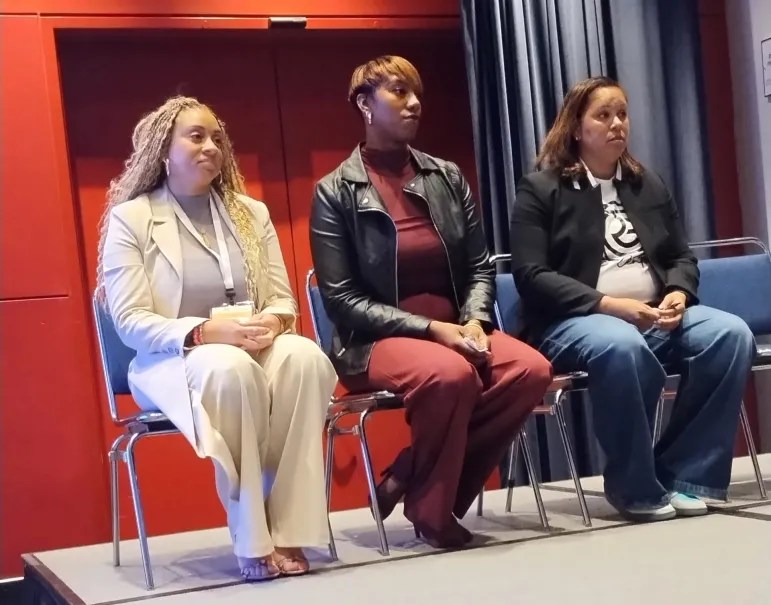
 (l-r) Vonchell Lewis, Arielle Wilson, Megan Hankins-Maldonado Credit: Charles Hallman
A 2023 NCAA mental health survey found coaches dealing with high stress and exhaustion among other pressure issues. And among female BIPOC and LGBTQ+ coaches under 40, mental health concerns are elevated.
Three Black females — two former coaches and a current volleyball head coach— discussed the importance of self-care and finding the balance of work and life demands. The three Sistahs spoke as panelists at last year’s Black Student Athlete Summit in Chicago where MSR was in attendance.
Megan Hankins-Maldonado, a California-licensed psychotherapist, coached basketball from Division I to high school for 15 years and has practiced psychotherapy for over 15 years. Today’s NIL and the transfer portal are additional pressures on college coaches, she said.
“What we’re not talking about is coaches and mental health, right?” Hankins-Maldonado pointed out. “Sixty-one percent of Division I coaches experience a negative impact on their mental health related to work issues. We’re not talking about that.
“I think what I’ve experienced too with other coaches is that they have a really hard time talking to their administrators about how they feel because they’re worried about what their job is if my AD don’t feel good [about] my mental health.”
Arielle Wilson will begin her second season this fall as head women’s volleyball coach at Central Michigan. She was hired in 2025 after two seasons as defensive and recruiting coordinator at Missouri (2023-24) and has nearly a decade of coaching experience, including assistant stops at Georgia Tech (2019-22), DePaul (2016-17), and as a volunteer assistant coach at Michigan State (2018).
“When I was playing,” recalled Wilson, a three-time All-American and three-time all-Big Ten player at Penn State (2008-10), “I work hard, play hard. I make sure I have a good work-life balance. My mom helps tremendously as well. She takes care of my daughter full time.”
Vonchell Lewis is a certified yoga instructor and a mental health clinician at Hampton University, an HBCU. She pointed out that coaches oftentimes are surrogate parents for their players, many if not all of whom are on their own for the first time in their lives.
“Coaches are doing everything similar to a parent,” said Lewis. “They’re protecting, they’re leading, they’re educating, they’re fostering growth.” She added that coaches too often put self-care on the backburner: “Coaches take work home, just like teachers, just like many of us. How can we balance that?
“How do you define self-care?” Lewis advised asking oneself. “What is something you like to do? What is something you like to engage in? What brings you joy?
“Self-care should not make you feel bad,” she stressed. “It should not be stressful. It should bring you joy. It should be simple and it should be very relaxing.”
Nonetheless, Wilson accepts both the positives and negatives of being a head coach. “Now being a head coach,” she surmised, “the goal for me is to impact young women and to really change just the form of what it looks like being coached.”
The three Black women all agreed how important it is to support fellow Sistahs these days. “We need to look at mental health from a holistic standpoint,” concluded Hankins-Maldonado. “There’s so many of us that need other people that look like us to support each other.”
Adofo-Mensah fired
Kwesi Adofo-Mensah was hired four years ago as the first Black general manager in Minnesota Vikings history. He was fired Jan. 30.
“I’ve known Kwesi for 20 years” when the two worked for the two Cleveland pro football and baseball teams respectively, said former Minnesota Twins president Derek Farvey. “He is a talented, talented person. He is an intelligent guy, a stand-up guy, a stand-up leader. I’m shocked” by his firing.
Charles Hallman welcomes reader comments to challman@spokesman-recorder.com.
Your Might Also Like