The line between law enforcement and mental health outreach was examined with vigor at Long Beach’s City Council meeting Tuesday night, as public officials discussed how to respond to “threatening” behavior that doesn’t meet the line of criminal behavior.
Between Long Beach and Los Angeles County, there are 28 resources equipped to respond to non-criminal threatening behavior, but it was clear Tuesday night that residents don’t know who to call, and there’s a lack of communication between the departments for these situations. City staff will work on creating pamphlets and public-facing resources cataloging all non-emergency resources, and report on the effectiveness of these programs pertaining to different situations, then revisit city council in the next few months.
Long Beach defers to the California Penal Code’s definitions for the two; criminal threatening behavior is anything that involves “willfully and maliciously communicating a threat to commit a crime that would result in death or great bodily injury to another person.” Non-criminal threatening behavior is defined as “actions that may cause fear, discomfort, or concern, but do not meet the legal threshold of a criminal threat and do not involve violence, weapons or explicit intent to cause harm.”
This can include passive-aggressive comments, insults or name-calling, someone talking to themselves or an imaginary person or someone who is disoriented or anxious but not violent.
“We have all these different programs, but I’m not confident that we are deploying them effectively and efficiently throughout the city, and that’s not necessarily anyone’s specific fault, it’s a system issue.”
– Councilmember Joni Ricks-Oddie
The Long Beach Police Department (LBPD) was consistent in their direction: the first two lines residents should call are 911 or the Long Beach non-emergency line. The dispatcher will ask the caller questions which will help them decide the level of priority as well as which response team is available and most appropriate for the situation at hand.
Multiple councilmembers pushed for more specifics for residents on who they should call and what the response time will be. The police department was consistent in their direction to call 911 or the non-emergency line.
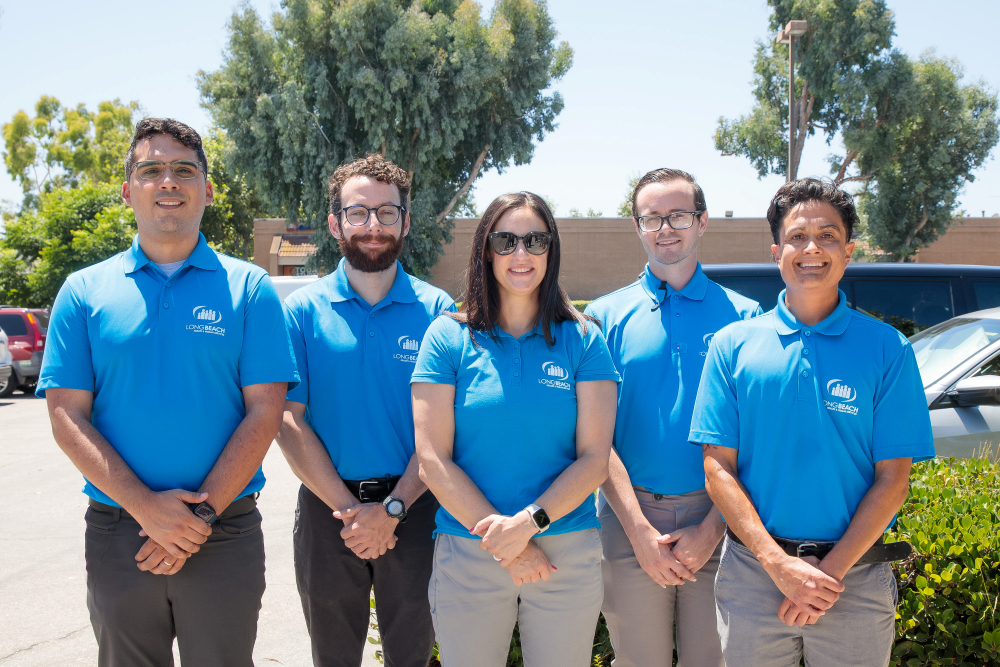 Long Beach’s Community Crisis Response team consists of five people, and will now respond to calls throughout the city for situations such as mental health crises, suicidal callers, public intoxication, unwelcome people, welfare checks and disturbances. (Courtesy of the City of Long Beach)
“We’re continuing to ask these questions because we don’t know how to respond to residents when they’re telling us and sharing with us these concerning behaviors,” said Councilmember Suely Saro.
The City acknowledged that not all people exhibiting “threatening behavior” have bad intentions, and often this behavior stems from complex social and behavioral health needs. Other underlying issues can include substance abuse, homelessness, severe economic distress or a mental health episode.
In Long Beach from 2018 to 2020, 42% of adults reported recent anxiety or depression and 37% of youth indicated a need for emotional or mental health help, according to the Health Department.
If LBPD receives a non-emergency call, they can send it out to one of the 22 city programs or six third-party programs for supportive services. The programs fall under multiple departments and are focused on deescalation, stabilization and connection to services rather than enforcement.
Health Department Non-Emergency Response Programs
Multi-Service Center
Street Outreach Team
Mobile Access Center
Community Crisis Response Team
REACH Team
Library Outreach
Activating Safe Communities
Safe Passages Program
Police Department Non-Emergency Response Programs
Mental Evaluation Team
Quality of Life Team
Community Service Assistant
Main Library Specialized Service Officers
Distract Car Checks
Neighborhood Safety Bike Team
Community Events
Other Non-Emergency Response Programs
Lifeguards
Park Ambassadors
Be Safe Programs
Teen Center Enhancements
Priority Access Diversion Program
Law Enforcement Assisted Diversion Program
CARE Court
Want more local news?
Sign up for the Signal Tribune’s daily newsletter
External programs include Long Beach Transit Ambassadors, the LA County Mental Health Help Line, the Long Beach Behavioral Health Urgent Care Center, the National Suicide & Crisis Lifeline, the Long Beach Mental Health Resource Guide and various Business Improvement Districts.
Reginald Harrison, Director of Disaster Preparedness, discussed a few challenges these programs face, such as limited staffing and hours of operation, as many of the programs only run during the week or stop at various times of the evening, leaving large gaps of time where no non-emergency professionals are on call.
He also acknowledged that non-emergency responses can only go so far, and there may be times where people could feel uncomfortable or concerned due to an individual’s behavior, but their First Amendment right means they don’t have to leave or stop what they are doing. These issues are also highly subjective.
There may also be instances where a situation is deemed an emergency, then when police officers arrive, they can decide it’s more of a mental health emergency and call for the Mental Evaluation Team.
 An aerial view of the Long Beach Multi-Service center on Feb. 6, 2023. (Richard H. Grant | Signal Tribune)
Next Steps
The City is currently pursuing funding through Proposition 1, which can only be used for behavioral health programs, to create an Office Based Opioid Treatment Facility at the Multi-Service Center to provide medical treatment for opioid use disorders. This project is estimated to cost $19 million. Long Beach is also looking to form a Social Rehabilitation Facility at the 702 W. Anaheim St. shelter, which offers 24-hour non-medical care and intensive supportive services for individuals with mental health needs. This project has an estimated cost of $12 million.
Another goal is to strengthen citywide collaboration across departments to better understand patterns of behavior, early intervention methods and effective responses. The Health Department is working on a Human Trafficking Report that will boost citywide responses to that issue as well.
All City departments will make sure their non-emergency resources are published in their public facing materials, and all public resources will be put into one catalog.
Councilmember Kristina Duggan asked if responses are different if a person is “committing a code violation” such as trespassing, sleeping in public, indecent exposure or public drug use. Community Services Bureau Deputy Chief Mike Solomita said that “absolutely” requires a different response since those are technically crimes. They would receive a “priority 1” designation from police.

After further questioning, Solomita said indecent exposure falls under a “priority 2” designation, which has an average response time of 38 minutes. Duggan said they need to revisit the conversation as she believes they are not clear on protocol, especially strained with staffing issues across departments.
Some people exhibiting unsafe behavior may refuse services or any kind of help multiple times, leaving residents to believe nothing is being done, a representative with the LBPD said. A person has to be a serious danger to themselves or others in order to be placed into resources by force for 72 hours, which has a very high threshold.
Councilmember Tunua Thrash-Ntuk suggested the City consider a neighborhood ambassador program where neighbors are specialized in the various non-emergency resources. She also suggested conducting case studies on each program and stress tests where residents can be in a simulated situation and learn what to do.
City staff will report back with data and metrics on how the City responds when they receive non-emergency calls, what types of calls are being effectively responded to and what types are proving more difficult.