
An Israeli man in his 20s who was expelled from a mental health center run by Israel’s Welfare and Social Affairs Ministry following a violent outburst was sent to prison for several months after no other residential facility was found for him, Haaretz has learned.
While at the northern Israeli Tzalmon Prison, the man was sexually assaulted by prisoners and was the victim of other violent attacks that resulted in injuries.
The man, who suffers from fetal alcohol syndrome, a condition that can cause severe behavioral problems and violent outbursts posing a risk to himself and others, was left unsupervised in jail and was not provided with his prescribed medication. After his emotional state deteriorated, he was placed in solitary confinement for part of his detention.
Haaretz Podcast‘Trump needs Netanyahu to not mess things up for him in Iran and Gaza’
play
Haaretz Podcast
‘Trump needs Netanyahu to not mess things up for him in Iran and Gaza’
Volume: 0.5
X1
total– : –time0:00
fast forward15
play
rewind15
“He’s a sick person who doesn’t understand what’s happening around him, and he’s been treated like he was a serious criminal,” his adoptive mother told Haaretz.
“He was held in a cell with criminals, where he was exposed to threats and abuse,” she added. “His entire body is full of bruises. He was terrified there, frightened, with shifting eyes and trembling hands. He’s a sick person who needs treatment.”
 Close
Close
The Beresheet Mental Health Center at Sha’ar Menashe in northern Israel. Credit: Eyal Toueg
The Beresheet Mental Health Center at Sha’ar Menashe in northern Israel. Credit: Eyal Toueg
The man has lived at Welfare Ministry institutions since he was a child. In recent years, he was a resident of the Beresheet Mental Health center at Sha’ar Menashe in Israel’s north, which specializes in treating people with complicated congenital issues. “It was good for him there,” his mother said. “He managed to realize his potential in good ways.”
In June, however, the man was arrested after attacking members of the medical staff in the course of an emotional outburst. “In a single moment, everything was turned upside-down, and before I understood what had happened, he had already been transferred to prison,” his mother recounted.
Related Articles
The Sha’ar Menashe facility refused to take him back, and the Welfare Ministry accepted the decision even though it had the authority to compel the facility to do so – because the ministry was concerned that staff members would resign in protest. The Hadera Magistrate’s Court then ordered that he be placed at a mental health center for observation due to the deterioration in his condition and the lack of any other placement option.
The incident is unusual, but in recent years, there have been other cases in which residents of care facilities were sent to prison while criminal proceedings against them were underway.
The Welfare Ministry is expected to issue a tender for the operation of five separate facilities for patients who pose a danger to those around them. Authorities are also considering opening a dedicated unit within an existing facility to address such violent outbursts.
“It’s not reasonable that the state isn’t finding a place for someone over whom no one doubts the fact that he’s sick and needs treatment,” the man’s mother said.
 Close
Close
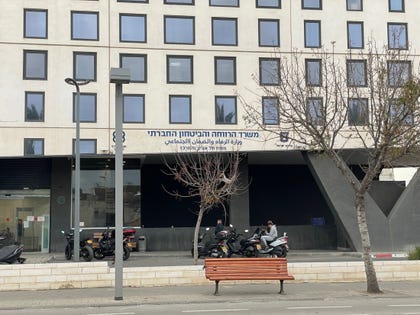
The Wellfair Ministry offices in Tel Aviv. Credit: Reut Guetta
The Wellfair Ministry offices in Tel Aviv. Credit: Reut Guetta
Unlike other emotional disturbances, fetal alcohol syndrome is the result of developmental harm, the treatment for which generally requires special facilities designed for people with cognitive impairment.
The paitent’s mother acknowledged that the medical placement was unusual under the circumstances and temporary. She said it did not meet her son’s needs but was preferable to any treatment option other than a facility that was designed specifically to meet his needs. “I’ve reached an absurd situation,” she said. “I prefer for him to be at a psychiatric hospital rather than in prison.” At the hospital at least, he can be helped and prevented from harming himself and those around him, she added.
Next week, following a professional opinion issued by the district psychiatrist, there will be another hearing in the case to which Welfare Ministry representatives have been summoned. They will be asked to report to the court on efforts to find another treatment facility for the man, as an alternative to prison.
The man’s lawyer, Anat Huly, who was appointed by the Public Defender’s Office, acknowledged that it is difficult to find placements for some of the people accused of crimes and who have been wards of the Welfare Ministry for their entire lives.
There are other instances, she said, in which they have found themselves imprisoned and subject to sexual assault, other violence or extortion. They need to be provided a facility where they don’t pose a danger to themselves or others, she said.
In its response to this article, the Welfare and Social Affairs Ministry said in part that although the Beresheet center is geared to deal with patients who pose a danger to those around them, “in extreme cases of serious harm to residents or staff, there’s an obligation to file a complaint with the police and to terminate the stay at the facility.”
It is the court, the ministry said, that decides whether or not criminal proceedings move forward or end and whether the patient is sent to prison or somewhere else. Treatment facilities do not have the authority to place a resident in isolation or to use restraints, the ministry said, even when a patient poses a risk to the other residents and to staff.
“There is therefore no alternative to expelling the resident from the facility and returning [the case] to court for further consideration,” it added.
The Israel Prison Service replied that, out of considerations of confidentiality, it cannot comment on the details of the individual case, but in light of the allegations, a criminal investigation has been opened.
“Any decision relating to supervision, placement in a cell or drug treatment is taken based on professional considerations and in accordance with recommendations from medical and social welfare officials at the prison service,” the statement said.
“The prison service works according to the law and regulations while protecting the well-being of all of those imprisoned in its custody.”