
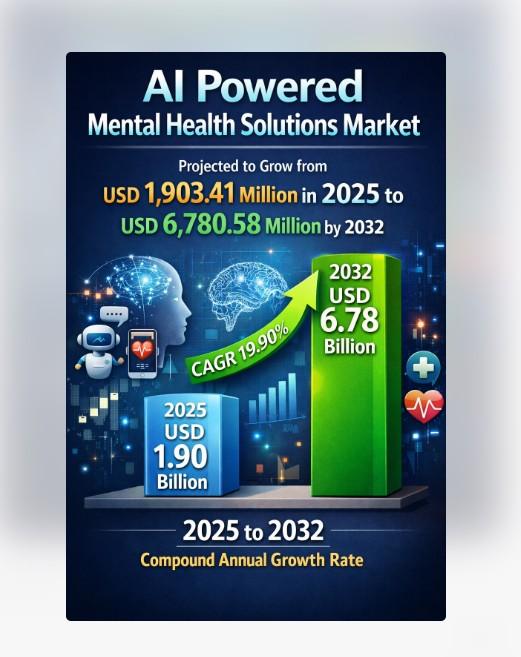
 The AI Powered Mental Health Solutions Market is entering a phase of rapid expansion, reflecting the global shift toward digital health technologies, personalized care models, and scalable mental healthcare delivery. The market is projected to grow from USD 1,903.41 million in 2025 to an estimated USD 6,780.58 million by 2032, registering an impressive CAGR of 19.90% from 2025 to 2032. This remarkable trajectory underscores the increasing reliance on artificial intelligence to address growing mental health challenges, healthcare resource constraints, and evolving patient expectations.
Browse the full Report at https://www.credenceresearch.com/report/ai-powered-mental-health-solutions-market
Mental health disorders have emerged as one of the most pressing global health concerns, affecting hundreds of millions of individuals across diverse demographics. Rising awareness, reduced stigma, and greater recognition of mental wellbeing as a critical component of overall health are driving demand for innovative solutions. However, traditional mental healthcare systems often struggle with workforce shortages, high treatment costs, accessibility barriers, and fragmented care pathways. AI-powered solutions are uniquely positioned to bridge these gaps by enabling continuous monitoring, early intervention, and highly personalized therapeutic experiences.
AI technologies are fundamentally transforming how mental health conditions are assessed, managed, and treated. By leveraging machine learning algorithms, natural language processing, emotion recognition systems, and predictive analytics, digital platforms can analyze behavioral patterns, detect early warning signals, and deliver tailored support. These capabilities are particularly valuable in mental healthcare, where timely intervention, patient engagement, and longitudinal data analysis are critical for positive outcomes.
Get Free PDf Sample Request: https://www.credenceresearch.com/report/ai-powered-mental-health-solutions-market#request_sample
Key Growth Drivers
Several structural and technological factors are fueling the market’s strong growth outlook.
One of the most significant drivers is the rising global prevalence of mental health conditions, including anxiety disorders, depression, stress-related disorders, and burnout. Modern lifestyles, urbanization, social isolation, and workplace pressures are contributing to increased mental health vulnerabilities. The growing demand for accessible and affordable mental health services is accelerating adoption of AI-driven digital solutions.
Another major catalyst is the scalability and cost-efficiency offered by AI technologies. Traditional therapy models depend heavily on human clinicians, limiting capacity and increasing costs. AI-powered platforms can deliver support to large populations simultaneously, reducing operational burdens while expanding reach. This scalability is especially important in regions with limited mental health infrastructure or clinician shortages.
Advancements in AI algorithms and computing capabilities are also enhancing solution effectiveness. Improvements in conversational AI, sentiment analysis, and behavioral prediction models are enabling more natural, responsive, and context-aware digital interactions. As AI systems become more sophisticated, their ability to emulate supportive therapeutic conversations and identify nuanced emotional states continues to improve.
The increasing integration of mental health into broader digital health ecosystems further strengthens market growth. AI-powered mental health tools are increasingly embedded within telehealth platforms, wearable devices, and electronic health record systems. This interconnectedness allows for richer data insights, more coordinated care, and improved patient monitoring.
Regulatory support and policy initiatives aimed at expanding digital health adoption are likewise contributing to market momentum. Governments and healthcare organizations worldwide are recognizing the potential of AI and digital therapeutics to enhance mental healthcare accessibility and efficiency.
Browse the full Report at https://www.credenceresearch.com/report/ai-powered-mental-health-solutions-market
Machine Learning
Machine learning forms the backbone of many AI-powered mental health platforms. These algorithms analyze vast datasets to identify patterns, predict outcomes, and refine interventions. In mental healthcare, machine learning supports risk assessment, behavioral analysis, symptom tracking, and treatment optimization. By continuously learning from user interactions and clinical data, these systems improve accuracy and personalization over time.
Natural Language Processing (NLP)
Natural Language Processing plays a critical role in conversational AI and digital therapy tools. NLP enables systems to understand, interpret, and respond to human language in meaningful ways. AI chatbots and virtual assistants use NLP to engage users in therapeutic dialogues, assess emotional tone, and deliver cognitive behavioral techniques. The growing sophistication of NLP models is enhancing user engagement and the perceived empathy of digital interactions.
Emotion AI / Affective Computing
Emotion AI, also known as affective computing, focuses on detecting and interpreting human emotions through voice, facial expressions, text, and behavioral cues. In mental health applications, emotion recognition technologies can identify stress, anxiety, or mood fluctuations, enabling timely interventions. This technology is particularly valuable for monitoring emotional wellbeing, improving user feedback mechanisms, and supporting adaptive therapy experiences.
Predictive Analytics
Predictive analytics leverages historical and real-time data to forecast potential mental health risks or outcomes. These tools can identify early indicators of mental health deterioration, relapse risks, or treatment response patterns. Predictive capabilities are increasingly important for preventive care strategies, enabling healthcare providers and individuals to take proactive measures.
Others
Additional AI technologies, including hybrid AI models, reinforcement learning, and multimodal data analysis, are also contributing to innovation in the market. These technologies support enhanced personalization, dynamic content delivery, and improved clinical decision-making.
Browse the full Report at https://www.credenceresearch.com/report/ai-powered-mental-health-solutions-market
Diagnostics Assistance
AI-powered diagnostics tools are revolutionizing early detection and assessment of mental health conditions. These systems analyze speech patterns, language usage, behavioral data, and self-reported inputs to identify potential symptoms. AI-assisted diagnostics can support clinicians by providing decision support, reducing diagnostic variability, and improving screening efficiency.
Treatment Personalization
Personalization represents one of the most compelling advantages of AI in mental healthcare. AI systems can tailor therapeutic content, coping strategies, and interventions based on individual user profiles, preferences, and behavioral responses. Personalized treatment pathways enhance engagement, adherence, and potential treatment effectiveness.
Monitoring and Management
Continuous monitoring and management solutions are gaining prominence as mental healthcare increasingly emphasizes longitudinal support. AI-driven platforms can track mood changes, sleep patterns, stress indicators, and behavioral signals. Real-time monitoring enables early intervention, relapse prevention, and adaptive care delivery.
Other Applications
Beyond core diagnostic and therapeutic functions, AI technologies are supporting various ancillary applications, including mental wellness programs, resilience training, digital coaching, and workplace mental health initiatives.
Get Free PDf Sample Request: https://www.credenceresearch.com/report/ai-powered-mental-health-solutions-market#request_sample
Market Segmentation by End User
Hospitals and Clinics / Healthcare Providers
Healthcare providers are among the primary adopters of AI-powered mental health tools. These solutions assist clinicians in diagnostics, treatment planning, patient monitoring, and workflow optimization. AI integration helps improve care efficiency while enabling more data-driven decision-making.
Individuals
Direct-to-consumer AI mental health applications are experiencing substantial growth. Individuals increasingly seek convenient, stigma-free, and on-demand mental health support. AI chatbots, self-help tools, and digital companions offer accessible and affordable options for self-management.
Employers and Corporate Wellness Programs
Workplace mental health has become a strategic priority for organizations worldwide. Employers are investing in AI-powered platforms to support employee wellbeing, reduce burnout, and improve productivity. AI tools enable scalable mental health support across distributed workforces.
Research Institutions
Research organizations leverage AI technologies for mental health studies, behavioral analysis, and clinical research. AI-driven data analytics facilitate deeper insights into mental health trends and treatment effectiveness.
Payers
Insurance providers and payers increasingly recognize the value of AI solutions in improving mental health outcomes and reducing long-term healthcare costs. AI-driven early intervention and monitoring can mitigate costly acute care episodes.
Government and Non-Profit Organizations
Public sector entities and non-profit organizations utilize AI-powered mental health solutions to expand access, particularly in underserved populations. Digital platforms support large-scale mental health initiatives and community-based programs.
Regional Analysis
North America
North America remains a dominant market, driven by strong digital health adoption, advanced healthcare infrastructure, and significant mental health awareness. The U.S. leads innovation and investment, while Canada and Mexico show growing digital health integration.
Europe
Europe represents a robust and steadily expanding market, supported by favorable regulatory environments and increasing digital health initiatives. Countries such as Germany, France, the U.K., Italy, and Spain are actively embracing AI-enabled healthcare technologies.
Asia Pacific
Asia Pacific is expected to witness the fastest growth, fueled by large population bases, rising mental health awareness, and expanding digital ecosystems. China, Japan, India, South Korea, and Southeast Asia present significant growth opportunities due to increasing smartphone penetration and digital healthcare adoption.
Latin America
Latin America is emerging as a promising market, with Brazil and Argentina leading adoption. Increasing healthcare digitization and mental health awareness are supporting market development.
Middle East & Africa
The Middle East & Africa region is gradually expanding, driven by healthcare modernization efforts, digital transformation initiatives, and growing recognition of mental health needs.
Key Player Analysis
The competitive landscape features a diverse mix of AI-first innovators, digital therapy providers, and hybrid care platforms.
Woebot Health is widely recognized for its AI-driven conversational therapy solutions designed to deliver cognitive behavioral techniques through engaging chatbot interfaces. Wysa has established a strong presence with its AI-powered mental health support platform emphasizing emotional wellbeing and self-help tools. Youper leverages AI to deliver personalized emotional health assistance, focusing on user-centric digital interactions.
Lyra Health and Spring Health differentiate themselves through employer-focused models that combine AI technologies with human clinicians. Headspace Health integrates mindfulness, meditation, and digital mental wellness with AI-enabled features. Talkspace and Ginger strengthen their positions through teletherapy networks and payer partnerships, offering hybrid mental healthcare services.
Browse the full Report at https://www.credenceresearch.com/report/ai-powered-mental-health-solutions-market
Competitive Analysis
The AI Powered Mental Health Solutions Market features a mix of digital therapy specialists, AI-first startups, and hybrid mental healthcare providers. Companies compete on clinical credibility, AI sophistication, user engagement, and enterprise reach. Platforms such as Woebot Health, Wysa, and Youper focus on AI-driven self-help and conversational therapy tools. Firms like Lyra Health, Spring Health, and Headspace Health emphasize employer-sponsored and hybrid care models that combine AI with human clinicians. Talkspace and Ginger strengthen positions through teletherapy networks and payer partnerships.
Competition centers on personalization depth, data security standards, regulatory compliance, and scalability across regions. As mental health data is highly sensitive, robust privacy protections and ethical AI frameworks are becoming essential differentiators. Vendors that successfully align AI capabilities with evidence-based therapeutic practices and clinical validation are likely to sustain long-term market leadership.
Strategic partnerships, continuous algorithm improvements, and user experience enhancements remain critical success factors. As AI technologies mature, the market is expected to reward providers that balance technological innovation with clinical responsibility and patient trust.
Future Outlook
The future of the AI Powered Mental Health Solutions Market appears exceptionally promising. As AI technologies advance and digital health adoption accelerates, intelligent mental healthcare platforms will become increasingly integral to global healthcare systems. Personalized, accessible, and data-driven mental health support is poised to redefine care delivery, improve patient outcomes, and expand mental wellness resources worldwide.
Browse the full Report at https://www.credenceresearch.com/report/ai-powered-mental-health-solutions-market
Get Free PDf Sample Request: https://www.credenceresearch.com/report/ai-powered-mental-health-solutions-market#request_sample
Contact US:
Credence Research Inc, Tower C-1105 , S 25, Akash Tower,
Vishal Nahar, Pimple Nilakh, Haveli,
Pune – 411027, India
India – +91 6232 49 3207
sales@credenceresearch.com
www.credenceresearch.com
About US:
Credence Research is a leading international provider of market intelligence and a key component in the due diligence process. We deliver high-quality, extensive, deep-dive reports that empower leaders and investors to make informed decisions and mitigate risks. Our strategic insights, based on extensive research frameworks and advanced data modeling, provide authoritative primary sources for evaluating market performance and potential across a wide range of industries.
This release was published on openPR.