
Kaiser Permanente study of nearly half a million adolescents finds cannabis use may precede onset of serious psychiatric disorders
A Kaiser Permanente analysis of adolescents aged 13-17 finds that those who report using cannabis in the past year are more likely to later receive a diagnosis of psychotic, bipolar, depressive, or anxiety disorders.
The study was published in JAMA Health Forum on February 20.
 Kelly Young-Wolff, PhD, MPH
The researchers found that self-report of past-year cannabis use typically occurred an average of 1.7 to 2.3 years before a psychiatric diagnosis. However, the study could not definitively determine whether cannabis use causes psychiatric disorders — or whether teens use cannabis to address emerging mental health symptoms.
“We designed the study to follow adolescents into young adulthood so we could better understand the timing of cannabis use relative to the onset of mental health disorders,” said lead author Kelly Young-Wolff, PhD, a research scientist with the Kaiser Permanente Division of Research. “Our findings show that adolescents who report cannabis use have a significantly higher risk of developing multiple psychiatric disorders, particularly psychotic and bipolar disorders. These results add to growing evidence that adolescence may be a particularly vulnerable period for cannabis-related harms.”
The analysis included 463,396 adolescents of diverse racial and ethnic backgrounds in Northern California. Of the total, 5.7% reported using cannabis the previous year.
Cannabis use was measured by responses on a confidential screening form filled out by patients before well-child visits to Kaiser Permanente Northern California pediatricians between 2016 and 2023.
The researchers tracked health data for the patients through age 25, or until the end of 2023. They found the teens who reported cannabis use were more than twice as likely to be later diagnosed with a psychotic disorder or bipolar disorder, 34% more likely to be diagnosed with depression, and 24% more likely to be diagnosed with anxiety disorders.
The likelihood of a serious mental health disorder was slightly less — but still significant — when previous mental health diagnoses were considered.
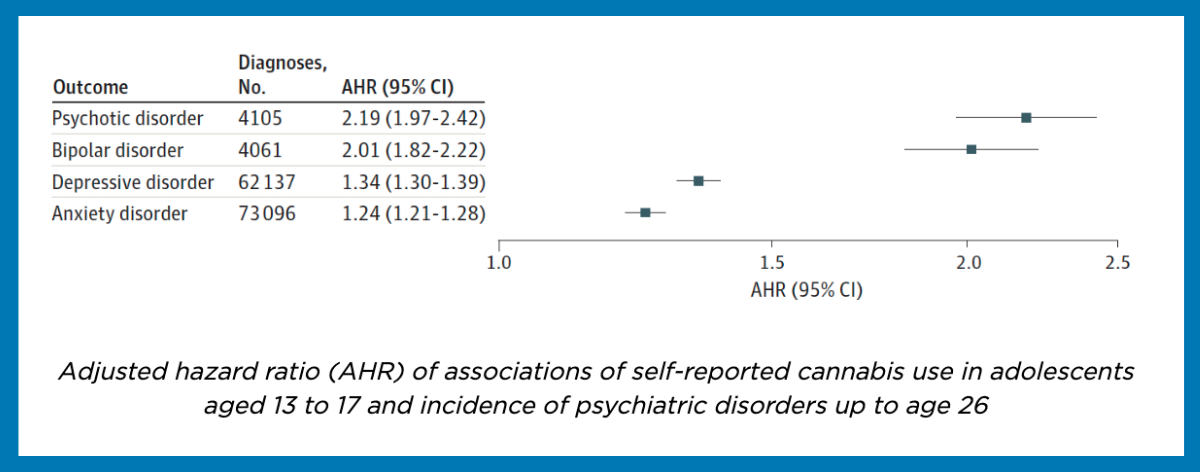 The strength of the associations between cannabis use and depressive and anxiety disorders decreased as adolescents aged and were no longer statistically significant among young adults aged 21-25. In contrast, elevated risks for psychotic and bipolar disorders persisted into young adulthood. The authors said this was consistent with other research. They said the data suggests adolescence is a particularly vulnerable time for cannabis-related mental health problems.
The authors emphasized that cannabis products available today often contain high concentrations of tetrahydrocannabinol (THC), which may disrupt the endocannabinoid system and affect brain regions involved in motivation, emotional regulation, and cognition. “It’s critical to study contemporary cannabis use, because the products and potency levels adolescents are exposed to today are very different from those in the past,” Young-Wolff said.
The researchers also acknowledged the complex and bidirectional relationship between cannabis use and mental health.
“While it is not possible to definitively determine causality, this study had a strong retrospective design,” they wrote.
At the same time, the authors acknowledged that some individuals may begin to use cannabis to self-medicate psychiatric symptoms before a diagnosis is made.
 Stacy Sterling, DrPH, MSW
“While this study doesn’t completely answer the question of causality, it adjusts carefully for previous mental health problems and moves the field forward towards establishing a chronology of problem development,” said senior author Stacy Sterling, DrPH, MSW, a research scientist with the Division of Research.
The authors emphasized that cannabis has not been shown to be an effective treatment for depression or anxiety and that ongoing use is associated with worsening mood symptoms and poorer adherence to mental health treatment.
The results highlight the importance of early prevention, routine screening for cannabis use in pediatric care, clear public health messaging about risks, and policies that limit youth access and exposure to cannabis, particularly as legalization expands, Young-Wolff said. “These efforts are particularly important because cannabis use is more common among adolescents living in neighborhoods with greater socioeconomic deprivation and among those insured by Medicaid. Ensuring that all families have access to accurate, evidence-based information about cannabis risks is a matter of health equity.”
The study was funded by the National Institute on Drug Abuse.
Additional co-authors were Catherine A. Cortez, MPH, Stacey E. Alexeeff, PhD, Natalie E. Slama, MPH, Derek D. Satre, PhD, Cynthia I. Campbell, PhD, MPH, and Monique B. Does, MPH, of the Division of Research; Maria T. Koshy, MD, of The Permanente Medical Group; Lynn D. Silver, MD, MPH, and Alisa A. Padon, PhD, of the Public Health Institute; and Rosalie Liccardo Pacula, PhD, of the University of Southern California.
###
About the Kaiser Permanente Division of Research
The Kaiser Permanente Division of Research conducts, publishes, and disseminates epidemiologic and health services research to improve the health and medical care of Kaiser Permanente members and society at large. KPDOR seeks to understand the determinants of illness and well-being and to improve the quality and cost-effectiveness of health care. Currently, DOR’s 720-plus staff, including 73 research and staff scientists, are working on nearly 630 epidemiological and health services research projects. For more information, visit .