
A Jan. 4 911 call became a 30-hour standoff between a Ypsilanti man experiencing mental health symptoms and several police agencies
Neighbors and community advocates are calling for leniency for the man, who faces eight felonies and remains in psychiatric hold
Police have defended the response, but critics see “systemic failure” of law enforcement struggling to deal with mental health situations
Ruben Peeler’s downstairs neighbor and landlords knew he needed help — help they couldn’t provide.
So they did what they thought they were supposed to do, calling 911 on multiple occasions as the Ypsilanti man’s behavior grew more erratic and their efforts to break through weren’t working. They called again on Jan. 4, reporting to dispatchers that Peeler, 53, was pounding on his neighbor’s door with a “large, long wooden stick.”
They had no idea that call would trigger a more than 30-hour standoff involving multiple law enforcement agencies, a SWAT team, tear gas, a fire hose, a long-range acoustic device, flash-bangs, utility shutoffs and a demolition crew that ripped a hole through the brick exterior of what had been Peeler’s second-floor apartment on West Cross Street before he was subdued and taken into custody.
Police said Peeler, a man with a well-documented history of severe mental health conditions, spent most of those 30-plus hours barricaded in his bedroom, armed with a katana sword. He’s been charged — but not yet arraigned — with multiple felonies, including assault with a dangerous weapon.
The overwhelming response has sparked a debate over how law enforcement should respond to mental health crises in Michigan. Critics call it a “systemic failure” that underscores how police too often resort to force — even in areas like Washtenaw County, which funds unarmed mobile crisis teams designed to work in tandem with law enforcement during mental health emergencies.
Related:
In this case, it resulted in “the torture of our friend Ruben and the destruction of the home that I purchased for my mother,” Samantha Danek, who co-owns the house with her husband, told the Washtenaw County Board of Commissioners in public comments last month.
The incident sent shock waves through Ypsilanti, a politically progressive college town southeast of Ann Arbor where city and county law enforcement leaders have publicly endorsed community-focused policing and nontraditional approaches to handling mental health emergencies.
Though there have been growing calls statewide for alternatives, experts say a 911 dispatch often remains the go-to option in situations where a person experiencing a mental health crisis is in danger of hurting themselves or others.
But if an already unpredictable situation turns volatile when law enforcement arrives, there’s no guarantee of a positive outcome — and in situations like Peeler’s, how the situation plays out can impact trust in the process, said Marianne Huff, president and CEO of the Mental Health Association in Michigan.
“People are told if your loved one is in the throes of a psychiatric crisis, you call law enforcement,” Huff told Bridge Michigan, later adding: “The flip side is that you could have a bad result if you do that.”
The Ypsilanti Police Department and the Washtenaw County Sheriff’s Office declined to speak with Bridge Michigan about the Cross Street incident, citing an ongoing internal investigation.
But in a Jan. 8 statement, the sheriff’s office applauded responding officers’ handling of the matter, citing “their unwavering dedication to service” as the reason why no one was seriously injured or killed.
In the weeks since, neighbors who witnessed what happened, public officials and other community members have insisted that law enforcement did not handle the situation appropriately.
“They just took somebody who…needed clinical intervention, and they turned him into a criminal,” said Dawn Keech, who serves as president of the Normal Park Neighborhood Association where the incident transpired.
“There’s just nothing about how any of this turned out that makes me feel like anybody deserves a pat on the back or congratulations.”
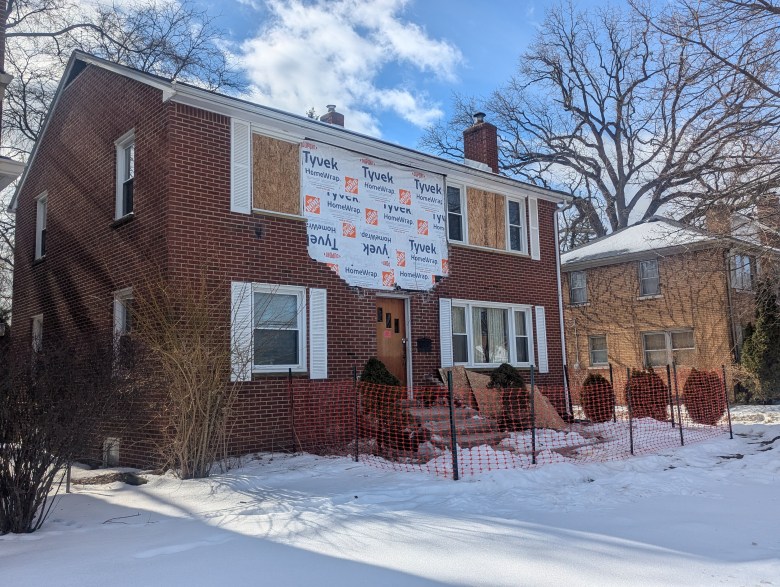 Peeler was a tenant on the second floor of the Cross Street home, pictured in February. The homeowner’s mother lived on the first floor prior to the Jan. 4-5 incident. (Lauren Gibbons/Bridge Michigan)
‘A total loss’
Many residents have called for leniency for Peeler, who currently faces eight felony charges related to the standoff for assault with a dangerous weapon and resisting police officers. An online fundraiser for Peeler’s legal fees has raised close to $10,000.
More than a month later, Peeler still hasn’t been arraigned on the charges and remains in court-ordered psychiatric treatment, court records show.
In a Jan. 9 statement, the Washtenaw County Board of Commissioners implored police and the county prosecutor’s office to drop the charges, arguing the decision to pursue criminal charges “risks further harm to someone who needed support, not punishment.”
Peeler has lived in Washtenaw County for decades, where he’s worked as a gas station clerk, produced his own music and video projects and designed footwear, according to his personal website, social media accounts and other available public records.
Prior to the January incident, Peeler had been detained and hospitalized in Washtenaw County several times since 2004 due to symptoms of bipolar disorder, a Bridge Michigan analysis of publicly available criminal and probate court records found. His most recent court-ordered hospitalization was in June 2023.
Court records show Peeler at times disagreed with doctors about the characterization of his condition and the course of his treatment plan, at one point appealing a judge’s order that he receive additional treatment recommended by his attending physician. That appeal was dismissed by the Michigan Court of Appeals.
In testimony to the Washtenaw County Board of Commissioners last month, Danek, Peeler’s landlord, said he’d been living in the Cross Street house for years when her family purchased the house as a permanent residence for her mother.
Peeler “quickly became part of our family,” Danek told commissioners, looking after her mother and handing out Halloween candy with her family. When he showed signs of struggling, she said her family offered what support they could and tried to direct him to relevant services, but noted “he was very skeptical of the system.”
Even as the situation escalated to calling 911 in January, Danek told the commission her mother wanted to stay and advocate on Peeler’s behalf. In the ensuing chaos, Danek said, the water damage, chemicals and partial demolition destroyed her mother’s apartment, too.
“Everything is a total loss,” she said. “She did the right thing. She lost everything.”
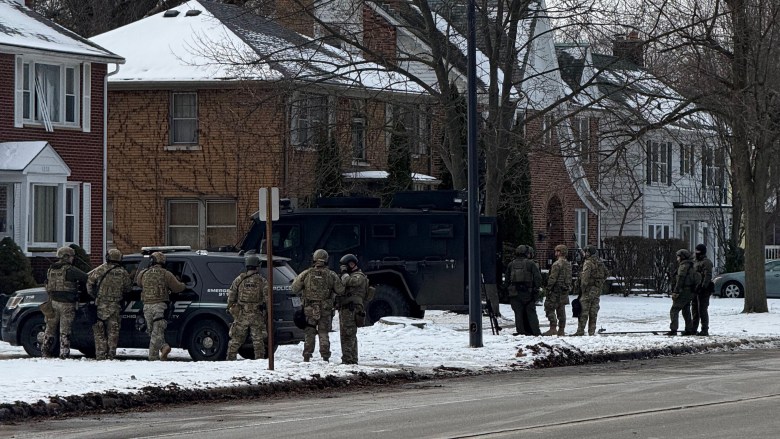 Police surround the Ypsilanti home of Ruben Peeler, who was in a more than 30-hour standoff with police Jan. 4 and 5 after he barricaded himself in his residence armed with a katana sword. (Courtesy of Greg Woodring)
From house call to ‘full force’
When local law enforcement first responded to the Cross Street call on that chilly Sunday afternoon, several neighbors who spoke with Bridge or shared their experience in local government hearings said they initially didn’t think much of it.
Mental health emergency resources
If you or someone you know is in need of immediate mental health support, the 988 Suicide and Crisis Lifeline offers round-the-clock phone, text and online chat services. Military veterans can also obtain specialized support through this service.
The Michigan Peer Warmline is an alternative to traditional crisis lines operated by certified peer support specialists. Any Michigan resident in need of mental health support can anonymously call 1-888-PEER-753 (1-888-733-7753) seven days a week between 10 a.m. and 2 a.m.
The Washtenaw County Community Mental Health crisis line for urgent mental health needs can be reached 24/7 at 734-544-3050.
First responders and their families can access specialized mental health support through the Frontline Strong program. Call 1-833-34-STRONG for additional information.
Michigan residents in need of substance abuse treatment, problem gambling counseling or other mental health resources may be eligible for publicly-funded care. Click here for contact information by county.
The National Alliance on Mental Illness offers a national resource directory for a wide variety of circumstances. People in need of mental health resources can also call the organization’s helpline at 1-800-950-NAMI (6264), or by texting “HelpLine” to 62640, available Mon-Fri from 10 a.m. to 10 p.m.
If you or someone you know is in need of immediate medical attention, call 911.
As the hours ticked by, though, more police from multiple law enforcement agencies continued to arrive. An armored vehicle and fire truck showed up. The street was blocked, and multiple neighbors have said they were told they couldn’t enter or exit their homes without police escort.
Greg Woodring, who observed much of the standoff from his yard down the street, said he and other observers witnessed tear gas and flash grenades get thrown into the house periodically for hours and heard hours’ worth of negotiators’ attempts to connect with Peeler via a loudspeaker, efforts Woodring said were “completely undercut” by other law enforcement activity.
Woodring said he was shocked when a fire hose sprayed water repeatedly into the home, especially considering how cold it was. When responders punched a hole through the wall and began dismantling the front of the building, “I was just screaming, trying to get them to stop,” he said.
“It just felt like the military state had just decided to come down into my little neighborhood and show its full force,” Woodring said. “It makes you feel helpless…it’s terrifying.”
At one point during the standoff, Washtenaw County Sheriff Alyshia Dyer spoke with Woodring and other residents about the situation, which Woodring recorded on video. Dyer told them the response from multiple agencies was necessary because Ypsilanti police didn’t have the resources to handle the situation alone.
“The reason it takes so long is we don’t rush in, we wait, we talk, we negotiate…our goal is to get this person safely into custody so the person does not hurt themselves or hurt someone else,” Dyer said.
Asked by community members why the joint response involved use of tear gas and other tactics, Dyer said police “tried for hours and hours without all this…it wasn’t working.”
Annie Somerville, a Washtenaw County commissioner representing the city of Ypsilanti, said in her view, the tactics that were used far exceeded what was necessary.
“When has a local SWAT team used a water hose to get somebody out of a home, who had not committed a crime or harmed anyone, in the middle of winter after turning the heat off?” Somerville said. “He could have died.”
Responding to crisis
Washtenaw County is no stranger to conversations surrounding how best to respond to mental health needs.
In 2017, county residents voted two-to-one in favor of a millage funding a 24/7 mental health line and related services aimed at connecting residents in need with care providers and other support, as well as crisis response programs and expanded education and training for first responders.
Much of that work is housed in Washtenaw County Community Mental Health, which runs the hotline and has unarmed mobile crisis teams that can be dispatched, as well a crisis response unit and crisis negotiation team that can work with law enforcement to de-escalate high-risk mental health situations.
Local law enforcement leaders have also previously expressed openness to improving how mental health emergencies are handled.
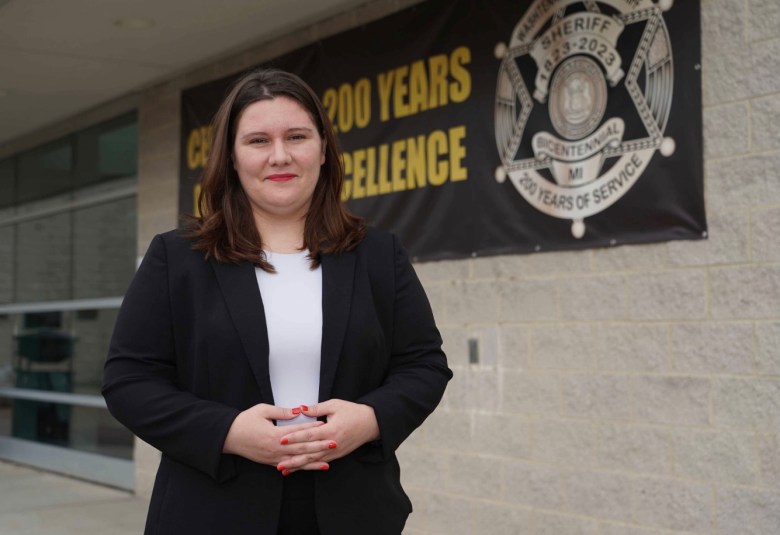 Washtenaw County Sheriff Alyshia Dyer took office in 2025. (Courtesy Washtenaw County Sheriff’s Office)
Dyer, who took office in 2025 and has a background in social work as well as law enforcement, told the Eastern Echo in a January 2025 interview that improving mental health services for officers and decriminalizing extenuating circumstances like mental health conditions and poverty was a priority for her.
“Law enforcement is so militaristic, and it oftentimes creates an environment where people feel like they’re walking on eggshells when they work in policing,” she told the student newspaper at the time.
“We have co-response, but also, there’s so many times when there may be something going on when the police are not needed, and it’s really a better fit to have a mental health responder or an unarmed responder show up to help address those needs,” she continued.
In a Jan. 8 statement, agency officials said Washtenaw County Community Mental Health was not contacted by law enforcement or anyone else about Peeler’s situation in the months prior to the Jan. 4 incident. They found out through the crisis negotiation team’s eventual involvement.
 Washtenaw County Commissioner Annie Somerville (Courtesy Washtenaw County Board of Commissioners)
Somerville, the county commissioner, said clearer cross-communication between 911 dispatch and the county’s mental health hotline would be a good start towards getting mental health professionals involved sooner to prevent similar escalations.
Considering the mental health resources at the county’s disposal, Somerville said residents who might not know those resources exist or how to access them should be told about it if they contact another agency.
“There should never be a reason where somebody contacts our 911 dispatch or a local law enforcement agency and they don’t even get informed about the fact that we have a 24/7 crisis line,” she said. “There’s just no system that currently exists that requires that information to be shared.”
Statewide, Michigan has a mental health court system designed to keep people living with mental health conditions out of criminal courts, as well as a variety of jail diversion programs.
There are limitations to who can participate, however, particularly when a person is charged with violent crimes. Experts say outcomes can also vary widely based on where the incident takes place, the individual circumstances of the case and whether judges offer leniency in order to divert people with diagnosed mental health conditions to treatment instead of jail.
Law enforcement actions
Complicating Peeler’s case was the presence of a katana sword, which police say he wielded repeatedly as he evaded police efforts to communicate with him and convince him to exit the house.
A partially redacted copy of the Washtenaw County Sheriff’s Office report of the incident indicates Peeler at one point “took up a defensive position with his sword and used a door (that was unhinged) as a shield.”
Another officer on the scene reported that they “observed the blade of a sword plunge … in a stabbing motion multiple times” in the direction of law enforcement.
In comments to the local radio station WEMU shortly following the incident, Ypsilanti Police Chief Tim Anderson said the incident was a “terrible situation all around” but defended the actions of his responding officers.
“I don’t know that mistakes were made,” he told the outlet. “He was armed with a sword…I think officers were acting in good faith.”
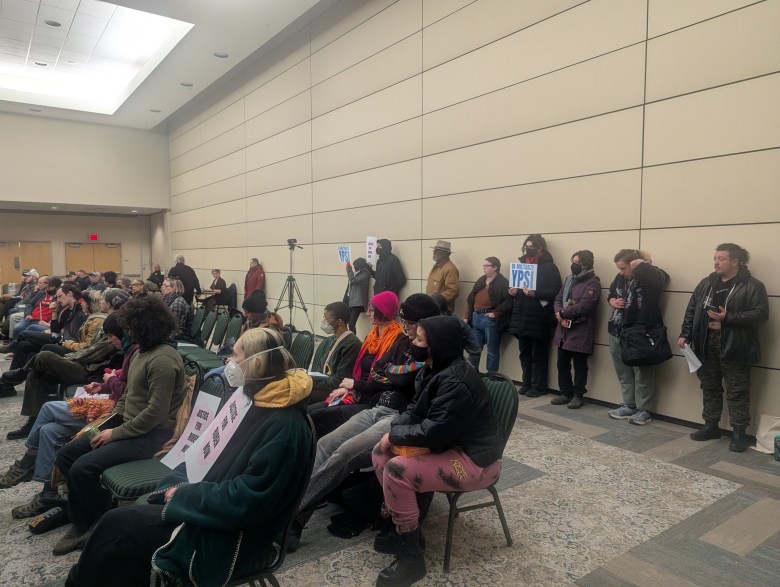 Community members and protesters gather at a January Ypsilanti City Council meeting to call for action in the aftermath of the Cross Street standoff. (Lauren Gibbons/Bridge Michigan)
At city and county government hearings since the incident, crowds have poured in to express their distaste with the situation and concerns that something similar could happen again.
Additionally, more than 100 community members have signed onto a letter demanding accountability and changes in how local law enforcement agencies handle mental health emergencies, calling what transpired a “systemic failure” caused in part by treating care-based crisis response as an afterthought.
“What we witnessed was a systemic failure, with inadequate frameworks and resources for responding to what was in fact a mental health emergency,” the letter reads.
Citing Denver’s STAR program and other US cities that send mental health workers and medics instead of police to respond to low-risk 911 calls, the letter suggests Washtenaw County has a similar opportunity to make unarmed mental health professionals primary responders in mental health crises.
The letter also called on local law enforcement to eliminate the use of several tools used during the standoff in future mental health emergencies, including tear gas, flash-bangs, battering rams, power tools, fire hoses, long-range acoustic devices, drones, assault rifles, snipers, and prolonged sensory tactics.
Yodit Mesfin Johnson, a community leader who led drafting of the letter, has researched and supported alternatives to policing for years.
She said she’s relieved that Peeler got out of the situation alive, but wants local law enforcement and government leaders to understand that a realistic alternative where Peeler, his neighbors and the community at large weren’t subjected to destruction and trauma in the process was possible.
“This is not an anti-police stance,” she told Bridge. “To me, this is a lack of imagination and an expectation of police to provide a care-based response that is unrealistic when they are trained to kill, not trained to help heal.”
The aftermath
The Cross Street house where the standoff took place remains boarded up, with sheets of plywood and house wrap covering broken windows and the hole law enforcement drilled into the front of the building.
In front of the decimated house, there’s now a large heart-shaped board filled with handwritten messages of encouragement for Peeler and his downstairs neighbor — a visual reminder that the community hasn’t forgotten what transpired there.
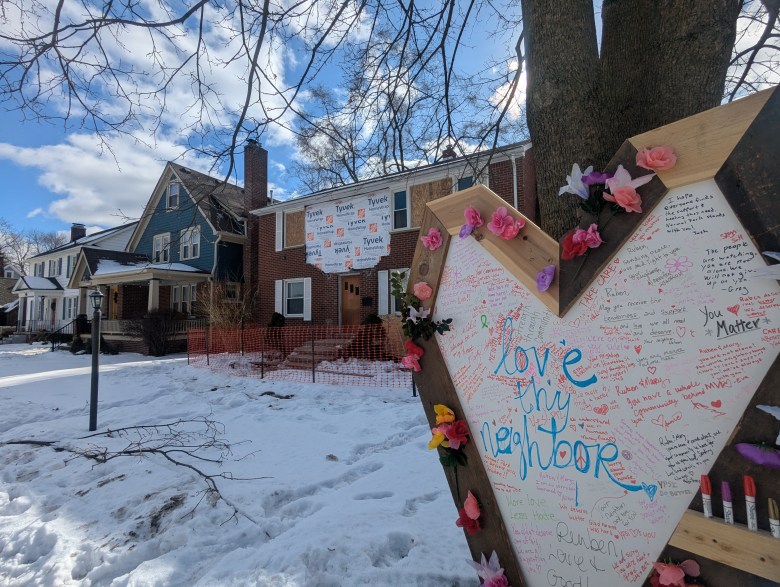 A heart-shaped board in front of the Ypsilanti residence features dozens of messages of support from local residents, including the largest: “Love thy neighbor.” (Lauren Gibbons/Bridge Michigan)
Both the Washtenaw County Board of Commissioners and the Ypsilanti City Council are considering opening independent investigations into the incident, which could come up for votes as soon as March.
At the council’s Feb. 3 meeting, members postponed further discussion on whether to do so to March 3, based on city officials’ words of warning that starting an investigation before the criminal trial concludes could expose the city to legal liability and interfere with ongoing police work.
Some council members feared the possibility of indefinite delay based on that rationale.
“At what stage in this legal process will you come before us and say, ‘OK, now you can do this?’” council member Patrick McLean said at the meeting. “Because I have great worry that the answer is two years from now.”
Woodring, one of Peeler’s neighbors, said he’s concerned by the “extravagant use of resources” that were used when dealing with one person with a sword, noting that he can’t imagine a situation where local law enforcement needs to have or use that type of equipment.
And Keech, the neighborhood association president, said the situation has shattered her trust in local police, because what she and her neighbors saw diverged widely from what law enforcement agencies described. If she needs help in the immediate future, she said, “I’m not calling for help.”
With few questions answered in the nearly two months since the incident, Keech said she’s concerned the multi-day terror her community experienced will fade into the past without any meaningful change.
“I just want to hear somebody say, ‘You’re right, this shouldn’t have happened like this, we should be able to do better,’” she said. “(Law enforcement) not only didn’t protect us, but…caused intentional damage to other humans into a home and into a neighborhood.”
Related
Republish This Story
