
Research suggests that most adults diagnosed with a substance use disorder began using substances before age 18. Today, young people are navigating social media influences and rising rates of anxiety and depression on top of peer pressures, making open, evidence-based conversations about substance use and mental health more important than ever. Sarah Bagley, MD, MSc, partners with adolescents, young adults, and their families to develop community-based solutions that minimize potential harms related to youth substance use.
HealthCity recently spoke with Dr. Bagley, Medical Director of the Center for Addiction Treatment for Adolescents/Young Adults Who Use Substances (CATALYST) and Director of the Youth Advocacy and Research Collaborative at Boston Medical Center (BMC), to discuss how her research at the intersection of primary care and addiction medicine centers young people’s voices to promote prevention, early intervention, and healthier futures.
HC: What is the goal of your research on youth substance use?
Sarah Bagley, MD, MSc: We are learning from young people that they are thinking about drug use because they see it on social media, in movies, and hear about it in conversations with friends. As a parent of three children, ages 7 to 13, I think about this often. Not talking about difficult topics doesn’t mean they aren’t happening, it simply means we are not addressing them openly.
A central focus of my work is therefore partnering directly with young people. Rather than asking them what they think and then making decisions on their behalf, we want to understand what outcomes matter most to them and then collaborate on solutions.
Our goal is to ensure adolescents and young adults have access to reliable, evidence-based information and supportive adults and peers who can help them stay safe. We want to validate their experiences and create space for open, honest conversations.
There are times when clinicians like myself should lead those discussions. But there are also times when peers or near-peers are better positioned to have meaningful, evidence-informed conversations with one another. We are interested in supporting approaches that resonate with youth.
“Rather than asking [young people] what they think and then making decisions on their behalf, we want to understand what outcomes matter most to them and then collaborate on solutions”
Sarah Bagley, MD, MSc, Medical Director of the Center for Addiction Treatment for Adolescents/Young Adults Who Use Substances (CATALYST) and Director of the Youth Advocacy and Research Collaborative at Boston Medical Center
We recently launched a Youth Advisory Board made up of adolescents and young adults in the Boston area. They are helping us think broadly about how to address adolescent substance use and mental health in community health settings. They provide input on our website, social media content, and outreach strategies, and they are helping shape peer-to-peer overdose prevention trainings. The goal is for them to help set priorities and guide the work.
We are also leading a participatory research project using a method called Photovoice. In this approach, young people explore research questions through photography and guided discussions. They take photos that reflect prompts about harm reduction and safety in their communities, then come together to share and discuss their perspectives. This work will be featured in art exhibits in Holyoke, Massachusetts and Providence, Rhode Island.
HC: What inspired you to pursue research on substance use disorder?
SB: My interest in medicine and public health started early. In high school, I had a biology teacher who had planned to go to medical school but chose to become a teacher instead. She brought medicine and public health into the classroom, and I became especially interested in preventing and treating HIV.
In college, I started as a pre-med student but found myself increasingly drawn to public health and advocacy. I worked with an HIV physician in Dallas, Texas, which reignited my excitement about caring for patients directly.
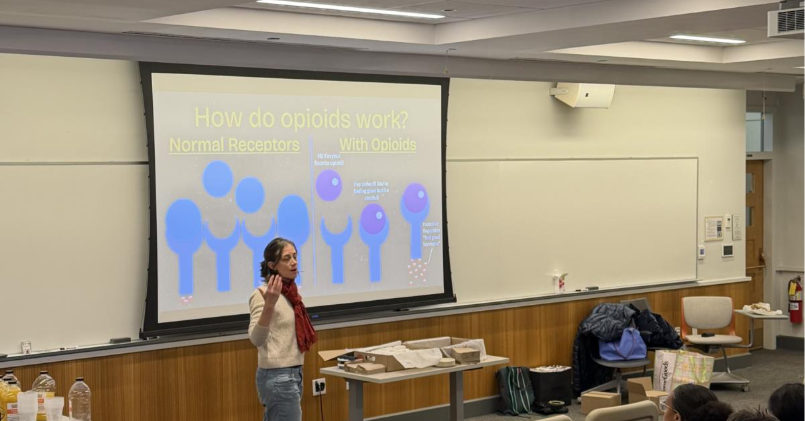 Sarah Bagley presents at an overdose training at BU Academy. Thursday, February 5, 2026. (Carla Renehan).
After college, I worked as a live-in staff member at a homeless shelter in Rochester, New York. Many of the women there were impacted by substance use, incarceration, loss of family connections, and complex health conditions. The shelter’s philosophy centered on compassion and meeting people where they were. That experience deeply shaped how I think about addiction care and reinforced the importance of dignity and access in healthcare.
Throughout medical school and residency, I also heard directly from patients who wanted their primary care providers to be more involved in addressing substance use. Those conversations strengthened my commitment to helping healthcare systems play a larger role in prevention, screening, and compassionate treatment.
HC: How does your work impact patients and families, specifically around youth substance use?
SB: Adolescence is a time of exploration, risk-taking, and impulsivity. That is developmentally normal. It is also a critical window for support and early intervention.
“The earlier substance use begins, the greater the risk of long-term challenges. That is why early identification and engagement are so important.”
Sarah Bagley, MD, MSc, Medical Director of CATALYST and Director of the Youth Advocacy and Research Collaborative at Boston Medical Center
Young people are learning how to distinguish between risks that are part of growing up and risks that can cause lasting harm. Substance use often begins during adolescence or young adulthood or young adulthood, sometimes driven by curiosity, peer influence, or emerging mental health challenges. Some young people may turn to substances seeking temporary relief. Programs like CATALYST are grounded in evidence-based care for youths. Our approach draws on the latest research in addiction medicine, adolescent development, and behavioral health to ensure that the care we provide reflects what we know works. This commitment to research-informed care allows us to offer thoughtful, comprehensive support designed specifically for adolescents and young adults at this critical stage of life.
The earlier substance use begins, the greater the risk of long-term challenges. That is why early identification and engagement are so important. By supporting young people sooner through mental health care, harm reduction education, trusted relationships, and access to resources, we have an opportunity to change trajectories. Our goal is to reduce harm, support safer choices, and help young people build healthy futures.
This interview has been edited and condensed for length and clarity.