
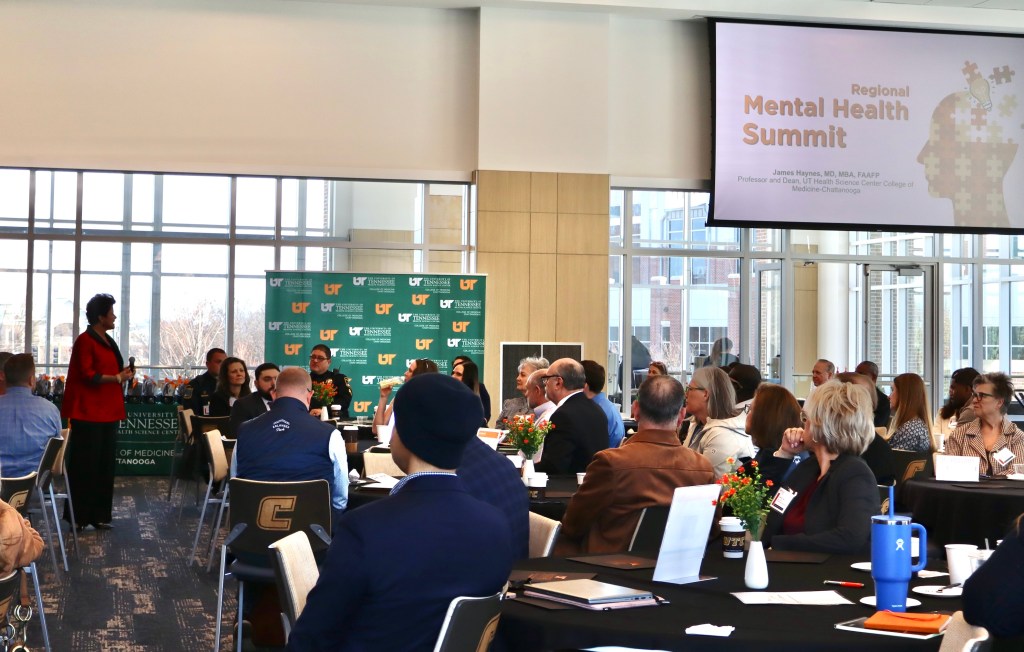
 The Regional Mental Health Summit convened by the College of Medicine-Chattanooga brought leaders from many fields together to talk about mental health in Southeast Tennessee.
Leaders from state and local government, health care, education, and community mental health organizations gathered in Chattanooga for a Regional Mental Health Summit on Friday, February 20, hosted by The University of Tennessee Health Sciences College of Medicine-Chattanooga to gain support in creating a new psychiatry residency program.
The summit featured speakers including Marie Williams, LCSW, commissioner of the Tennessee Department of Mental Health and Substance Abuse Services; Leslie Meehan, MPA AICP, director for the Office of Primary Prevention with the Tennessee Department of Health; Jennie Mahaffey, MD, medical director of Erlanger Psychiatry; Michael Sigsworth, MD, medical director of Erlanger Children’s Child and Adolescent Psychiatry; James Haynes, MD, MBA, FAAFP, dean of the UTHS College of Medicine-Chattanooga; and Joe Sanchez, corporal and lead chaplain for the Hamilton County Sheriff’s Office Each speaker offered perspectives underscoring the human toll of mental illness and the urgent need for expanded services.
“The state of Tennessee currently ranks 46th in the nation for mental health provider access, despite ranking 16th in mental illness prevalence,” Dr. Haynes said. “Our state has a projected shortage of over 700 psychiatrists by 2030. Currently, we only produce 37 psychiatry graduates each year, only seven of those being trained east of Nashville.” Not having a psychiatry residency at the College of Medicine-Chattanooga has fueled the shortage of psychiatrists in the region.
“While we have a plethora of medical students interested in psychiatry, we do not have enough residency positions to train them,” he said. “Residency programs bring clinical leaders to a community and serve as force multipliers to elevate the care being delivered at all levels of mental health care. Additionally, it is well documented that residency program graduates tend to practice near where they trained and serve as a significant recruiting arm to attract the best and brightest physicians to a community.”
Sigsworth, who was born at Erlanger and raised in Ooltewah, Tennessee, reflected on being unable to complete psychiatry training locally, though he knew he eventually wanted to serve the community he calls home. He hopes to help build a pipeline for future psychiatry graduates from the region to have a residency in Chattanooga.
The proposed psychiatry residency program would expand training capacity in Southeast Tennessee, helping to address workforce shortages while strengthening the continuum of care. Residents would rotate through hospital, outpatient, and community-based settings, broadening patient access, supporting interdisciplinary collaboration, and increasing psychiatric expertise across the region’s health care infrastructure.
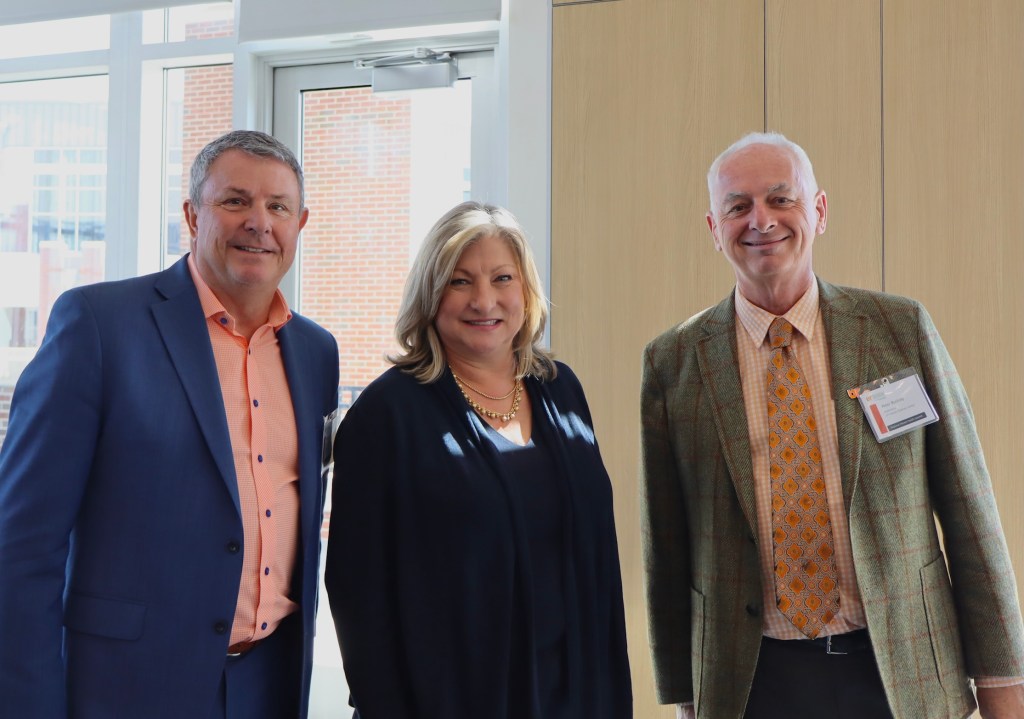 From left: College of Medicine Executive Dean Michael Hocker, MD, UT Chattanooga Chancellor Lori Mann Bruce, PhD, and UT Health Sciences Chancellor Peter Buckley, MD, attended the inaugural Regional Mental health Summit in Chattanooga.
Sanchez described the emotional toll on first responders from repeated exposure to trauma. “You don’t see a whole lot of trauma in your lifetime, but we see two to three traumatic incidents per shift, and nobody knows how to process that,” Sanchez said. “We see it, we bring them here to the hospital, and we go home and end up either in a depressive state or filled with grief and it’s exciting to me because there has been this recognition lately to take care of our people and their mental health.”
Although the summit was not open to the public, organizers emphasized its impact extends well beyond the conversations held in the room. Mental health issues touch many in Tennessee. Behind the statistics are real stories.
“This is a picture of a family who was impacted by suicide,” Meehan said. “This could be any of our families, and in fact it was mine. My husband had no previous diagnosis, no addiction, and no abnormal behavior, but we lost him to suicide in 2022.”
The event marked a significant first step toward expanding psychiatric training, strengthening provider networks, and building a more resilient system of care. Leaders expressed hope that collaborative momentum generated at the summit will translate into action, ensuring the Chattanooga region is better equipped to meet the mental health needs of its communities in the future.
Related