
QuickTake:
A new mental health support service called T.H.E. Van launched in Eugene, and it’s on wheels — which helps it get to where the young people are.
A new counseling and substance use service is helping young people in Eugene, and it’s powered by a four-cylinder diesel engine.
T.H.E. Van — short for Teen Health and Empowerment — launched in September 2025 and turned a Mercedes-Benz Sprinter van into a mobile clinic that can travel wherever unhoused and at-risk youth in Eugene need services.
Michael McCart, a licensed clinical psychologist and certified alcohol and drug counselor who is director of T.H.E. Van, said the idea came from knowing that unhoused youth in Lane County go underserved and face challenges when it comes to accessing resources.
“There are shelters in town, and places to go get a warm meal, but when it comes to health care, there aren’t many options,” McCart said. “T.H.E. Van is mental health and substance use counseling or therapy, just like you would get in an office building, but we’re just sort of bringing it to their doorstep.”
T.H.E. Van’s interior is set up to resemble a therapist’s office, and a therapist’s services are what adolescents and young adults aged 16 to 25 can receive when they walk up to wherever T.H.E. Van is parked.
Treatment starts, McCart said, with a full diagnostic assessment.
“We are speaking with the individual to identify the types of challenges they’re facing, if they meet certain criteria for a diagnosis of substance use or a mental health problem like depression or anxiety,” he said. “And once the challenges that the person is having are defined by a diagnostic assessment, we then develop a treatment plan.”
McCart said a treatment plan follows a protocol, tracks a client’s progress, is based on evidence, and, in the case of substance use, helps identify what leads an individual to use drugs or alcohol.
“There are usually events or feelings or thoughts that trigger someone to turn to drugs and alcohol,” he said. “We help individuals identify what those triggers are, and then we work with the person to try to figure out if there are other ways of managing those triggers more effectively.”
Barriers to traditional service
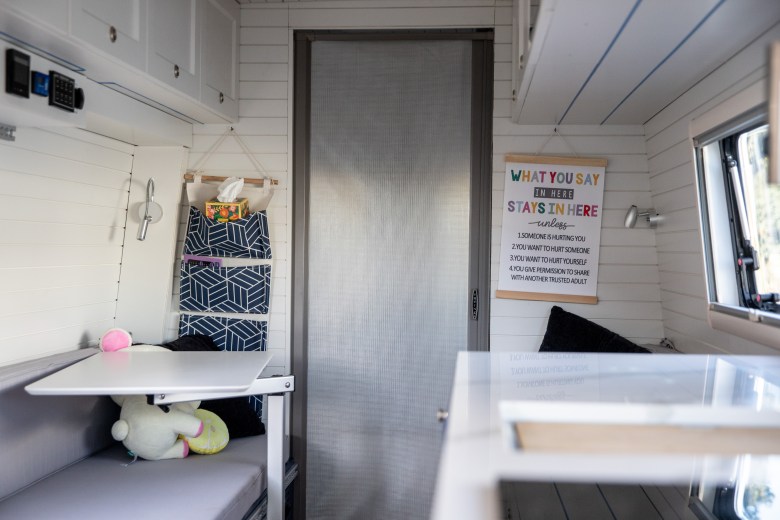 A sign that reads, “What you say in here, stays in here” hangs in T.H.E. Van as it is parked in Eugene, Feb. 4, 2026. The interior of T.H.E. Van is designed to resemble the inside of a therapist’s office. Credit: Payton Bruni
T.H.E. Van bills clients through Medicaid, but if someone doesn’t have insurance, there are no out-of-pocket fees, and the expenses are covered by grant funding.
“We are able to serve anyone, regardless of their financial circumstances,” McCart said.
Jenn Lewis, co-director of T.H.E. Van, said it’s rare for unhoused or at-risk youth to attend a traditional clinic setting.
“Transportation is a barrier. Cost is a barrier. Stigma is a barrier,” she said. “There’s also just this barrier of them not feeling welcome in traditional clinic settings, feeling unsafe or insecure to walk into a clinic setting, so bringing that service directly to them where they’re at substantially reduces that stigma and makes them feel more comfortable.”
While local school districts like Bethel and Eugene 4J have high school counselors and places they can refer teenagers to for mental health and substance use services, it’s not a perfect system. Students fall through the cracks, especially those who are unhoused.
Surviving day to day
When you’re young and struggling to find a safe place to sleep at night, just getting through the day can be a challenge.
“Your entire day is structured around surviving, making sure your stuff doesn’t get stolen, meeting your basic needs like eating, sleeping, which is not happening for most of these people,” said Emily Houck, a counselor with T.H.E. Van.
Houck and Lewis said nighttime is particularly dangerous for unhoused youth, and some try to stay awake all night by keeping themselves on the move or relying on substances.
Lane County data for 2025 estimated that there were 237 youth ages 24 and younger who were experiencing homelessness in the county. Of the 2,004 people who were unsheltered, 130 youth stayed in places not meant for habitation, such as a car or tent, and six stayed in an alternative shelter.
Beyance C., 25, moved to Eugene roughly five months ago and recently started meeting with counselors at T.H.E. Van for help with substance use. (She asked that her last name not be used.) She said she has housing for now, but she’s at risk of losing that housing and frequently wonders what she would do if she ended up without somewhere to stay.
“If you’re not born on this side of the struggle, you’re blind to it,” she said.
She said when she was 7 years old, violence in her Los Angeles neighborhood forced her and her family to leave their home. She struggled with homelessness from then until she was 17.
She said services from T.H.E. Van and other agencies in Eugene have helped.
“No one wants to be homeless and cold and vulnerable and jobless,” she said. “We’re all looking for a community. We’re looking for some help, some stability.”
Funding shortfalls, plans to expand
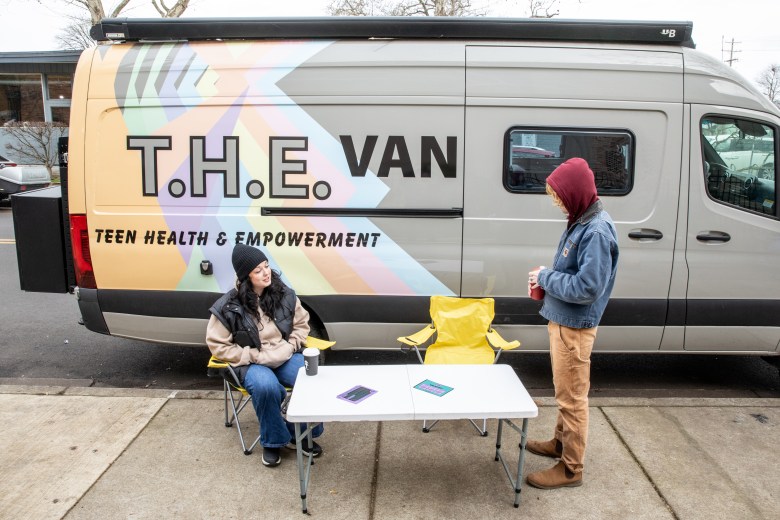 T.H.E. Van counselors Emily Houck (left) and Jeremiah Perry-Weed wait by T.H.E. Van as it is parked outside of Hosea Youth Services in Eugene on Feb. 13, 2026. Credit: Payton Bruni
T.H.E. Van was made possible after McCart and the nonprofit he works for, the Oregon Social Learning Center, received approximately $2 million in grant funding from the Oregon Health Authority for what the state classifies as Behavioral Health Resource Networks, or BHRNs (pronounced burns). Approximately $190,000 was allocated for the creation of T.H.E. Van.
T.H.E. Van’s funding, and funding for other BHRNs in Oregon, is uncertain, however.
BHRNs received their funding through Oregon Measure 110, which funneled tax dollars from cannabis sales to drug addiction treatment and recovery programs. That funding plan remained intact when Measure 110 was rolled back, but cannabis sales are down, and BHRNs are taking a financial hit.
In January 2026, the Oregon Health Authority sent an email to grant recipients stating there was going to be a 14.06% budget reduction to BHRN grants, largely due to “the negative impact of declining cannabis revenue.”
McCart said the budget cuts hurt T.H.E. Van, but it won’t kill the program.
“We will have to make some difficult decisions,” he said, “but I think what it may mean is that T.H.E. Van can be on the street four days a week instead of five.”
Currently, T.H.E. Van operates on Wednesdays and Fridays outside of Hosea Youth Services in the west side of Eugene. McCart said an estimated 10 clients visit T.H.E. Van each week for first-time or follow-up sessions, and T.H.E. Van refers people to other services in town for resources like food, clothing, shelter or primary medical care.
He said he hopes to expand its services to Springfield and rural parts of Lane County, where there are fewer support services to come by.
Lewis said T.H.E. Van is still new, but accessible counseling and therapy services can help give unhoused and at-risk youth an edge to make a difference in their lives.
“I like to think that really small changes at first can lead to bigger changes and get people out of situations where they’re unsafe or unhoused,” she said, “and can start living the lives they want to.”