
Business Community Government Health & Wellness
As a union president with nearly four decades in the construction industry, Chuck Moe has seen how mental health and substance use issues keep people off the job. Yet, until recently, little was ever done about it.
Moe started his career as an apprentice in 1990. For most of that time, it was taboo for construction workers to admit they were struggling with depression or an addiction. Personal issues were kept off the jobsite. Workers were told to “rub some dirt on it,” he said. They were there to “get the job done.”
“It’s that old mentality that if you’re in construction, logging or commercial fishing, you’re tough,” said Moe, president of both the Laborer’s Local 252 union and Olympic Peninsula Building and Construction Trades Council. “It’s time someone stepped up and said this is an issue.”
Bill aims to reduce stigmas
Recognizing the challenges facing workers in the industry — who continue to die by suicide or overdoses at rates much higher the general population — the Legislature last month passed a law that industry leaders believe will reduce stigmas and accelerate changing attitudes toward behavioral health care.
House Bill 2492, passed with bipartisan support on Feb. 28, requires that all state-registered apprenticeship programs in the building and construction trades offer at least two hours of behavioral health and wellness training starting in July 2027. Supporters say the mandate is subtle but could make a profound difference.
Rep. Greg Nance, D-Bainbridge Island, the bill’s prime sponsor, said tradesworkers face record levels of depression, substance abuse and overdoses. The legislation, he argues, will ensure they have the skills to recognize stressors and behavioral health issues before they become a crisis.
Trainings will focus on destigmatizing behavioral health, recognizing signs of distress, suicide prevention, substance abuse disorder awareness, peer support and connection to resources, according to state documents. The law also allows established electricians and plumbers to count up to four hours of an approved training towards their continuing education.
“I hope this modest training requirement helps future construction workers navigate the demands of the job, look out for one another, and get help early — so fewer families experience tragic loss and more workers can keep building Washington’s affordable homes, roads, bridges, and ferries,” Nance wrote in a statement.
As of March 5, the bill awaits Gov. Bob Ferguson’s signature.
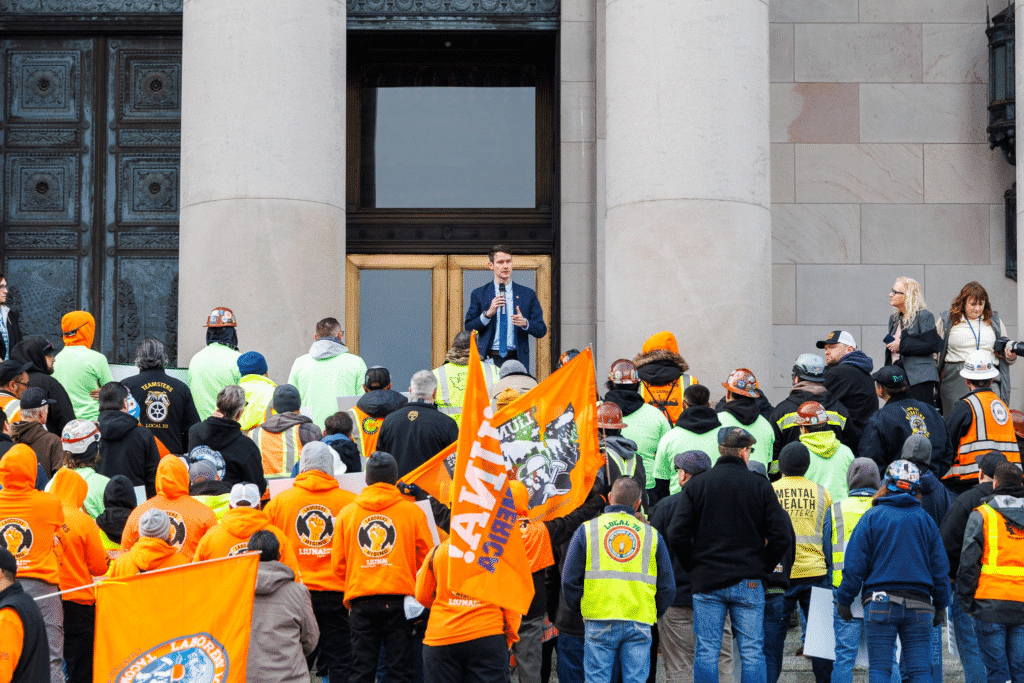
State Rep. Greg Nance, D-Bainbridge Island, speaks at a Building and Trades rally in Olympia on Feb. 17, 2026.
Higher rates of suicide, overdose
Industry leaders believe the legislation acknowledges challenges they have faced for years. Construction workers have among the highest rates of suicide and drug overdoses among any occupation in the country.
Data from the Centers for Disease Control show that among all men who work, the rate of suicide is 33 deaths for every 100,000 people in 2021. For those in construction, that number jumped to a rate of 56 per 100,000. For women, the rate increased from 8 suicides per 100,000 in the general working population to 10.4 for construction workers.
Construction remains one the nation’s most dangerous jobs. About 1,000 workers die on the job per year, according to the Center for Construction Research and Training. By comparison, about five times as many construction workers died by suicide in 2022 and 2023.
“Every person I know who works in construction has been touched by a suicide or other mental health issue,” Clint Bryson, president of the Washington State Association of Electrical Workers, said during testimony on HB 2492.
Hard work, erratic schedules
Construction work is physically demanding, featuring long hours and high injury rates. That stress can often contribute to poor mental health outcomes and drug use. In 2023, more than 15,000 construction workers died due to drug overdoses, according to the Center for Construction Research. Three quarters involved synthetic opioids.
Financial worries also add stress. During the summer construction season, workers often rack up plenty of overtime, Moe said. By the winter, work can be more inconsistent and harder to find.
“That change alone can bring on high anxiety,” he said.
Christopher Ellis, vice chair of the Bricklayers and Allied Craftworkers Local 1 Washington and Alaska, said for much of his career workers have kept personal issues off the jobsite. They could be ridiculed by coworkers or their foreman for discussing personal problems.
But he has noticed that attitude start to shift in the last two years. Unions started speaking to their members and distributing information about 988, the national suicide and crisis prevention hotline. The new generation of tradesmen, he said, also seem more willing to be open about their mental health.
Ellis hopes that the introduction of House Bill 2492 – a law he believes to be the first of its kind in the nation – could further accelerate that changing dynamic.
“It’s a monumental shift,” he said of the law. “I think it will save lives.”