
The professional gambler moves in the shadows, tight-lipped and furtive about how he makes his living. He is paranoid in new company. He keeps himself to himself and gets defensive when normal people quiz him. He hates being a plaything for their curiosity.
Well, yes – except someone forgot to tell any of that to Johnny Dineen. We’re sitting in a busy coffee shop in Dublin city centre and as he chats away about the highs and lows of a life spent punting for a living, he couldn’t be more amiable or candid about it all. At no point does he check over his shoulder or lower his voice. This is who he is and there aren’t many like him.
Dineen is an ex-bookmaker (although he’s coming out of retirement for Cheltenham next week). He’s 55-years-old and lives in Youghal, Co Cork with his wife and five kids, ranging in age from four to 21. He bets on horse racing every day. He has never had an office job in his life.
“A fella said to me one time that if you’re able to do it, gambling is basically money without work. If you’re good enough at it, if you get it right, you can get something tangible. You can be like: ‘I bought that car and I didn’t work at all for it. I got it because I was good at picking horses.’ There’s an element of satisfaction in that.
“I like gambling. I love it. I would describe what I have as a controlled addiction. I get a satisfaction out of it. Not many people can do it. There is an element of achievement in it for me – I have been able to raise my family out of it. I suppose I was never one for the security of a nine-to-five job.
“I can appreciate people that work hard for a living and all that. It’s not the way I wanted to play my life, but I can very much appreciate that. And I respect other people that have good jobs and bad jobs and all kinds of jobs, people who do stuff I’d hate to have to do.
“The way I look at it is you have to have one of two things – you either have to have job satisfaction or huge money to counteract the lack of job satisfaction. I nearly always get job satisfaction. The money is in the lap of the gods sometimes, whether I actually make the money or not. But I have great job satisfaction.”
The racing world is small and gossipy and everybody talks about everybody, not always in the kindest of terms. But it might be easier to find the winner of one of the handicaps at Cheltenham next week than to find someone who’ll cut the back off Johnny Dineen. His appearances on the Upping The Ante YouTube show have made him into an unlikely star in racing media and he’s a mainstay of the preview night circuit.
Ask around as to why he’s so popular and the same lines keep coming back at you. He’s genuine, obliging, no bullshit, an open book. Plenty of people talk their gambling up and even more talk it down – Dineen does neither. A good day is a good day and a bad day is a bad day. No point bluffing either way.
“There was a time,” he says, “when a fella who could actually make money as a punter, he was seen as half a hero. But nowadays he’s almost a pariah. If you go around saying you’re gambling for a living, it’s not a million miles away from being a drunk driver or a drug dealer in some people’s eyes. It’s a dark, seedy world that they see.
“For someone from the outside world looking in, most people would say: ‘Jesus, I don’t fancy that life.’ But it’s all I’ve ever done and it’s all I’m ever going to do. I couldn’t ever see myself doing anything else now at this stage. I wouldn’t mind retiring from it at the same time. And if I did retire, I’d never have a bet again.”
Dineen grew up in Youghal, the son of two teachers. In the 1980s, the dog track in the town was a social hub and families built their weekends around it. His dad often clerked for one of the bookies on the rail on a Friday night, writing down the bets as they came in and keeping track of potential liabilities from race to race. Eventually, he got tired of it and got his young lad to fill in for him.
“I could maybe clerk for a fella at Youghal dogs on a Friday night, then do the same at Cork dogs on a Saturday night and maybe a point-to-point of a Sunday. And between the three days, you could have 80 quid on a Sunday night. And you only 14 years of age. My parents would be giving us £2 for the week going to school. So if you had your 80 quid, that’s a fortune.”
It’s been his life, in one form or another, pretty much ever since. After a short stint in UCC – and an even shorter one in London living with his brother – he clerked for a bookmaker back in Cork for a few years before striking out on his own. He was a bookie for the guts of two decades and the reason he can be a punter now is that he had the good fortune to be in the game when the game was good.
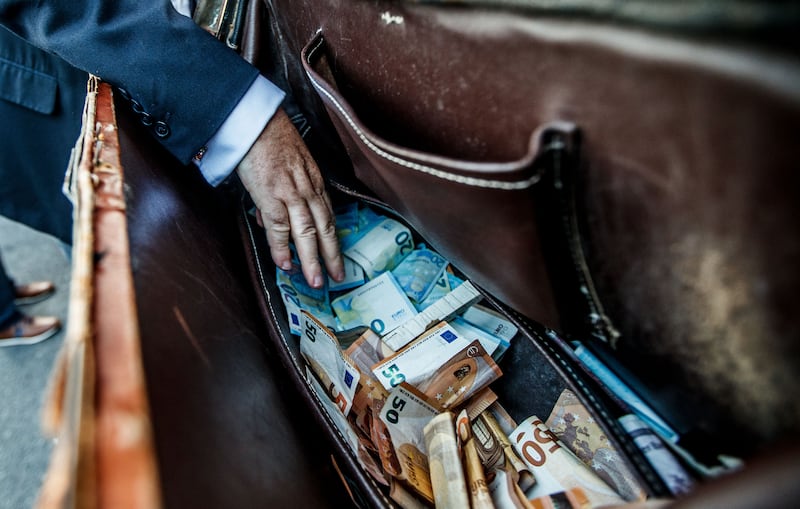
There was endless money sloshing around the place during the Celtic Tiger and he was expert enough at his trade to make sure it regularly found a home in his satchel. Those were the halcyon days and if he did one thing right in his life, it was recognising them for what they were and acting accordingly.
“A huge thing for me is to take money off the table when you win,” Dineen says. “If you have a stack of money that high [holds his hand at forehead-height], you’ll bet like it’s that high. You bet away and if the stack goes down, you start saying to yourself: ‘Sure I’ve loads of money, I can bet away here and it doesn’t matter a damn.’ So to me, the secret is keeping the stack at a lower level and always be hungry to build it up.
“Because if you have it lying around the place, you’ll end up betting it. If you have 100 grand available to you, you’ll start betting in 15 grands and 20 grands. But if you have 10 to 15 grand on hand, you’ll bet in twos and threes. There’s no need to be betting 15, 20 grand a bet.
 It’s a good idea to take your money off the table when you win, says Johnny Dineen. Photograph: James Crombie/Inpho
“The higher you go in the stakes, the more dangerous your opponent is going to be. You’ll get found out. So it was crucial in all those good times to take money and put it into something. I have some bits of property that I put it into and I never had a mortgage on any of them.”
When the crash came and money got tight all over, it became harder and harder to make a living as a small bookmaker. One losing year turned into two and he couldn’t risk it becoming three. He had made his money, he had taken chunks of it off the table and he wasn’t in hock to anyone. Time to get out.
“I never got into debt anywhere. I was lucky enough that I was able to walk away from being a bookie and didn’t owe anyone, which is massive. That was the big thing for me when I started doing Upping The Ante.
“It was a completely different thing for me, something I’d never done in my life. But I felt I could chance it because at least I knew I’d be doing it and there’d be no fella watching it and pointing at the screen going: ‘That bastard owes me money.’
“That was a massive thing and it still is a massive thing for me today. That you still have your reputation when it’s not an easy game to keep your reputation intact. You see a rake of fellas getting into financial trouble in our game. But to be doing it for over 30 years, I can actually say it’s the one thing I’m proud of – that nobody can point at me and say: ‘Here, he owes me money.’”
Fundamentally, his life didn’t really change. He was a full-time punter now but his daily bread still came down to separating the winners from the also-rans. Bookmakers gamble more than punters – at least a punter can take a race off. He knew the game, he knew the people, he knew the pitfalls. Most importantly, he knew himself.
“You have to have a good temperament for it. You have to have a bit of bottle and you have to be able to take the rough with the smooth. There’s no good crying if they lose. But then, you can’t take it too good either. You can’t be a really good loser because it has to hurt at the same time.
 Bookmakers at the Galway Racing festival. Photograph: James Crombie/Inpho
“Discipline is a lot in this game. I’m not the best at discipline but you get older and you make the same mistakes and you learn it. My discipline is probably at the best it’s ever been really. But it’s taken 30 years to get there.”
His stakes have come down accordingly. Back in the mid-2000s, Dineen says he was betting five-figure sums on more or less a daily basis. His workaday stake would be a fraction of that now. He bets through intermediaries most of the time but it would rarely be enough to attract too much attention anyway.
And so he makes a living that is serviceable, without, as he puts it, “looking to win gazillions”. He can bet that way because he built up enough of a cushion in the good times. So if he has a bad year now, it (a) won’t be a catastrophic amount of money and (b) can be offset by selling one of the assets he has gathered up over the years.
[ Generation gamble: the invisible addiction crisis gripping Ireland’s teenagersOpens in new window ]
“It all depends on how you plot yourself going up the ladder,” he says “I put stuff away and I know that if the shit really hits the fan, I can sell A, B, C and D. It’s massively important to me to start each year being able to say myself: ‘Okay, if I lose this year and we have no money, I can bang one of those out to cover it.’ So I have that bit of a fallback. It’s a lot more precarious when you have nothing to sell.
“Once my kids are happy and the family is happy, that’s all that matters. One major thing I had was I didn’t want my kids saying: ‘Ah, my dad was never around when I was at matches.’ I was at every match they ever played. My small one is eight and she does gymnastics now and I’m at that the whole time. My life allows me to be there for them.
“Look, it’s a game that wouldn’t suit many people. I get that totally. Thankfully, my kids won’t follow in my footsteps – I’d hate for them to be involved in it. Or to be depending on it anyways. Because the landscape has changed completely. If I had to start now at 19 years of age, I wouldn’t have a prayer. I wouldn’t last pissing time.”
At Cheltenham, he’s going to stand as a bookie for the week, frontman for Paul Byrne’s Fitzwilliam operation. It’s a bit of a gimmick but he’ll be taking it seriously all the same. We can’t let him go without extracting a tip so he reckons The New Lion has no opposition in the Champion Hurdle on Tuesday and Carrigmoornaspruce is a good shout in the Mares Novice Hurdle on Thursday.
And then, when it’s over, the circus will move on and he’ll stay going. Navan on the Saturday, Limerick on the Sunday. All the stuff in England. Day in and day out, like he has done his whole life.
“I fancy my chances every single day. I don’t win every single day obviously, but I fancy my chances every single day. And if I can behave properly and not go chasing, I kind of know I’ll probably win over time.”