
Six years after the start of the COVID-19 pandemic, its effects are still visible — from widespread hybrid work schedules to declining student performance.
Add another wrinkle to the list — new prescriptions for ADHD medicine have more than doubled since the start of the pandemic, especially among younger adults.
ADHD, or attention-deficit/hyperactivity disorder, is persistent inattention, hyperactivity and impulsivity that interfere with daily functioning and disrupt quality of life. About 15.5 million of US adults (roughly 6%) and some 7 million children (around 11%) have been diagnosed with it.
 Recent research finds that new prescriptions for ADHD medicine have more than doubled since the start of the COVID-19 pandemic, especially among younger adults.
In a study published Monday, Canadian researchers noted that ADHD diagnoses and stimulant prescriptions for adults have increased worldwide over the last two decades, with the trend gaining steam after the pandemic started.
“Our findings may reflect improved recognition and treatment of ADHD in adulthood; however, the speed and scale of this growth also raises important questions about how diagnoses are being made, and if this prescribing is always appropriate,” Dr. Tara Gomes, program director of the Ontario Drug Policy Research Network at St. Michael’s Hospital, said in a statement.
For this study, Gomes’ team determined that about 327,000 Ontario adults were given a new prescription for stimulants from 2016 to 2024.
Stimulants like Ritalin and Adderall increase the neurotransmitters dopamine and norepinephrine to enhance focus, attention and executive function.
The typical patient in the study period was a 31-year-old woman living in an urban area. Still, the group of new stimulant recipients that grew the most was 18- to 24-year-old women.
“Many of these findings are consistent with trends in stimulant prescribing observed globally in the post-pandemic era and are likely influenced by greater awareness of adult ADHD and improved access to care following a historical pattern of underdiagnosis of ADHD in adulthood — particularly among women,” said co-author Dr. Mina Tadrous, an associate professor at the University of Toronto.
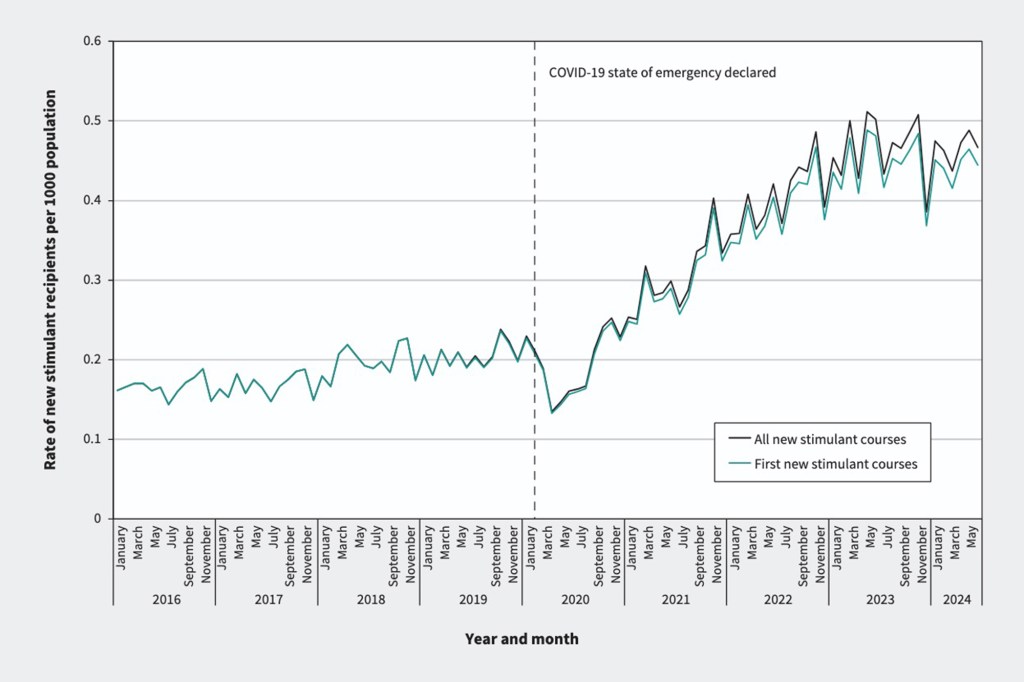 This graphic from the new study shows the sharp increase in new stimulant prescriptions after the start of the COVID-19 pandemic. CMAJ 2026 March 9;198:E313-25. doi:10.1503/cmaj.251065
Tadrous said that the uptick in adult ADHD diagnoses is likely fueled by the rapid expansion of virtual health services, mental distress from the pandemic, greater screen time and the flood of ADHD information on social media.
But inaccurate and unverified online content could contribute to misdiagnoses and potential harm.
Diagnosing ADHD involves a comprehensive clinical evaluation by a specialist who conducts interviews, assesses behavioral patterns and reviews childhood developmental history.
Researchers have not pinpointed a single cause of ADHD — it’s believed to result from genetic, brain-based and environmental factors. It’s highly hereditable.
Symptoms of ADHD, which typically start in childhood, generally include trouble focusing, restlessness, disorganization, impulsiveness and forgetfulness.
Gomes noted that before the pandemic, psychiatrists were prescribing ADHD medicine at a rate of 26%.
After the start of the pandemic, that rate fell to 18% while prescriptions from nurses and nurse practitioners rose from 2% to 10%.
“Because diagnosing adult ADHD requires careful and comprehensive clinical evaluation,” Gomes said, “these patterns point to the importance of ensuring that rigorous assessment protocols are used to support treatment decisions that are better aligned with clinical standards.”
The findings were published in the Canadian Medical Association Journal.
The study authors are calling for additional research into the rising rates of stimulant use and the efficacy of this treatment for ADHD.