
Most federal school mental health grants that have been in limbo for nearly a year will see their funding continue for the next three months—and potentially through the end of 2026—after the Trump administration lost a bid in court late last month to keep the awards frozen.
The U.S. Department of Education last week told the recipients of 120 of those grants that their funding to hire and train new school mental health professionals would continue until June 1. But it said in a notice to grantees that it was issuing the extended awards “under protest” as it appeals a lower-court decision concerning the grants.
The grantees “may receive additional” funds after they submit midyear performance and budget reports that are due June 1, the department said in a Friday court filing that also noted the agency has set aside money for the projects through the end of the year.
Meanwhile, the recipients of about a dozen other grants will see their funding end, the department said, either because they didn’t submit required project updates or because of “performance, fiscal, and administrative concerns” with their projects.
The three additional months of funding bring a temporary resolution to a long-running period of uncertainty and legal limbo for the recipients of dozens of grants awarded under two programs that began during the first Trump administration to expand school-based mental health services: the School-Based Mental Health Services and Mental Health Service Professional Demonstration grant programs.
The uncertainty began in late April last year, when grantees received surprise notices from the Education Department telling them their funding would end Dec. 31, 2025—years earlier than planned—because their work reflected Biden administration priorities and was now “inconsistent” with “the best interest of the federal government.”
Northwest Educational Service District 189, which serves school districts in northwest Washington state, had hired 20 licensed behavioral-health providers to work in member school districts by the end of last year, the third of its five-year, $11.9 million grant.
Before last week, without knowing whether funding would keep flowing, “the programs have been operating under complete uncertainty of how or if they could continue,” said Natalie Gustafson, the service district’s director of behavioral-health and prevention services, in an email to Education Week.
While the extension is welcome, Gustafson said the partial-year funding with a report due midyear is a departure from how the grant funding previously worked, when the organization received access to a full year at a time.
In addition, the district and other grant recipients will only be able to access money on a reimbursement basis, using other funding sources first to cover expenses rather than being able to draw down federal funding to pay costs as they incur them.
One of the Ed. Dept.’s largest round of grant cancellations in 2025
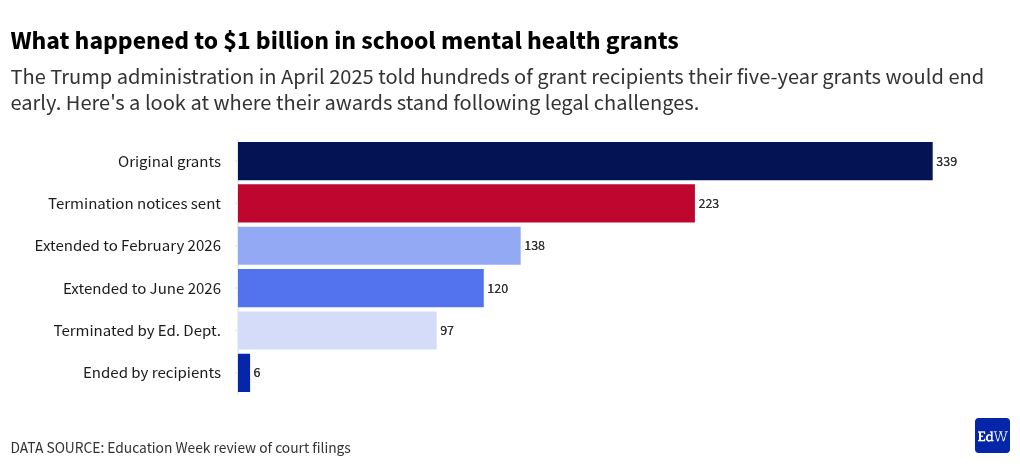
Some 339 entities across the country—a mix of school districts, multidistrict partnerships, state education departments, and universities—received five-year awards from the Biden administration after Congress devoted $1 billion to the two mental health grant programs in 2022 following the school shooting in Uvalde, Texas.
The School-Based Mental Health Services grant program underwrites projects to hire and retain school mental health professionals while the Mental Health Service Professional Demonstration program pays for efforts to train new school counselors, psychologists, social workers, and school-based clinicians.
Some 223 of those grantees received the late April notices telling them their funding would end at the close of 2025, according to court filings. Some had just begun their projects while others were starting their third year.
That round of discontinued grants was among the largest undertaken by the Education Department last year, as it disrupted more than 760 in-progress grants from more than 30 programs, totaling more than $2 billion.
The discontinued awards sparked a lawsuit from 16 states with Democratic attorneys general in late June that’s led to the current situation.
Ultimately, a federal judge found the Education Department acted illegally when it canceled the mental health grants without providing individualized reasoning for each one. The Seattle-based judge, Kymberly Evanson, ordered the agency to make new decisions either continuing or discontinuing the projects’ funding that met its obligations under the federal Administrative Procedure Act.
Her ruling applied to 138 of the 223 discontinued grants—all projects in the states that sued.
The Trump administration then appealed Evanson’s decision in January, and asked the U.S. Circuit Court of Appeals for the 9th Circuit to pause the decision while it considered the appeal. The appeals court denied the administration’s request for that pause on Feb. 26—prompting the continuation awards for grantees that were initially due Dec. 30, 2025.
The administration’s broader appeal of Evanson’s ruling is still pending.
Grantees received some interim funding at the start of 2026, but they still were exploring other strategies to keep their work going in the long run. Six grant recipients voluntarily terminated their grants before they could receive funding extensions, the administration said in its Friday court filing.
Meanwhile, the Trump administration awarded 65 new school mental health grants in December worth $208 million, using money from the awards it had expected to cancel.
The Education Department didn’t respond to a question Monday about the source for the mental health grants’ extended funding, but Congress in February set aside at least $164 million for the two school mental health grant programs in its fiscal 2026 budget.
With the future of its grant uncertain, Northwest Educational Service District 189 in Washington state was “working on several strategies to avoid an end of services” if its federal funding stopped, said Gustafson, the district’s behavioral-health director.
Now, she said, “we are beginning to have some hope that we can continue with the rest of this school and potentially calendar year.”