
When Patrol Officer Tyree White responded to the Chakraborty family’s 911 call about their 22-year-old son, Jabez, experiencing a psychotic break, he arrived at their home in Queens trained to handle this potentially volatile situation.
He’d completed all four days of NYPD training on responding to people in crisis and had been certified as a member of the department’s Crisis Intervention Team (CIT). He’d also taken a separate NYPD course in how to handle an involuntary mental health removal.
In all of these classes, White had been urged to avoid using force during interactions with people in crisis, to do everything possible to de-escalate what could be a tense dynamic and to talk the subject of the call into cooperating.
In a matter of seconds in the Chakraborty home, all of that went out the window.
As Officer White stepped into the family’s living room, Jabez — standing in the kitchen — picked up a large kitchen knife and began advancing toward him. White instantly drew his service revolver and aimed it at Jabez, shouting, “Put down the knife!”
White backed out of the room into an entrance vestibule and shut a glass door between him and Jabez, but Jabez pushed his way inside. White then fired four times, critically injuring Jabez.
There was no time for de-escalation and dialogue. The entire interaction took 16 seconds. Jabez, who remains hospitalized, now faces a felony charge of attempted assault.
The NYPD has touted the training White received as a crucial tactic in its effort to reduce the number of police responses to individuals in mental health crises that turn violent and sometimes fatal. It has tried to expand the number of cops receiving this training, making it part of the police academy curriculum in 2017.
Officers interviewed by THE CITY agreed that this training has helped them avoid calamitous results while responding to what the NYPD refers to as 911 EDP calls (for emotionally disturbed persons). Thousands of these calls have been resolved each year without the use of force. When the de-escalation and dialogue training is successful, the person agrees to be transported to a hospital or go with a family member without incident.
It doesn’t always work out that way.
In eight incidents since 2019 where cops wound up either shooting or tasing the subject of a 911 mental health call, the officers involved were trained in crisis intervention, a review of NYPD records by THE CITY found. That included six encounters where the subject was killed.
These disastrous interactions have fueled a desire from elected officials and advocates for mental health care reforms to remove the NYPD from responding to these calls as much as possible. This no-police notion, in fact, is central to Mayor Zohran Mamdani’s planned Department of Community Safety.
Mamdani favors greatly expanding an existing program known as B-HEARD that sends mental health professionals to calls dispatchers deem non-violent instead of police. (He’s yet to reveal details of the proposed new agency, but promised to accelerate its inception after Jabez Chakraborty was shot).
“The mayor believes it is important that the police department follow effective, evidence-based training practices,” spokesperson Sam Raskin said in response to THE CITY’s questions. “The Mamdani administration is evaluating how we can improve our city’s current system of responding to people experiencing mental health issues — both through early intervention and in moments of crisis — while working to develop a more holistic approach to these challenges through the Department of Community Safety.”
Because the vast majority of 911 mental health calls are deemed by dispatchers to be potentially violent, cops wind up responding to nearly all of these calls. In the first half of fiscal 2026, THE CITY found, 86% of 911 mental health calls triggered a police response.
“I think you have to send police to the great majority of these scenes,” said Brian Stettin, the senior advisor to the mayor on mental health issues under Eric Adams. “I’ve seen estimates that as many as half of crisis calls might be diverted from the police, but I consider that a very rosy estimate.”
Given that police will likely continue to handle many of these calls under whatever new system Mamdani sets up, CIT training will continue to play a role in the ongoing effort to reduce the number of NYPD interactions that go awry.
Four Days of Training
The NYPD has stated its goal is to train all cops in crisis intervention, and while the number of CIT-certified cops has fluctuated over the years, it’s since risen from 14,000 in 2022 to 22,360 this year. That’s two-thirds of the NYPD’s 33,950 uniformed officers.
Currently the four-day training consists of separate “modules”:
— Part One was until recently listed as “Sending the Right Signal” to the person in crisis, but last June the NYPD added a training called Integrating Communications, Assessment and Tactics that specifically drills down on de-escalating interactions where the subject of the call is armed with a weapon other than a firearm.
— Part Two consists of instruction on mental health law, discussions with individuals with specific disorders describing their personal experiences and prior interactions with law enforcement, and role playing where officers confront scenarios with actors portraying individuals with schizophrenia or displaying suicidal ideation.
— Part Three continues with more simulated crisis situations, addressing how to respond to specific diagnoses including personality disorders, anxiety, and PTSD.
— Part Four presents scenarios regarding responding to individuals with development disorders, anti-social personality disorder, autism and dementia.
There have also been separate classes available on handling involuntary mental health removals, “tactics when engaging individuals in a mental health crisis” and “successfully disarming an EDP.”
A 2017 Department of Investigation report that recommended greatly expanding this training offered more detail, noting that officers were instructed to “avoid provoking subject and take necessary time, establish dialogue,” “de-escalate if possible” and “allow officers to use discretion to avoid hospitalization when appropriate.”
In response to a query by THE CITY, Police Benevolent Association President Patrick Hendry praised the training, but acknowledged that the complex nature of these encounters sometimes requires that the police show up.
“New York City police officers respond to hundreds of thousands of mental health emergencies every single year. We are always in support of more training to help our members handle these situations safely and effectively,” Hendry said in an emailed statement. “However, police officers know that some situations are so unpredictable and dangerous that no amount of training can fully mitigate the risk. No matter who is initially sent to these calls, there will always be a significant number that cannot be safely resolved without a police response.”
An officer assigned to the 6th Precinct in the Village who has responded frequently to 911 mental health calls and received crisis intervention training at the academy, said, “Most of the time [the training] is pretty effective.”
The officer, who spoke to THE CITY on condition of anonymity because he’s not authorized to speak with the press, described a recent encounter with a man whose parents had called the NYPD to say their son was talking about killing himself. The officer found the man in a parking garage and spoke calmly with him, convincing him to get into an ambulance for transport to a nearby emergency room.
A sergeant assigned to patrol public housing developments who has received crisis intervention training recalled a woman who came at him with a baseball bat. He was able to get the bat away without using force. In general, he said, the idea is “keep as much space between yourself and these people.”
Both of these cops, however, also made clear these interactions don’t always go so smoothly.
“The main thing with EDPs is to slow things down and take your time. You have to be really, really patient,” said the officer assigned to the Village. “Unfortunately, training is just a tool. Dealing with the emotionally disturbed is very unpredictable.”
The officer noted that “cops realize that their presence changes the dynamic automatically. It’s hard to come into someone’s home and tell them we have to take you away … Nobody wants to be told that.”
Stettin, Adams’ advisor on mental health, noted that in some cases, there’s no time for cops — even those with CIT training — to de-escalate: “If it’s just the appearance of police,before they even say a word, the person is triggered by the sighting of the police. There’s no training in the world that’s going to avoid those tragedies.”
With Chakraborty, body camera footage shows that the second the police entered his family’s living room on Jan. 26, he grabbed a knife and began advancing towards them, pushing past his mother, Juli, who tried to hold him back. The time between “first encounter” and “shots fired” was 16 seconds.
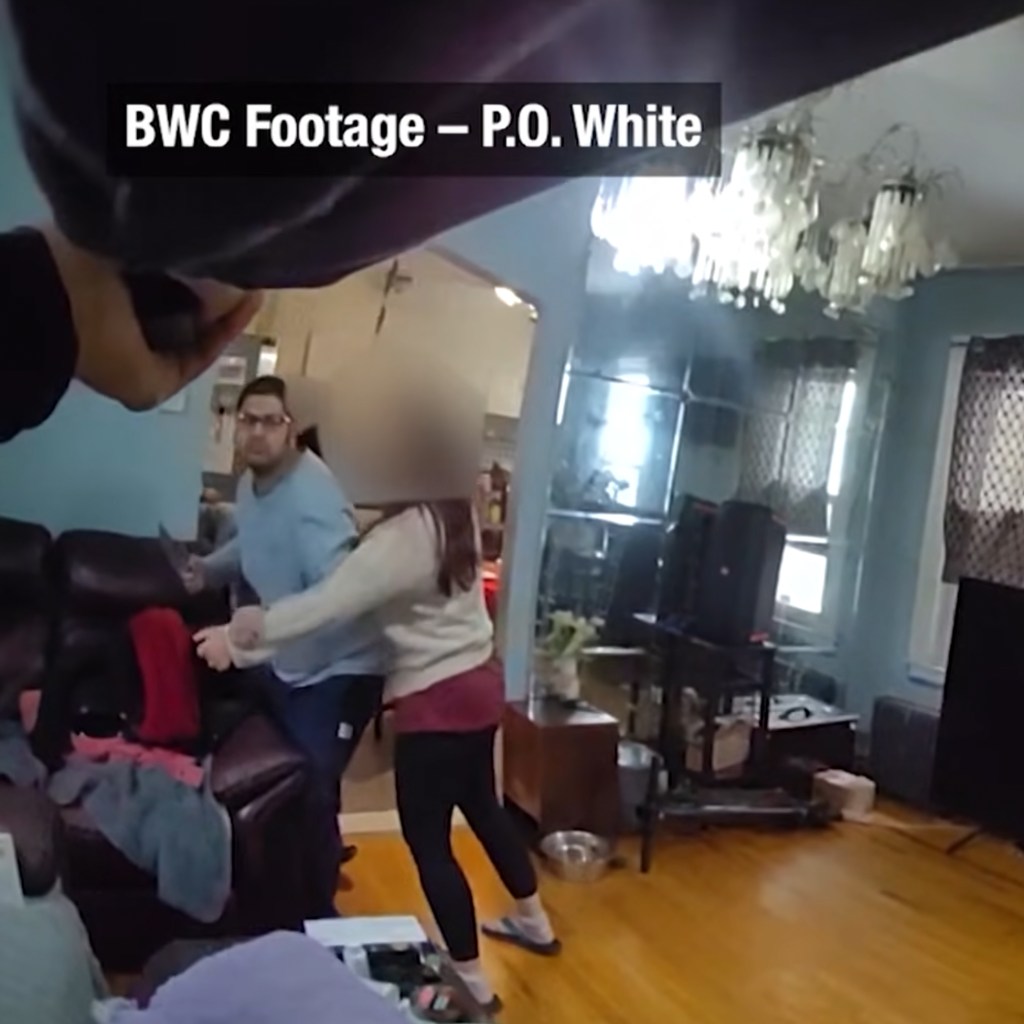 Jabez Chakraborty’s was recorded on NYPD body camera footage approaching officers with a knife after they responded to a 911 call about Chkraborty having a schizophrenia episode inside his family’s Queens home, Jan. 26, 2026. Credit: Via NYPD body camera footage
THE CITY examination of the eight cases since 2019 that resulted in CIT-trained police shooting or tasing a subject revealed that even when the officers attempted dialogue, the situation sometimes culminates in tragedy.
Ruth Lowenkron, director of the Disability Rights Program at New York Lawyers for the Public Interest, which has filed a class action lawsuit over police interventions in mental health calls, said the eight cases reviewed by THE CITY make clear CIT “can’t be the answer.”
“Police are never going to be the right people to respond,” said Lowenkron, who’s also on the steering committee of Correct Crisis Intervention Today (CCIT), a group that advocates for zero police response to mental health calls. “You can train them up the wazoo but they are not going to be the right people. That’s not casting aspersions on any one police officer. It’s about the training to suspect danger everywhere and to be hyper vigilant in eliminating any danger. But that’s just not the right mindset in responding to people in a health crisis.”
Heat of the Moment
THE CITY’s review found that in the heat of the moment, the training can play out differently with different officers.
Last December, police officers Amada DelaRosa and Rocharlie PointDujour responded to a 911 call from a family saying their son, Chez Fray, was experiencing a psychotic break. NYPD officer history records show both had received crisis training: DelaRosa had taken classes on “People in Crisis” and “Mental Health Involuntary Removals,” and PointDujour had received three of four CIT training modules.
Both officers were speaking with family members in the hallway of their apartment building in Far Rockaway when Chez emerged with a box cutter in hand. In body camera footage DelaRosa can be seen immediately pointing her taser at him, while PointDujour aims her service weapon. For several minutes they repeatedly order him to drop the box cutter. At one point DelaRosa shouted, “I’m going to tase him.” Seconds later PointDujour, pointing her pistol at Fray, shouted, “I’m going to shoot!”
DelaRosa responded, “No!”
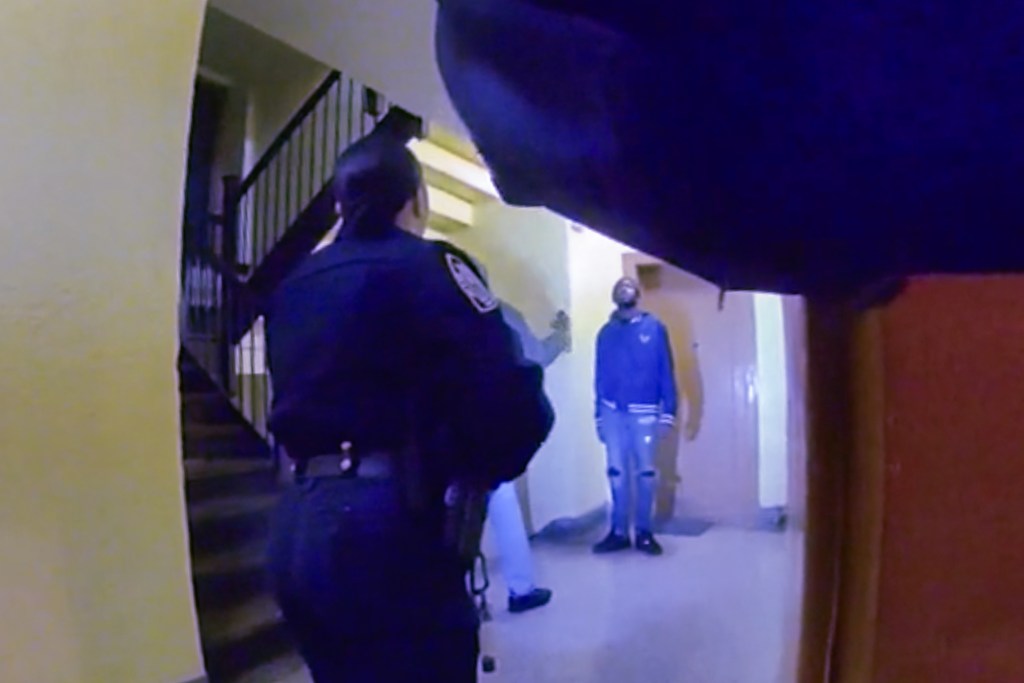 NYPD officers fatally shot Chez Fray after he advanced at them holding a box cutter after family members made a 911 call that he was experience a psychotic break insider their Far Rockaway home in 2025. Credit: Screengrab via NYPD Body Camera Footage
Chez’s father then tried to wrestle the weapon away from him, but Chez pushed him aside and began advancing toward the cops. DelaRosa fired her taser. PointDujour fired her service weapon. Chez was pronounced dead hours later. The shooting is now under investigation by state Attorney General Letitia James’ Office of Special Investigation which examines the circumstances surrounding some fatal police shootings.
This type of dramatic contrast between officers also emerged in the April 2019 shooting of Kawaski Trawick. Both officers involved had received crisis intervention training shortly before the incident: Officer Brendan Thompson three months earlier, and Officer Herbert Davis just three days prior to responding to a 911 call that wound up with both officers standing inside Trawick’s Bronx apartment.
Officers Davis and Thompson entered the apartment to see Trawick standing at his stove cooking, holding a knife in one hand and a stick in the other. Almost immediately both pulled out their tasers and began repeatedly ordering him to drop the knife. Trawick repeatedly asked them why they were inside his apartment.
Davis and Thompson then proceeded to approach this confrontation differently.
Though both officers were now wielding tasers, Davis advised Thompson, “We ain’t gonna tase him.” Thompson then unholstered his service weapon as well, triggering Davis to push down Thompson’s arm with the gun while stating, “No, no. Don’t, don’t, don’t.”
Body camera footage shows when Trawick began walking toward the officers, shouting, “Get out bitch! I’m going to kill you all!” Davis aimed his taser but didn’t fire, while Thompson fired four shots. Trawick was pronounced dead at the scene.
The independent police watchdog, the Civilian Complaint Review Board (CCRB), substantiated illegal entry and excessive force charges against both officers and sought disciplinary charges at an internal NYPD trial. An administrative judge dismissed the case, finding that CCRB hadn’t proved the officers broke any laws.
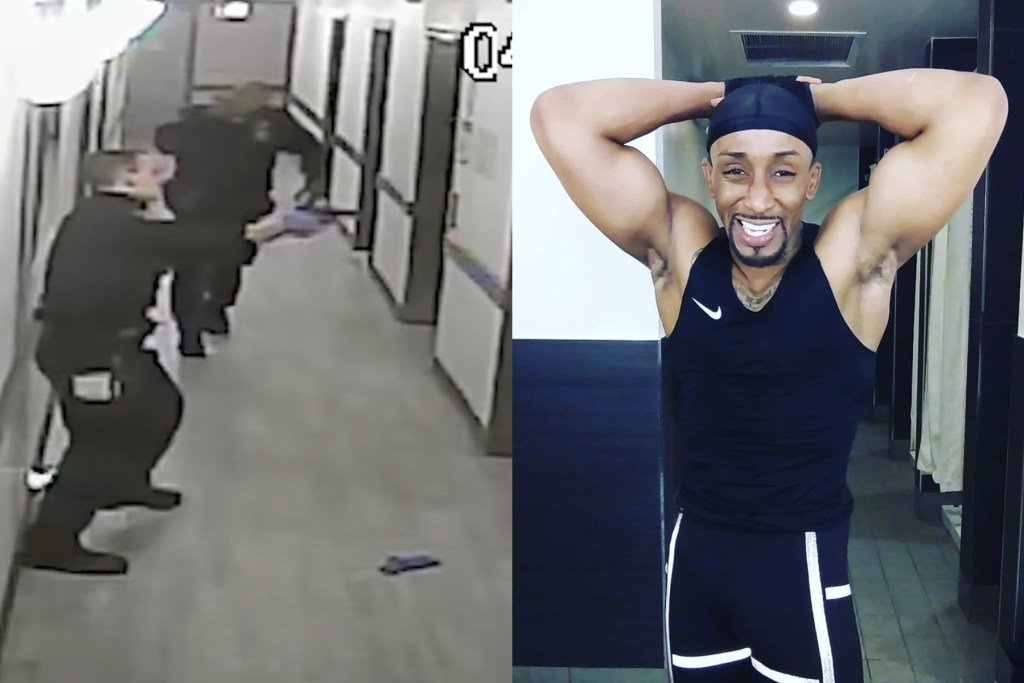 A still from video footage shows an NYPD officer shooting into the apartment where Kawaski Trawick was standing. Trawick, pictured at right, was hit twice and killed. Credit: First image: Surveillance footage; Second image: Instagram.
The Trawick interaction unfolded over about two minutes. In the case of George Zapantis, a 29-year-old man diagnosed with bipolar disorder, officers engaged in a dialogue with him for 10 minutes when they responded in June 2020 to a call about people fighting.
Standing outside the door of his Flushing, Queens, apartment, they could see him inside dressed in a gladiator outfit holding a sword. Zapantis appeared “confused and agitated,” the attorney general’s investigators later asserted, and body camera footage shows he adamantly refused to let officers inside his apartment.
The officers told them they wanted his “side of the story” about a dispute he was having with an upstairs neighbor, and stated they “just wanted to talk.” Zapantis said he was calling for the Marines and “for my own police.” He put down the sword, but then pushed the door open and came at the officers — unarmed. Four of them then tased him in succession. Zapantis suffered a heart attack and was pronounced dead soon after.
NYPD officer history records show at least four of the officers at the scene — including three who engaged their tasers — had received CIT training a year earlier. (Zapantis’ family filed suit in 2021 and reached a $550,000 settlement with the city in May).
Language Barriers Exacerbate Tensions
In other incidents, despite the CIT training, language was a barrier.
In March 2023, the father of Raul de la Cruz called 311 to say through a Spanish interpreter that his son was having a mental health crisis and needed help. The operator transferred the call to 911 and the police who were dispatched were told “EDP has a weapon” and is “violent.”
Upon arrival Officers Derek Bernard and Nicholas Trupia — neither of whom speaks Spanish — met the father outside his Bronx apartment building. As they were trying in vain to communicate with him, the son came out holding a kitchen knife.
Body camera footage shows both cops immediately drew their firearms and pointed them at de la Cruz, who was standing far away from them — about 15 feet away. Right away they began yelling at him in English to drop the knife. De la Cruz speaks only Spanish. Within moments of encountering de la Cruz, both officers opened fire, severely injuring him.
At least one of the cops, Bernard, was fully trained in CIT. NYPD records for Trupia were not in the officer history system. CCRB later found Officer Bernard used excessive force and recommended that he be fired. The police commissioner rejected the board’s recommendation and issued no punishment. Officer Trupia resigned before the CCRB probe was complete. (A lawsuit filed in Manhattan federal court by de la Cruz’s family is pending.)
Language also played a role in the April 2025 shooting of King Wong, a 60-year-old diagnosed with schizophrenia who speaks only Mandarin. He had lived with his parents for years and both had recently died. The 911 calls came in as “man with knife” walking in the streets of Astoria, Queens, and there’s no indication the cops sent to the scene had any indication of his mental history.
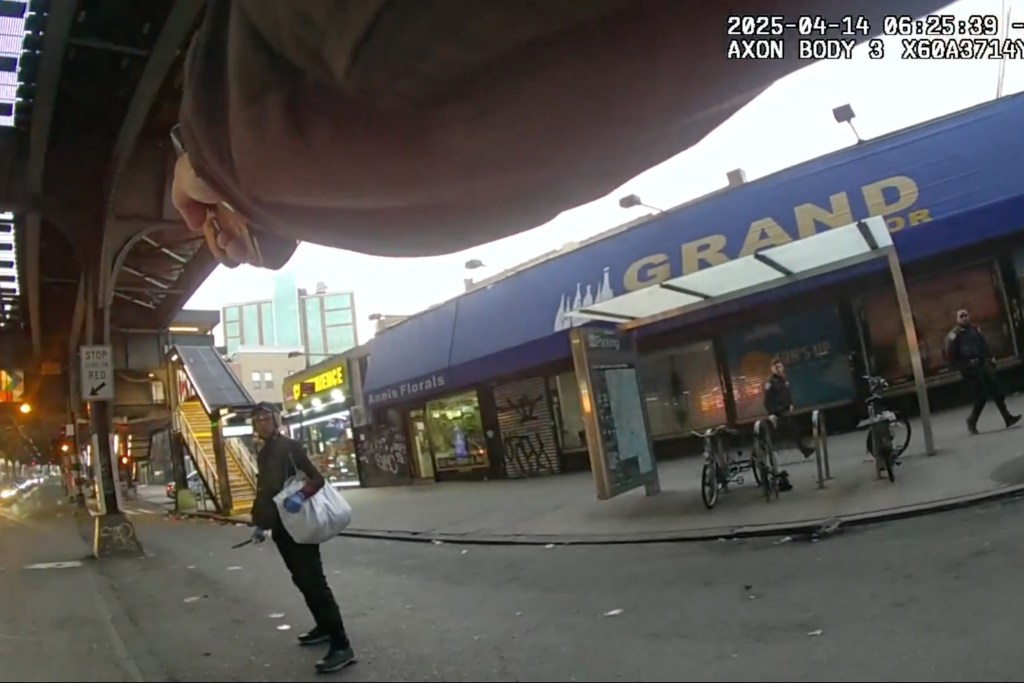 NYPD officers responded to a 911 call of a man holding a knife in Astoria before fatally shooting 60-year-old schizophrenic man King Wong in 2025. Credit: Screengrab via NYPD Video Camera Footage
If they had checked, they would have learned that on two recent prior occasions, police had been dispatched to his apartment building when he’d inadvertently wandered into a neighbor’s apartment (without incident). It’s not clear whether knowledge of Wong’s history could have informed how they responded. What is clear in body camera footage is that the minute Patrol Officer Kendouchy Coissy saw Wong, he put his cruiser in park, jumped out into the street and began shouting, “Put the fucking knife down!” while pointing his service revolver at Wong.
Wong responded in Mandarin and continued walking. Coissy and two other officers, all with weapons drawn, followed him. When he turned towards them, all three shot him. Total interaction time: 56 seconds. Wong, who lay on the ground still holding the knife, was pronounced dead later that day.
Officer Coissy had received training in “mental health involuntary removals” and three of the four modules of CIT, including “sending the right signals” and the “Intro to CIT video series.” King’s shooting is now under investigation by Attorney General James.
At times, the complexities of these incidents inspired different responses from different oversight entities.
In December, James declined to file charges against the cops in the case of 19-year-old Win Rozario, fatally shot in March 2024. The CCRB took a different position, finding that the two CIT-trained officers involved, Salvatore Alongi and Matthew Cianfrocco, had used excessive force and abused their authority during a response to a March 2024 mental health call by Rozario’s family.
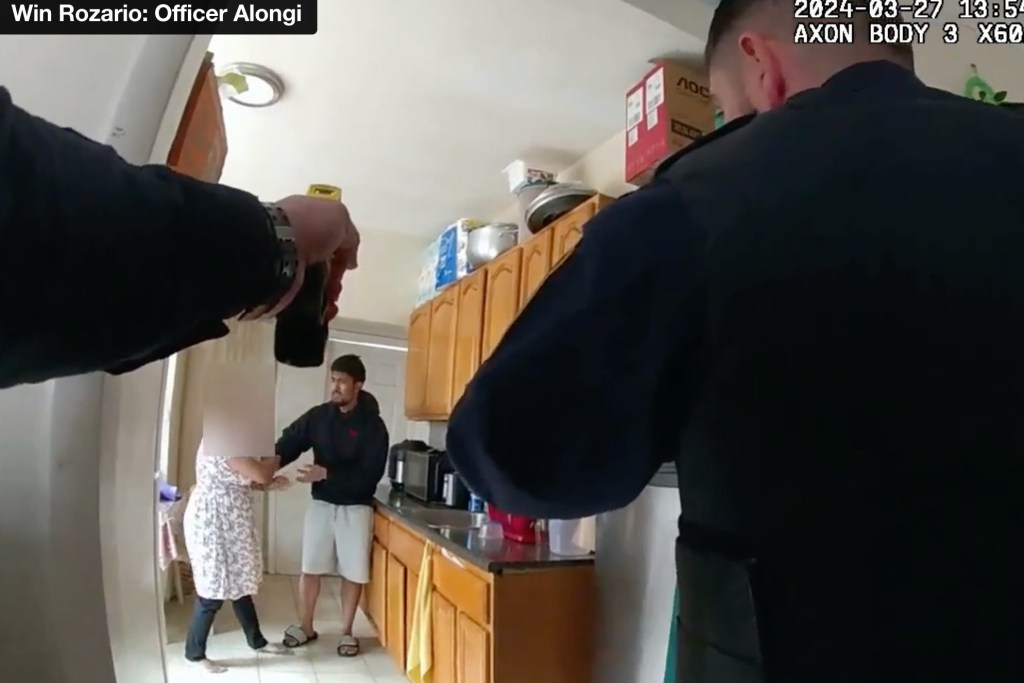 Moments before police officers from the 102nd Precinct in Ozone Park, Queens, shot and killed Win Rozario on March 27, 2024, as his mother tried to protect him. Credit: Screengrab via NYPD Body Camera Footage
The officers entered the family’s Queens apartment to find Rozario and his mother in the kitchen. Body camera footage shows that when Rozario saw them he reached into a drawer and pulled out scissors. Officer Alongi immediately hit him with a taser.
His mother, Notan Eden Costa, wrested the scissors from Rozario and placed them on a chair. As she pleaded with the officers not to shoot, Alongi tasered Rozario again, though he no longer had a weapon in his hands. This prompted Rozario to again pick up the scissors and begin advancing towards them. Cianfrocco immediately fired one shot with his service weapon.
Rozario stumbled back into the kitchen as his mother and younger brother tried to shield him from the police. Cianfrocco then fired four more shots. Rozario was pronounced dead several hours later.
Cianfrocco, a 10-year veteran of the NYPD, had received training in “Successfully Disarming an EDP” in 2019 along with two modules of CIT training, including one on “active listening.” He’d also viewed the CIT “Responding to People in Crisis” video series in 2018.
Alongi, who only fired his taser, had received one module of CIT training in 2018 and a second in 2022.
In September, Police Commissioner Jessica Tisch notified both officers the department would pursue disciplinary action against them. Both face departmental trials with the potential for dismissal.
Related