
AI in Mental Health Market
Market Size and Growth
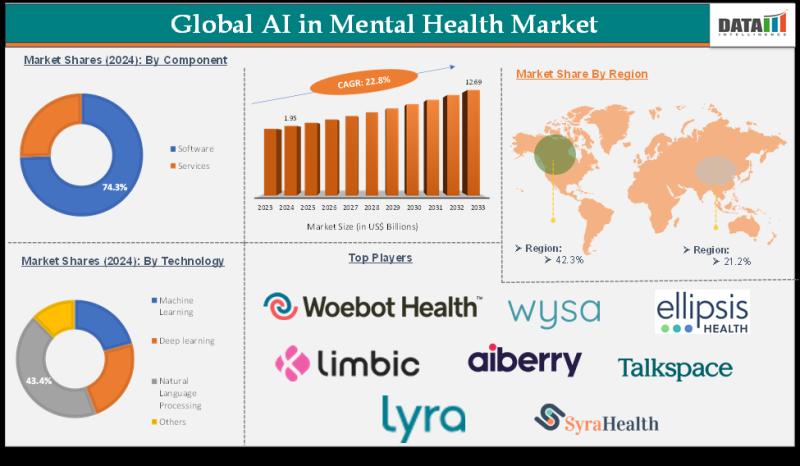
The growing global burden of mental health disorders, combined with increasing demand for accessible and personalized mental healthcare, is accelerating the adoption of artificial intelligence in behavioral health services. AI-powered mental health solutions are transforming the way mental conditions are diagnosed, monitored, and treated by enabling early detection, predictive analytics, and digital therapeutic interventions. According to DataM Intelligence, The global AI in mental health market reached US$1.95 billion in 2024 and is expected to reach US$12.69 billion by 2033, growing at a CAGR of 22.8% during the forecast period 2025-2033, according to DataM Intelligence report.
Get a Free Sample PDF Of This Report (Get Higher Priority for Corporate Email ID):- https://www.datamintelligence.com/download-sample/ai-in-mental-health-market?sb
Key Development:
United States: Recent Industry Developments
✅ In March 2026, Woebot Health launched an upgraded AI-powered mental health chatbot platform designed to deliver cognitive behavioral therapy (CBT) support for anxiety and depression. The system integrates conversational AI with clinical insights to provide personalized emotional support. It aims to expand access to digital mental health care across healthcare providers and employers.
✅ In February 2026, Headspace Health announced a strategic investment to expand its AI-driven mental health platform that analyzes user behavior and emotional patterns to personalize therapy and wellness programs. The initiative focuses on improving early detection of stress, anxiety, and burnout. It strengthens digital mental health support for corporate and healthcare sectors.
✅ In January 2026, Lyra Health introduced an AI-enabled mental health care navigation platform that matches patients with therapists using machine learning-based behavioral analysis. The technology helps identify the most effective treatment options for individuals. It enhances access to personalized mental health services through digital care systems.
✅ In December 2025, Talkspace launched an AI-assisted therapist support tool designed to help clinicians analyze patient conversations and generate treatment insights. The system uses natural language processing to identify emotional patterns and therapy progress. It aims to improve clinical decision-making and therapy outcomes in digital mental health care.
Buy Now & Unlock 360° Market Intelligence: https://www.datamintelligence.com/buy-now-page?report=ai-in-mental-health-market
Japan: Recent Industry Developments
✅ In March 2026, Fujitsu launched an AI-based mental health monitoring platform designed to analyze speech patterns, facial expressions, and behavioral data to detect early signs of stress and depression. The technology supports remote mental health assessment and digital therapy programs. It aims to enhance preventive mental healthcare services across workplaces and healthcare institutions.
✅ In February 2026, NTT Data announced the expansion of its AI mental health analytics platform used by healthcare providers to monitor emotional well-being and predict mental health risks. The system uses machine learning models to analyze patient interaction data. It supports early intervention and personalized treatment strategies.
✅ In January 2026, Sony partnered with healthcare organizations to develop AI-driven digital mental wellness solutions that track mood patterns through wearable and mobile applications. The platform integrates behavioral data with AI analytics for real-time mental health insights. It supports preventive mental health management and personalized therapy recommendations.
✅ In December 2025, NEC launched an AI-powered emotional analysis platform designed to help healthcare providers detect psychological stress and emotional disorders through voice and behavioral data. The technology enables early identification of mental health conditions. It supports Japan’s growing adoption of AI-enabled digital healthcare solutions.
Rising Demand for Scalable Mental Health Solutions
One of the primary growth drivers of the AI in Mental Health market is the rising global prevalence of mental health disorders such as depression, anxiety, stress-related conditions, and substance abuse disorders. According to international health agencies, millions of people worldwide suffer from untreated mental health conditions due to a shortage of trained mental health professionals and limited access to care.
AI-powered chatbots, virtual therapy assistants, and digital mental health applications are helping bridge this treatment gap by providing scalable, affordable, and accessible mental health support. These platforms can analyze user interactions, track emotional changes, and deliver personalized therapeutic guidance in real time.
Healthcare providers are increasingly integrating AI-driven platforms into telehealth services to support mental health screening, therapy support, and continuous patient monitoring. The growing acceptance of digital health technologies is expected to further accelerate the adoption of AI-based mental health tools across healthcare systems.
Speak to Our Analyst and Get Customization in the report as per your requirements: https://www.datamintelligence.com/customize/ai-in-mental-health-market?sb
Competitive Landscape and Industry Leadership
The global AI in Mental Health market is highly dynamic, with numerous technology companies, digital health startups, and healthcare organizations developing innovative AI-driven mental health solutions. Key players operating in the market include: Woebot Health, Wysa Ltd, BetterHelp, Lyra Health, Inc., Talkspace, Inc., Spring Care, Inc., Syra Health, Limbic, Ellipsis Health, Inc., and Aiberry, among others.
Key Segments:
By Component
Software leads the market with 65% share, driven by growing adoption of AI-powered mental health platforms, digital therapy applications, and predictive analytics tools used for early diagnosis and treatment support. Services hold 35%, supported by increasing demand for implementation, training, consulting, and maintenance services associated with AI-based mental healthcare systems.
By Technology
Machine Learning dominates with 35% share, fueled by its ability to analyze large volumes of patient data to identify behavioral patterns and predict mental health conditions. Deep Learning holds 28%, driven by its advanced capabilities in analyzing complex psychological and neurological datasets. Natural Language Processing (NLP) accounts for 25%, supported by its use in chatbots, virtual therapists, and sentiment analysis for patient interaction and mental health monitoring. Others contribute 12%, reflecting emerging AI technologies and hybrid models used in digital mental health platforms.
By Application
Depression leads the market with 26% share, driven by the increasing global prevalence of depressive disorders and the demand for early diagnosis and digital therapy solutions. Anxiety holds 22%, supported by growing awareness and adoption of AI-driven mental health monitoring tools. Schizophrenia accounts for 14%, reflecting the need for advanced diagnostic tools and predictive analytics for complex mental disorders. Post-Traumatic Stress Disorder (PTSD) represents 13%, fueled by growing focus on mental health among veterans, trauma victims, and frontline workers. Insomnia holds 12%, supported by the integration of AI tools in sleep monitoring and mental health assessment platforms. Others contribute 13%, covering various mental health conditions managed through AI-driven technologies.
By End-User
Hospitals and Clinics dominate with 55% share, driven by the integration of AI technologies into clinical mental health diagnosis, patient monitoring, and treatment planning. Mental Health Centers hold 30%, supported by growing use of digital therapy platforms and AI-powered counseling tools. Others contribute 15%, reflecting adoption by research institutions, telehealth providers, and digital health startups.
By Region
North America leads the market with 35% share, supported by advanced healthcare infrastructure, strong investments in digital health technologies, and widespread adoption of AI-based mental healthcare solutions. Europe holds 25%, driven by government initiatives promoting digital mental health services and increasing awareness of mental health disorders. Asia Pacific accounts for 22%, fueled by growing healthcare digitization, rising mental health awareness, and increasing adoption of telehealth platforms. South America represents 10%, reflecting gradual adoption of AI technologies in healthcare systems. Middle East & Africa hold 8%, supported by emerging digital health initiatives and improving mental healthcare infrastructure.
Outlook & Opportunity Analysis (2025-2033)
The global AI in mental health market is expected to witness substantial growth between 2025 and 2033, driven by rising prevalence of mental health disorders, increasing demand for digital therapy solutions, and advancements in artificial intelligence technologies. Machine learning and NLP technologies will continue to dominate due to their ability to analyze behavioral data and enable AI-powered virtual therapy platforms. Hospitals and clinics will remain the primary adopters, while mental health centers and telehealth providers are expected to experience rapid adoption. North America and Europe will continue to lead the market, while Asia Pacific is projected to witness the fastest growth due to expanding healthcare digitization and increasing investments in AI-driven healthcare solutions. Innovations in AI-powered chatbots, predictive analytics, and personalized digital therapy platforms will create significant opportunities for improving mental healthcare accessibility and patient outcomes worldwide.
FAQ
What is the current size of the AI in mental health Market?
A: In 2024, the AI in mental health Market was valued at US$1.95 billion, reflecting its strong industry presence.
Q2: How large is the AI in mental health Market expected to be by 2033?
A: By 2033, industry forecasts suggest the AI in mental health Market will grow to around US$12.69 billion , demonstrating significant expansion.
Q3: What is the growth rate of the AI in mental health Market?
A: The market is projected to expand at a compound annual growth rate (CAGR) of 22.8% during the forecast period from 2025 to 2033.
Unlock 360° Market Intelligence with DataM Subscription Services: https://www.datamintelligence.com/reports-subscription
Power your decisions with real-time competitor tracking, strategic forecasts, and global investment insights all in one place.
✅ Competitive Landscape
✅ Sustainability Impact Analysis
✅ KOL / Stakeholder Insights
✅ Unmet Needs & Positioning, Pricing & Market Access Snapshots
✅ Market Volatility & Emerging Risks Analysis
✅ Quarterly Industry Report Updated
✅ Live Market & Pricing Trends
✅ Import-Export Data Monitoring
Have a look at our Subscription Dashboard: https://www.youtube.com/watch?v=x5oEiqEqTWg
Contact Us –
Company Name: DataM Intelligence
Contact Person: Sai Kiran
Email: Sai.k@datamintelligence.com
Phone: +1 877 441 4866
Website: https://www.datamintelligence.com
About Us –
DataM Intelligence is a Market Research and Consulting firm that provides end-to-end business solutions to organizations from Research to Consulting. We, at DataM Intelligence, leverage our top trademark trends, insights and developments to emancipate swift and astute solutions to clients like you. We encompass a multitude of syndicate reports and customized reports with a robust methodology.
Our research database features countless statistics and in-depth analyses across a wide range of 6300+ reports in 40+ domains creating business solutions for more than 200+ companies across 50+ countries; catering to the key business research needs that influence the growth trajectory of our vast clientele.
This release was published on openPR.