
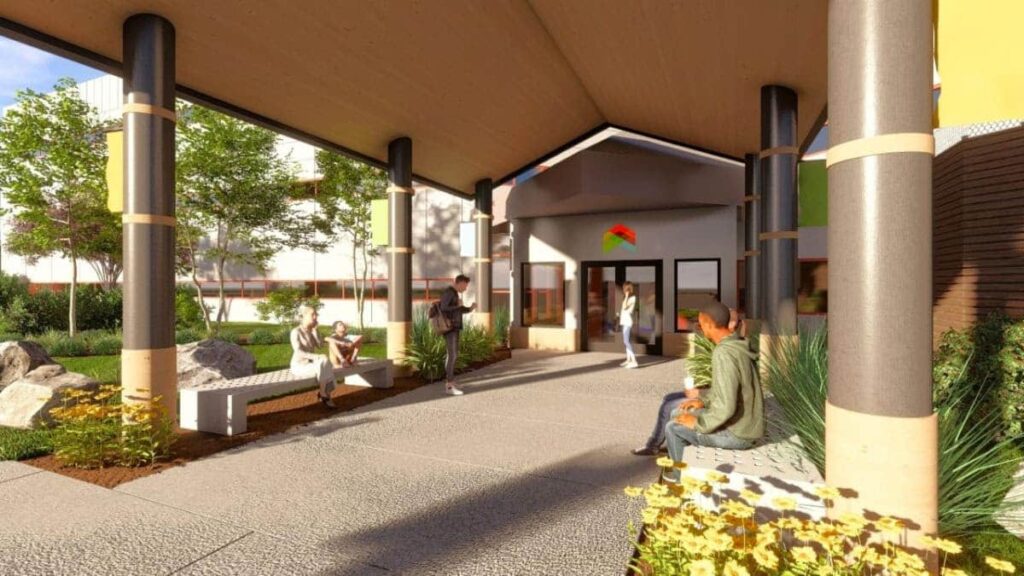
 Rendering of the Crisis Center courtesy of the ADAHMS Board.
Construction on a new walk-in Behavioral Health Crisis Center on E. 22nd St. in Cleveland’s Central neighborhood will proceed as planned following an agreement by the parties leading its development.
On Tuesday, the Cleveland nonprofit The Centers and the Cuyahoga County Alcohol, Drug Addiction & Mental Health Services (ADAMHS) Board announced a “significant breakthrough” in the impasse that had threatened to slow or derail the project, which has been underway since February 2025.
Details of the breakthrough were not immediately available, but a statement by the two groups said the new understanding will permit them to move toward finalizing an agreement and open a facility many believe is desperately needed.
Advertisement

“This agreement reflects our shared commitment to building a robust crisis continuum of care for Cuyahoga County,” said Jason Joyce, CEO of ADAMHS, and Eric Morse, president and CEO of The Centers, in a joint written statement. “By working together, we are ensuring that individuals in our community have a safe, dignified place to receive care when they need it most.”
The breakthrough is significant enough that ADAMHS canceled the special meeting of its board on Wednesday, March 11, during which the facility was to be evaluated anew.
But that’s not the end of the story. In their statement Tuesday, both organizations noted that many issues regarding the center’s long-term viability and quality of service still have to be addressed.
Specifically, the groups said they’re reviewing ways to: lower risks associated with American Rescue Plan Act (ARPA) funds; reduce costs to the broader behavioral health network; secure funding from other sources including the county’s opioid settlement fund; and settle on standards of performance.
Why this facility is needed
About the need for a crisis center in general, there was little question. Since the closure of St. Vincent Charity Medical Center in 2022 and the December closing of the psychiatric emergency department at MetroHealth’s Cleveland Heights Medical Center, Clevelanders needing urgent mental health care have had little choice but to visit emergency rooms at area hospitals, where wait times can be long and staffing inadequate. Some also end up in jail.
At the same time, the surrounding Central neighborhood ranks as the poorest in Northeast Ohio and among the poorest areas in the nation. “The amount of mental health issues, small nonprofits can’t cover it,” said Lisa Goods, senior pastor at Shiloh Baptist Church, which on Tuesday, March 3 hosted a gathering of about 100 people “fired up” in support of the center.
“I am passionate about the center being built there,” Goods said.
Neither was anyone disputing the nature of the project itself, a three-floor center with separate facilities dedicated to crisis, residential and outpatient care. In other cities where such facilities have opened, including Lorain and Columbus, the number of patients at the sites exceeded expectations. Many now regard the concept as the nationally recognized best practice for emergency mental health treatment, according to both Centers and ADAHMS leaders.
“It really humanizes mental health care, as opposed to institutionalizing, stigmatizing and criminalizing it,” Goods said, noting that with facilities like the one under development in Cleveland, “People are more likely to seek care. People are more open to taking their loved ones there.”
Figuring out funding
Where the parties differed was over how the project was to be funded. When Joyce, who is new to ADAMHS, reviewed the project, he discovered elements in the agreement with The Centers that could have obligated ADAMHS to return up to $6.8 million in ARPA funds to the federal government.
This led him and ADAHMS to rethink and nearly withdraw their support for the project, a move that Stacey Rubenfield, chief of institutional advancement at The Centers, said would have effectively “killed” the Crisis Center.
One sticking point in the agreement was the center’s opening date. For ADAMHS to avoid possibly having to repay the ARPA loan, Joyce said the Crisis Center needed (and may still need) to be fully open by Sept. 30.
The other sticking point is related to operating costs and the possibility of a closure later, which could have resulted in ADAMHS having to repay the ARPA funds. Joyce’s concern stemmed from a $4 million reduction in The Centers’ request for annual operating support from ADAMHS, a move that would have required the new center to hit unrealistic goals.
How these concerns will be addressed by the new breakthrough remains to be seen. In their statement Tuesday, ADAMHS and The Centers said they will reveal the details of their plans to community stakeholders “over the next few weeks.”
But the announcement Tuesday answers the question of whether the two sides will work together at all. Indeed, it appears that ADAMHS and The Centers have done exactly what Rubenfeld said she’d hoped they would.
“We would love for them to come to the table and figure this out with us,” she said before Tuesday’s announcement. “We owe it to our community to figure this out.”
Read previous coverage on this topic: