
Baltimore County officials removed 14 dogs, 21 birds, several reptiles and a cat from a Halethorpe woman’s property in February. It was the same woman charged with animal cruelty the year before.
She later acknowledged hoarding the animals but not intending to harm them — behavior likely tough for the public to comprehend.
It’s also tough for animal and social welfare experts to fully explain, even as they increasingly tie the behavior to a psychiatric condition.
“Our knowledge is very limited, but certainly we understand it as a psychiatric problem, a mental health problem,” said Christiana Bratiotis, an associate professor of social work at the University of British Columbia who has written two books on hoarding.
“What do we know about how precisely it gets started and what fuels it?” she said. “Not much.”
Several animal welfare organizations now estimate that some 250,000 animals a year are hoarded in the United States.
Baltimore County Animal Services, which handled the Halethorpe case, said complaints about hoarding have jumped to 48 in 2025, from 26 in 2023.
County officials said Thursday that all 42 animals seized in the recent case were brought into custody, and three have already been adopted out.
Understanding why such cases happen remains challenging. Hoarders can face significant stigma, as well as criminal charges for animal neglect and abuse, so Bratiotis said they rarely volunteer for scientific studies.
That has left researchers to dig into public records for insight into the hoarders’ backgrounds and the motives fueling their conditions.
Hoarding became an officially recognized mental health disorder in 2013, with animal hoarding considered a subtype defined by a person’s compulsive need to acquire animals, failure to provide basic care and denial of consequences.
A profile of a typical hoarder has slowly emerged. Bratiotis said they tend to be socially isolated and more often women than men. The severity of their condition often surfaces when they are in their 50s and 60s, typically when a neighbor or family member reports them to authorities, or animal shelters or veterinarians suspect a problem.
The researchers believe hoarders tend to have stronger lifelong relationships with animals than other human beings. That could be due to chaos in their early lives from violence or substance use among family members, experts say.
They can become delusional and unable to see the animals’ suffering even as they accumulate more cats and dogs and other animals. They often believe they are giving them the best care or are the only ones who can properly care for them, researchers say.
They may stick with their delusions when challenged, said Bratiotis. She recalled one hoarder who told her brown water in her animals’ bowls was not a result of unsanitary conditions, but due to the “magic potion” she created to keep animals healthy.
Animal welfare groups say more cases are now being identified, likely because more people recognize it as hoarding.
David Rosengard, managing attorney for the Animal Legal Defense Fund, an animal rights group, said mental health is a serious factor and people deserve assistance. But the fund doesn’t attribute all cases of hoarding to a psychiatric diagnosis.
He said some cases involve financial motive, such as backyard breeders who cut corners or run sham shelters to look noble and collect donations.
Many others, however, are simply overwhelmed by the cost and needs of the many pets they always intended to aid.
Those “overwhelmed caregivers” are by far the most common cases, and people are often relieved when animal welfare officials arrive, said Dr. René Varela, a veterinarian and director of Baltimore County’s Bureau of Animal Services.
Less common are the “rescuer” types who believe they are saving animals, who usually won’t open their doors to officers and require relationship building. The most infrequent, and most sensationalized, cases are the “exploiters,” the cruelty cases that the county actively seeks to prosecute.
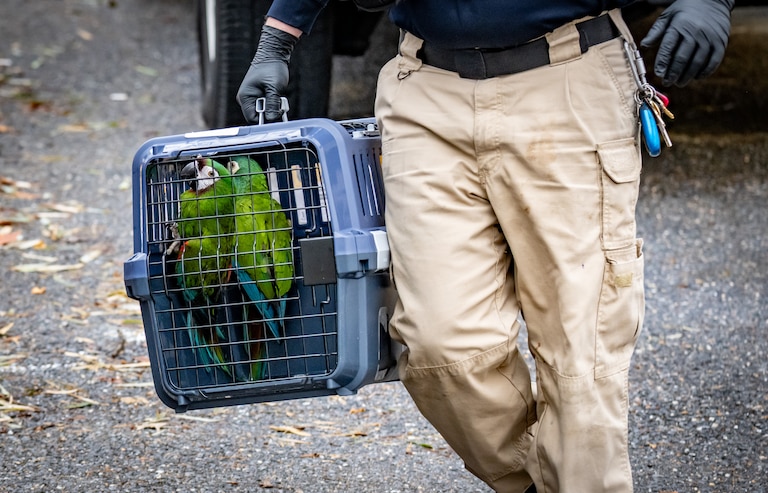 A pair of macaws are carried to a waiting van as Baltimore County Department of Health animal services division officers remove dozens of animals from a home in Halethorpe. (Jerry Jackson/The Banner)
“The majority of cases call for compassion,” said Valera, adding that the county has just launched a multi-agency task force to better meet the needs of both animals and residents.
County officers are increasingly finding people unable to feed themselves or their animals, even as they accumulate more animals in their homes. He said officers are no longer surprised to find that hoarders have run out of space indoors and have moved into their cars.
“We are trying to work more seamlessly to get people the resources they need sooner rather than later,” though he said a challenge is a national lack of access to mental health services.
The Animal Legal Defense Fund is among the groups working for a more systematic approach to hoarding cases nationally, one that determines when someone needs treatment and supervision versus punishment.
Rosengard said schools, from legal to veterinary, are already adding training on hoarding.
 Gibby, 3 months old, was rescued from a hoarding case in Halethorpe in February, and will be available for adoption from Baltimore County Animals Services on Saturday. (Baltimore County Animal Services)
And a few courts are just beginning to offer mental heath assessments for hoarders, but a more coordinated statewide or national approach is needed to ensure better outcomes for people and animals, he said.
Many experts say more people need treatment and supervision, especially if they are permitted to keep a small number of animals, a tactic increasingly tested to reduce recidivism and trauma for hoarders losing their closest relationships.
But how such a coordinated process unfolds and is funded remains unclear.
Rosengard said many animal control offices and shelters are underfunded. And Varela said paying for animal care from just one hoarding case can be immense.
The treatment typically offered hoarders can be lifelong.
An improved process “is in its infancy,” Rosengard said. “We’re not there yet.”