
March 17, 2026
3 min read
 Add Us On GoogleAdd SciAm
Medical cannabis isn’t an effective treatment for anxiety, depression or PTSD, new research shows
People frequently use medical cannabis to treat anxiety, depression and PTSD, but two new reviews show there is little evidence that it works
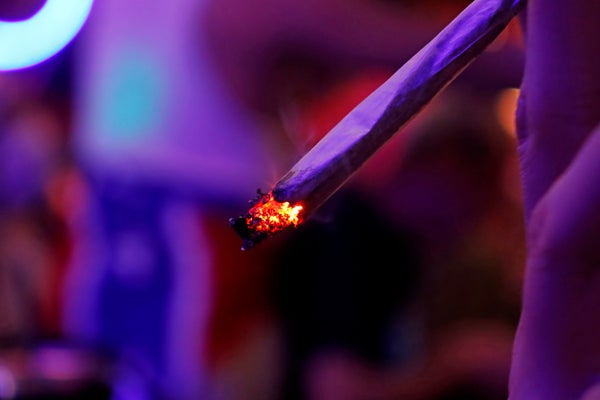
Rapeepong Puttakumwong/Getty Images
There is no evidence that medical cannabis treats anxiety, post-traumatic stress disorder (PTSD) or depression, according to two new research papers—yet many people who take cannabis for medical purposes use the drug for precisely these conditions. Some U.S. states even authorize cannabis for people with these conditions specifically.
A new study published today in the Lancet Psychiatry found no good evidence that cannabis is an effective or safe treatment for anxiety, PTSD or depression.
“For a long time, people have been using cannabis to cope with mental illness. And what is really lacking is controlled, rigorous evidence, which would be the same standards you would want for any medication,” says psychologist Tory Spindle of the Johns Hopkins University School of Medicine, who studies how our body responds to cannabis and was not involved in the new research.
On supporting science journalism
If you’re enjoying this article, consider supporting our award-winning journalism by subscribing. By purchasing a subscription you are helping to ensure the future of impactful stories about the discoveries and ideas shaping our world today.
Scientists compiled and analyzed the results of 54 randomized controlled trials that tested cannabis for various mental health conditions. These kinds of trials are the gold standard for determining the effectiveness and safety of a new medication. The 54 trials were described in papers published between 1980 and 2025, and most of them involved fewer than 100 participants. Cannabis showed no effect for anxiety disorders, PTSD, anorexia nervosa or psychotic disorders. None of these randomized controlled trials tested how well it might treat depression.
“The way cannabis for medical use has been rolled out [in the U.S.] is completely backward from how medications are typically brought to market,” Spindle says. Typically, a new medicine needs to complete at least one randomized controlled trial before it is approved for use by the Food and Drug Administration. But cannabis is different: it is illegal for both recreational and medical use at the federal level, which means how the drug is regulated is up to individual states. Cannabis is legal for medical purposes in 40 states and Washington, D.C. States can specify what medical conditions cannabis can be used to treat, enabling doctors who practice in the state to authorize the use of medical cannabis to people with those conditions.
Currently, more than a dozen states consider PTSD as a qualifying condition. Although anxiety and depression are only listed explicitly as qualifying conditions in a handful of states, additional states include them under broader categories such as “debilitating psychiatric conditions” or allow for medical providers to authorize medical marijuana as a treatment for them when deemed appropriate.
“We all just want people to be able to access medicines that are both effective and safe for their conditions,” says Jack Wilson of the University of Sydney, who led the Lancet study. “Unfortunately, for a lot of people using medical cannabis, I don’t think that is the case.”
This patchwork of regulation means scientists are left playing catch-up to determine if cannabis is effective to treat the conditions it’s authorized for, Spindle says. And because cannabis is considered a Schedule I drug—the government’s code for a drug that has high abuse potential and no accepted medicinal use—researchers in all states have to navigate challenging red tape in order to study it.
“What’s happening in the real world and the medical evidence—there’s a big gap between the two,” says Deepak Cyril D’Souza, a psychiatrist at Yale University. D’Souza was not involved in the new Lancet study, but he co-authored an independent review of cannabis and mental health that was published last week in the Journal of the American Medical Association.
D’Souza’s review found very similar results to Wilson’s team and highlighted how cannabis may actually harm people with certain mental health conditions: it can worsen mania symptoms in people with bipolar disorder and psychotic symptoms in people with psychotic spectrum disorders, such as schizophrenia.
“Both of us reached the same conclusion: that there is very little—and mostly low-quality—evidence to support any efficacy of cannabis derivatives in the treatment of mental health disorders,” D’Souza says.
It’s Time to Stand Up for Science
If you enjoyed this article, I’d like to ask for your support. Scientific American has served as an advocate for science and industry for 180 years, and right now may be the most critical moment in that two-century history.
I’ve been a Scientific American subscriber since I was 12 years old, and it helped shape the way I look at the world. SciAm always educates and delights me, and inspires a sense of awe for our vast, beautiful universe. I hope it does that for you, too.
If you subscribe to Scientific American, you help ensure that our coverage is centered on meaningful research and discovery; that we have the resources to report on the decisions that threaten labs across the U.S.; and that we support both budding and working scientists at a time when the value of science itself too often goes unrecognized.
In return, you get essential news, captivating podcasts, brilliant infographics, can’t-miss newsletters, must-watch videos, challenging games, and the science world’s best writing and reporting. You can even gift someone a subscription.
There has never been a more important time for us to stand up and show why science matters. I hope you’ll support us in that mission.