
People struggling with addiction and mental health in two North Georgia counties have a new way of getting help.
Treatment and accountability courts in the Conasauga Circuit consist of drug treatment, mental health, and domestic violence courts.
Last year, the drug treatment court and mental health court combined. This offered participants a new path to recovery.
Last week, the programs had their first two graduates since expanding.

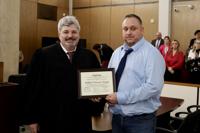
Richard Preston Nichols, Graduate
Whitfield Co.
“The reason that we decided to combine this year is that we already had some overlap in our teams. We can utilize some of the same resources and share some of the same resources and not have duplicative efforts. Number one, from a budgetary standpoint, is to combine to save the taxpayers some money. The second reason is better for the participants, because we have, again, we’re able to use more of our resources and focus those on our participants,” explained Judge Scott Minter, Superior Court Judge for the Conestoga Judicial Circuit.
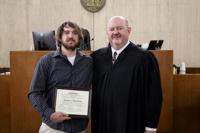
Austin Blackmon, Graduate
Whitfield Co.
The domestic violence court recently joined the umbrella of programs. Now, all three programs are able to work under the same roof and assist workers and participants.
“We’ve got our own little treatment facility here that includes all of our treatment court staff. It includes our own drug test lab, and because we cross services, our participants can provide support for each other,” said Judge Cindy Morris, Superior Court Judge for the Conestoga Judicial Circuit.
The CDC reports over 53,000 overdose deaths in 2024, with over 17,000 occurring in Georgia. At least 67% of the drug overdoses had at least one potential opportunity for prevention.
In Whitfield and Murray County, they hope to change these statistics with their proactive approach. Judge Bert Poston, who oversees the Drug Treatment Court, describes themselves as a cheerleader. However, he says those in the program must want to be there, which makes the outcome even better.
“We want everyone to graduate, and we want everyone to succeed. We want we’re not going to cure your addiction, but hopefully by the time you graduate, you have the skills and the tools and the relationships to successfully manage that addiction, to stay clean so over the rest of your life, if you, if you choose to do so and so that’s what we’re trying to build with them,” said Judge Poston.
The programs take one to a year and a half to complete. They are also free to people wanting to participate.
They’re expecting another graduation in April.
To find out more about the programs, visit here.