
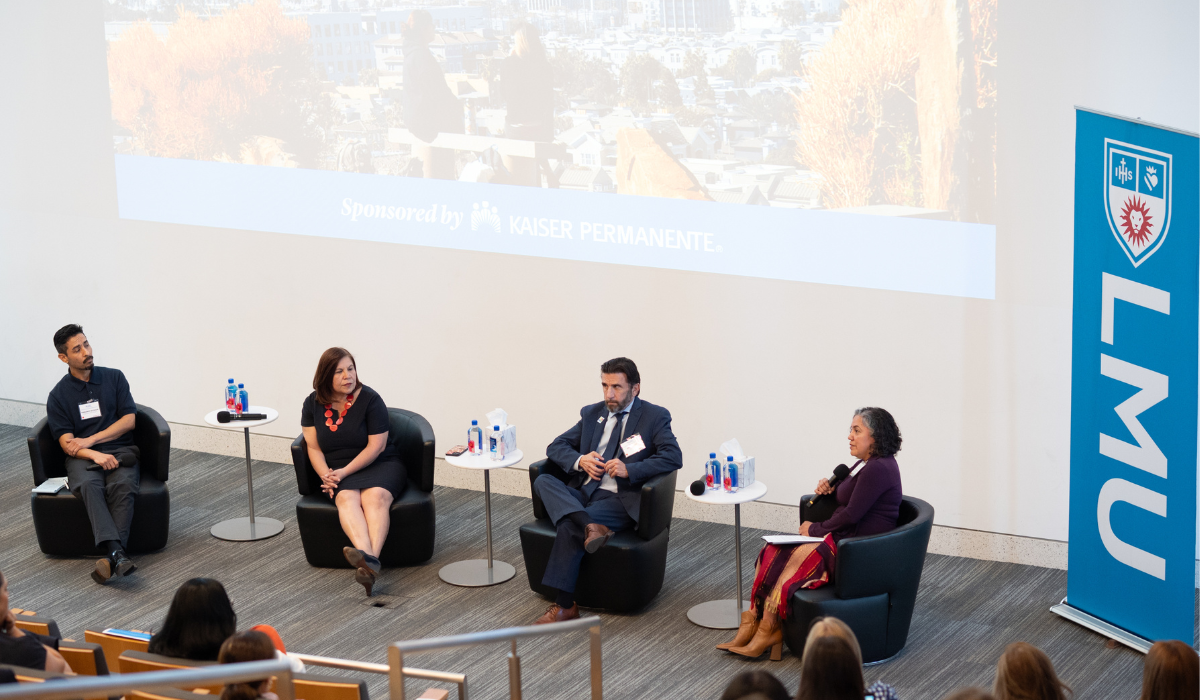
Loyola Marymount University’s (LMU) School of Education (SOE) convened educators, school leaders, policymakers, and others on Friday, March 12, for an afternoon of guided conversations about mental health challenges faced by today’s youth, as well as the ways that schools and communities are supporting them and growing the mental health workforce.
In her opening remarks, SOE Dean Estela Zarate cited data from a recent study by the Public Policy Institute of California about the youth mental health crisis. Over the past year, three in 10 children ages 12 to 17 reported symptoms meeting the criteria for serious psychological distress; a third reported chronic sadness; and 14.5 percent reported suicidal thoughts. “It is not surprising, given the recent events in this country and ongoing conditions students are living through,” she said. She cited post-COVID exhaustion, gun violence in schools, social media anxiety, the 2025 wildfires in Los Angeles, and immigration enforcement actions as topics that arise frequently in her conversations with school leaders, mental health professionals, and others.
Power in Community
After her remarks, a discussion titled, “Youth Mental Health, Immigration, and School Communities,” was moderated by Fernando Estrada, professor of counseling at LMU. He was joined by panelists Angélica Salas, executive director of the Coalition for Humane Immigrant Rights of Los Angeles (CHIRLA); Margarita Luna, strategic implementation lead at The California Endowment; and Drew Furedi, Ed.D. ’09, president and CEO of Para Los Niños. Their conversation focused on the effects of immigration enforcement and dehumanizing rhetoric about marginalized communities, as well as protective responses that schools and communities are developing.
“Resistance is often quiet and practical,” said Luna. “It looks like educators creating safe spaces, families building support, and organizations offering resources. It’s powerful to see communities coming together to provide mutual aid, civic engagement, and collective support during difficult times.”
Salas weighed in on the unique ability of school communities to foster change, and the importance of giving agency to youth. “It is important to understand the power of those connected to young people. Educators can create safe spaces when trust is hard to find,” she said. “Open conversations [like these] with fellow educators about what works are crucial. And giving students a voice empowers them to have empathy and support their peers.”
Growing the Mental Health Workforce
A second panel focused on growing the mental health workforce for schools and community organizations. Moderator Jolie Delja ’03, executive director of AIM Youth Mental Health, was joined by panelists Michelle Castelo Alferes, executive director of wellbeing support and services at the Los Angeles County Office of Education (LACOE); Virginia Castro, superintendent of the Lawndale Elementary School District; and Lakisha Clark ’94, principal at Orville Wright Middle School in Westchester. The discussion highlighted challenges in sustaining the school mental health workforce despite fluctuations in public funding, as well as SOE’s partnerships with schools and districts that support preparation for mental health professionals.
“We do whatever we can to give our district’s students the support they need. We are scrappy,” said Castro. She noted that her district has created a pathway for aspiring counselors to get their schooling and certifications, and that six of the eight mental health professionals in her district came through a partnership with SOE.
“We need to shift to an understanding that mental health support should be an operational core in educational institutions,” said Castelo Alferes of LACOE. Ebbs and flows in funding to support the pipeline of professionals will continue happening, she added, and discussions among stakeholders will be key to maintaining awareness about needs in this area.
Agents of Hope
Dean Zarate also shared steps that the SOE is taking to address workforce needs for youth mental health. Within the last year, the school has raised funds to offer additional scholarship support and to launch a bilingual certificate in counseling so that graduates can serve California’s diverse population. She also expressed a desire to build community mental health training clinics that would serve area schools and neighborhoods. “There is much more work to do, and we won’t be stopping here,” she added.
As a sendoff, Zarate shared a quote by Pope Leo XIV from “Drawing New Maps of Hope,” an apostolic letter written last fall: “Education is not only the transmission of content, but also the learning of virtues. It forms citizens capable of serving and believers capable of witnessing, men and women, who are freer, no longer alone.”
“This sentiment reflects the heart and spirit of what we are doing here at the School of Education,” she said. “I hope today’s conversations inspire us to commit to being agents of hope and change.”