
“A few of them have come to join us from knitting, but others have been a little more shy,” she said. “But we have noticed that when we’re doing the leg stretches and stuff like that with the chair yoga, their legs are moving under the table.”
Smithville is one of eight Central Texas libraries receiving funding from the St. David’s Foundation as part of the Libraries for Health initiative, a pilot project aimed at boosting mental health support in rural communities. Since 2021, it has allowed libraries like Smithville’s to incorporate programming like yoga and grief groups, and has provided funding for peer support specialists to provide one-on-one mental health support to library patrons.
Meeting people where they are
Abena Asante, a senior program officer at the St. David’s Foundation, says the idea came after a community health needs assessment showed there was insufficient mental health support across the five Central Texas counties the organization covers.
“Looking at the behavioral health workforce, we know that there’s a shortage of mental health providers, not only here in urban communities, but also more so in rural [communities],” Asante said. “In rural [communities], the gap is compounded with transportation issues and so many other barriers.”
Asante said her team wanted to identify existing assets in rural communities that could serve as access points for mental health support. Libraries came up “again and again,” she said. Most communities already have libraries and rely on them — not just for books, but for all kinds of resources.
That’s certainly true in Smithville, a small town located about 35 miles Southeast of Austin. Bergeron says for some people, the library is the only place they have access to computers and the internet.
“It’s not just coming in to use the computer, but it’s coming in because I have to fill out a critical social security benefits form, and I don’t know how to do it, and how can I get help?” Bergeron said.
Other people who walk through the door might be veterans unsure how to access their benefits, people looking for help recovering from addiction or unhoused people looking for a space to warm up or cool off.
But library staff just aren’t always equipped with the time or training to help. That’s where Libraries for Health comes in; starting in 2021, the St. David’s Foundation gave grants to libraries in Smithville, Taylor, Elgin, Martindale, San Marcos, Buda, Del Valle and Jarrell, allowing them flexibility to fund the resources they thought would be most helpful, from yoga to books on mental health and community health fairs.
The foundation also provided funding for a peer support specialist — someone with lived experience who can talk patrons through mental health challenges and help them find resources.
In Smithville, that’s Britany Khan Flores. She says she has experience with addiction and mental health challenges that help her identify with library patrons and build trust.
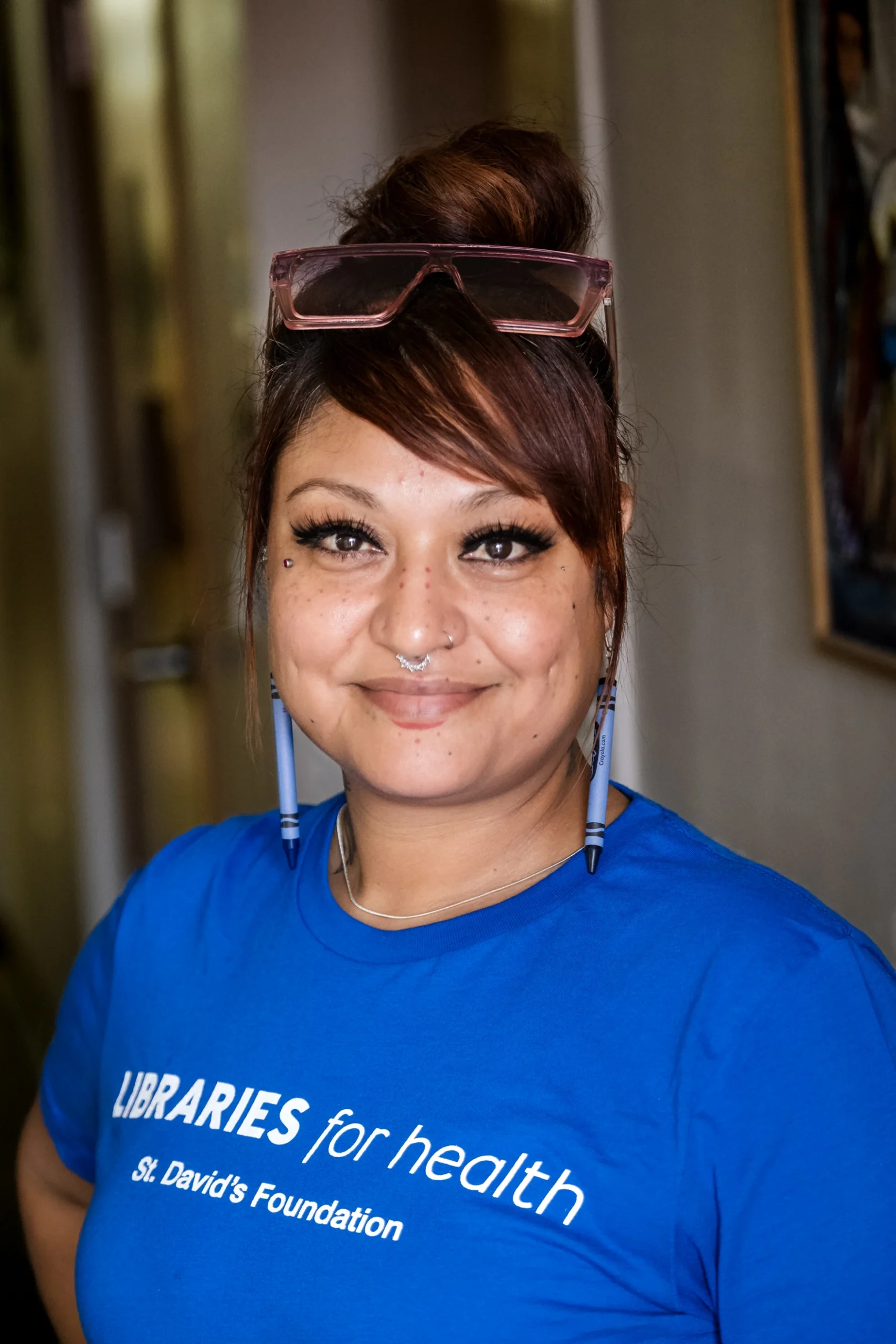
Britany Khan Flores, mental health peer specialist at the Smithville Public Library. Laura Skelding for KUT News
“I can tell a story … or hey, just share, ‘You know, when I was in that situation, this is what I did,’” Flores said. “I can’t say it’ll work for you, but it’s a possibility. If you’d like to try it, we can maybe strategize on how to get you there.”
The specialists were originally overseen by the nonprofit Via Hope, followed by Austin Mental Health Community when Via Hope shuttered last year. TaKisha Moore, an expert on the peer support model who oversaw the Libraries for Health peer support specialists through the end of 2025, said these non-clinical support figures are uniquely positioned to make a difference in rural communities. While access to clinicians can be important, Moore said trust often has to be built before people are ready to take that step.
“They feel more comfortable when they are just speaking to a regular person — someone that they feel is not like that therapist or that psychiatrist who has the power and ability to write on a piece of paper and maybe change their life in some kind of way,” she said. “I think this is a very low-staticky way to meet people where they are, with the least amount of friction and pushback to support and help.”
A new library mindset
Up north at the community library in Jarrell, there are currently two peer support specialists who work with different groups that make up key portions of the growing Jarrell community.
“One works with young families and parenting and parents who have children with disabilities, and the other works with more of the senior citizens,” said Susan Gregurek, the library’s director.
That second specialist also works with veterans, American Sign Language speakers, and with people dealing with grief, anxiety and depression. Gregurek says the peer support specialists have dramatically expanded what the small library is able to do.