
Sabrina Ortengren had almost no hope when she and her husband Jay sat down with an autism therapy provider in Evergreen in 2022.
All of the specialized schools in their home state of Virginia had deemed their son Ethan’s needs too severe to manage. The family had made the three-day journey west based on reports that autism services in Colorado would be better, but in the upheaval of a move, Ethan had gotten worse and thrown his father into a wall.
After a week in Children’s Hospital Colorado, he was doing better, but she couldn’t imagine anyone would want to work with a 14-year-old with the build of a lineman and a history of aggression.
“We were telling them every awful thing we could think of, so they’d know upfront,” she said.
Rebecca Urbano Powell, who owns Seven Dimensions Behavioral Health, could tell Ethan was going to be a challenging student, but she was confident he could make progress with applied behavior analysis, a therapy focused on breaking down tasks and using repetition to help people with autism learn to function more independently. The technicians working with him had to wear pads at times during the first year to limit injuries when he lashed out, but then, something began to shift.
 Ethan Ortengren, 18, who has autism, takes a break from assembling a Lego set during therapy at Seven Dimensions Behavioral Health in Evergreen, Colorado, on March 16, 2026. (Photo by RJ Sangosti/The Denver Post)
Ethan began learning to express himself through a combination of short spoken phrases and pointing to icons on a tablet. He developed enough self-regulation that his parents felt safe taking him to restaurants and stores, confident that he wouldn’t bolt into traffic or hurt someone. He started to develop passions, such as building with Legos, riding over “bumpity bump” mountain passes and listening to 1980s hair bands, Jay Ortengren said.
His therapy “changed how our family is able to live,” Sabrina Ortengren said. “It gave him a life, and us with him.”
But the Ortengrens worry that Ethan and others like him in Colorado may not be able to get applied behavior analysis — known as ABA therapy — as easily in the future. The state agency that funds Medicaid is asking lawmakers to lower the rate paid to providers to help balance the budget and to allow more chances to review payments. The department is also seeking a new requirement that behavioral technicians doing most of the front-line therapy get certified, following a federal audit that flagged most bills for the service as questionable.
Kim Bimestefer, executive director of the Colorado Department of Health Care Policy and Financing, said the state has to make changes if Medicaid is going to continue paying for ABA therapy. Colorado’s payments to providers quintupled in six years, reaching $287 million in the fiscal year that ended in June.
Practices owned by private-equity firms that were “exploiting” the lack of standards for autism care accounted for a significant share of that increase, she said.
“Ultimately, evidence-based guidelines and best-practices assessments — which exist in most every other area of care — would enable Medicaid programs and commercial carriers to drive the right care, at the right price, in the right setting, for the right patient outcome for autistic children, thereby curbing the current outrageous, profit-driven provider behaviors,” Bimestefer said in a statement.
Colorado is facing a budget deficit as high as $1.5 billion, making Medicaid cuts almost inevitable, because the program accounts for about one-third of the state’s spending. In the current year, the Department of Health Care Policy and Financing’s budget, the vast majority of which goes to Medicaid, reached $18 billion, including about $10 billion in federal funds.
In addition, the U.S. Department of Health and Human Services’ Office of the Inspector General found Colorado may have overpaid ABA providers by about $78 million in 2022 and 2023, based on a sample of claims it reviewed. The OIG report recommended the state repay almost $43 million to the federal government, though Colorado is contesting the way it calculated that number.
 Sayeena Normanleier, a registered behavior technician, left, and Dezart Stover, a behavior technician, right, help Ethan Ortengren, 18, assemble a Lego set during autism therapy at Seven Dimensions Behavioral Health in Evergreen, Colorado, on March 16, 2026. (Photo by RJ Sangosti/The Denver Post)
Two sides pointing fingers
The Department of Health Care Policy and Financing and therapy providers have dramatically different takes on the OIG’s findings.
Colorado officials say autism therapy providers, especially those owned by private-equity investors, saw an opportunity to make money in a new field without much federal guidance. Providers say the state failed to provide clear guidance about how they should document their work and is punishing them for its mistakes.
The OIG focuses on whether payments followed Medicaid’s rules and can’t determine if anyone attempted to defraud the program, said assistant regional inspector general Kim Kennedy.
In about one-third of the sample of bills the OIG examined, enough evidence existed to conclude the state shouldn’t have paid because the bills didn’t have the right documentation, the provider didn’t have the necessary credentials, or the child didn’t have a relevant diagnosis recorded. In the remainder, the documentation was too poor to say one way or the other.
Without sufficient records, states have no way of knowing whether providers just didn’t document the high-quality sessions they offered, or if Medicaid has paid for little more than babysitting, Kennedy said.
“You could not tell what’s a good provider, a bad provider or a fraudulent provider from the documentation,” she said. “It’s not just a payment issue. It’s a quality of care issue.”
The OIG found similar problems in Maine, Wisconsin and Indiana, and is working on audits of three additional states, which haven’t been publicly identified. Medicaid has only consistently covered ABA therapy since about 2015, and states may still be learning how to make sure providers are following rules and giving necessary care, Kennedy said.
Urbano Powell, who is president of the Colorado Association for Behavior Analysis, said the Department of Health Care Policy and Financing has itself to blame for the findings, because it didn’t provide clear information about how to document sessions with clients, told providers to use the wrong billing codes for services, and continued to pay claims now flagged as problematic.
The state is sending a message with the cuts that it doesn’t value people with developmental disabilities, she said.
“Budgets are important, but I think humans are more important,” Urbano Powell said.
Bimestefer countered that some providers have pushed families toward more hours than necessary to maximize their payments. Those providers also billed for time that clearly wasn’t eligible, such as when children took play breaks or naps, she said.
 Ethan Ortengren, 18, who has autism, right, places his hand on his father Jay Ortengren’s hand after his father arrives for a visit during Ethan’s school day at Seven Dimensions Behavioral Health in Evergreen, Colorado, on March 16, 2026. (Photo by RJ Sangosti/The Denver Post)
All medical specialties have rules for filling out their notes, and ABA providers shouldn’t need the state to tell them that copying and pasting the same summary for each session, as the inspectors found in some cases, wasn’t good enough, Bimestefer said.
“The industry has to evolve,” she said. “In the meantime, we have to hold bad actors accountable.”
Nationwide, Medicaid payments for autism behavioral therapies increased from about $660 million in 2019 to $2.2 billion in 2023, and the number of companies offering the services roughly doubled.
In some cases, states reimbursed providers hundreds of dollars for an hour of therapy, even though the workers providing it had little education beyond high school, according to The Wall Street Journal. The average rate was $61. Indiana was particularly prone to high spending because it reimbursed providers 40% of whatever they billed, rather than setting an hourly rate for therapy.
Certification and reviewing payments
Two of Colorado’s proposals, increasing payment reviews and requiring behavior technicians to get certified, appear targeted at problems the OIG report found. The state pays board-certified behavior analysts to assess children, develop care plans and supervise the technicians doing much of the hands-on work with clients.
Currently, Colorado doesn’t require specific credentials for behavior technicians.
In December, the department asked the state Medical Services Board to pass an emergency rule requiring the roughly 2,000 technicians without credentials to complete a certification. About 6,600 technicians had already completed the process, which includes about 40 hours of coursework, on-the-job training and a test. The board ultimately didn’t pass the rule, but the department plans to try again this year.
The credentialing is one part of a rule to create regulations specific to ABA, said Adela Flores-Brennan, Medicaid director at the Department of Health Care Policy and Financing. Right now, providers operate under the rules for services to screen and treat young children, she said.
“It’s mostly about who can provide the services, what services can be billed,” she said of the proposed regulations.
Most providers support requiring technicians to get certified, but they need a grace period so that new hires can complete their training while they work, said Will Martin, a board-certified behavior analyst at Soar Autism Services, which has 15 locations in the Denver area and one in Colorado Springs.
The certification requirement would have little impact on the state’s budget. Legislative staff estimated that increasing reviews before and after payments to ABA providers go out could save about $10 million in the coming fiscal year, though.
Unlike prior authorization, which happens before the patient gets a service, pre-payment review occurs after the service but before reimbursement, while post-payment review could force providers to pay Medicaid back. Pre-payment reviews would likely be the bigger problem, because they could mean providers wait as long as six months for reimbursement on services they already provided, Martin said.
Medicaid currently does pre-reviews of payments for non-emergency medical transportation because of fraud in that field, and the pauses for review are typically less than three months, Flores-Brennan said. Post-payment review takes longer because the state has to dive into medical records, she said.
Legislative staff also said the state general fund could save about $2.7 million in the coming year by lowering Medicaid’s rate from 100% of the average paid by comparable states to 95%. The state would pay about 47 cents less for time spent assessing a child and $8.49 less for ABA therapy delivered in a group.
Colorado had raised that rate in 2023 because nine providers had left the state, and lawmakers were worried about access, Martin said. Lowering it risks creating the same problem again, he said.
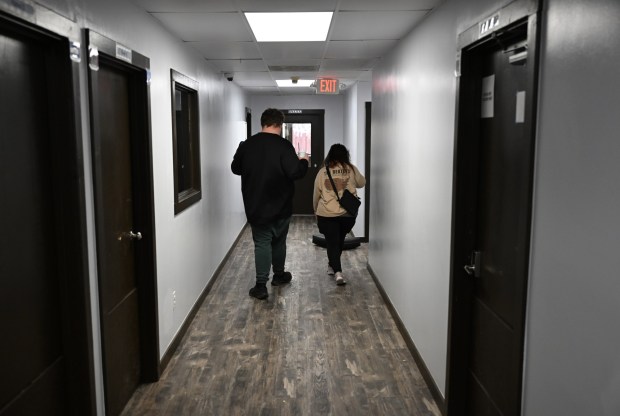 Ethan Ortengren, 18, who has autism, left, and Dezart Stover, a behavior technician, walk down a hallway at Seven Dimensions Behavioral Health as they head outside for exercise in Evergreen, Colorado, on March 16, 2026. (Photo by RJ Sangosti/The Denver Post)
‘Fearful for what’s going ot happen’
Urbano Powell said she already had to stop taking new clients covered by Medicaid because the $80 per hour rate doesn’t cover her costs, especially since she can’t bill for time supervising technicians or working with parents, which takes up about half of her day.
School districts pay for the therapy that full-time clients such as Ethan receive during classroom hours, but Medicaid or private insurance pays for any services outside that time, she said.
“I can barely support myself and my husband at this point,” she said. “I really am fearful for what’s going to happen to our Medicaid families in Colorado.”
When Colorado raised its rates in 2023, the group of comparable states included Nebraska, despite the department’s request to exclude it as an outlier, Bimestefer said. Nebraska has since lowered its rates, and states are adjusting after overpaying for a time, she said.
The number of providers increased steadily from 88 in fiscal year 2017 to 373 in fiscal year 2024, and pushing providers to stop prescribing more hours than necessary will free up sessions for additional children, Bimestefer said.
“We’ll be fine,” she said.
While a few providers probably are overprescribing therapy or providing less care than they bill for, the majority are trying to help kids reach their potential based on their best clinical judgment, Martin said. The state should focus on auditing outlier providers, such as those giving every client 40 hours of therapy each week, rather than reviewing payments for everyone or cutting rates, he said.
“A rate cut is something that is like a sledgehammer,” he said.
The state also needs to weigh cutting costs now against saving money in the future by allowing children to function more independently when they grow up, Martin said. More-intensive therapy before children turn 5 increases the odds they won’t need as much support as adults, though obviously not everyone will be able to hold a job and live on their own, he said.
“Their investment in children early in their developmental window would literally pay dividends over time,” he said.
While Ethan, who is now 18, probably will need some support throughout his life, he has far exceeded their initial goals of learning to pay attention for five minutes and not harming himself or others, Sabrina Ortengren said.
Jeffco Public Schools will continue to pay for his therapy until he turns 21, and Urbano Powell has started talking to his parents about gradually introducing skills he could use in a supported work environment.
That seemed impossible four years ago, when they moved to Colorado in a last-ditch effort to keep him out of an institution, she said.
“We’re, probably for the first time, excited to see where his future goes,” she said.
Sign up for our weekly newsletter to get health news sent straight to your inbox.