
It was one of Donald Trump’s many unbelievable moments. A Japanese reporter asked him on Thursday in the Oval Office, during a visit by Prime Minister Sanae Takaichi, why Washington hadn’t warned its allies about the attack on Iran. “Who knows better about surprise than Japan?” Trump joked, “Why didn’t you tell me about Pearl Harbor?” The remark seemed to make Takaichi uncomfortable, broke the rules of diplomatic decorum, and shattered decades of avoiding, in the name of bilateral harmony, the issue of the attack in 1941 that killed more than 2,400 people and led the United States into World War II. It also created a space-time paradox: no one could have warned Trump because he was still five years away from being born.
On Monday, the president contradicted himself no fewer than five times regarding his plans in Iran, after weeks of simultaneously insisting that the United States had won the war and that much remained to be done. Hours later, he posted several incomprehensible messages on his Truth Social platform, retweeting flattering news stories about himself published months earlier. And not too long ago, there was the letter to the prime minister of Norway criticizing him for not awarding him the Nobel Prize, even though it wasn’t within the monarch’s power to do so; there was also the speech full of insults directed at his allies in Davos; and that news conference in which he launched into a monologue about a mental institution in Queens and his mother’s belief that he would one day be a baseball star.
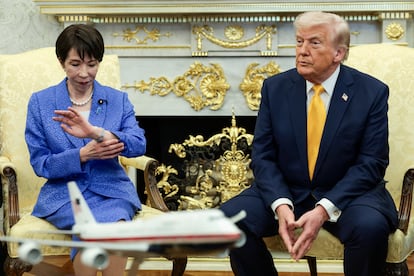 Japanese Prime Minister Sanae Takaichi looks at her watch during a meeting with U.S. President Donald Trump in the Oval Office at the White House in Washington on March 19.Evelyn Hockstein (REUTERS)
For his supporters and for members of his Administration, all this only proves the unorthodox personality of the president, as well as the unpredictable and approachable style of someone who has no regard for the conventions of traditional politics and who has created around his own figure an almost cult-like movement that is unprecedented in the recent history of the United States.
According to Johns Hopkins University psychologist John Gartner, these examples add to the growing evidence that the U.S. president is not well.
A Reuters-Ipsos poll released in late February revealed that 61% of Americans believe Trump has become “erratic with age” (including 30% of Republicans). It also showed a decline in the number of people who believe Trump is “mentally sharp and capable of handling challenges,” from 54% in September 2023 to 45% today.
Gartner has been warning about Trump’s “mental disorders” for a decade, and he has no doubt about them. “He is a malignant narcissist,” the psychologist explained in a video conference with EL PAÍS. He explained that this is an illness described by Holocaust survivor Erich Fromm to diagnose Hitler, and that, according to the doctor, it has these components: “Narcissism, of course—many politicians have it—antisocial personality disorder (psychopathy) —they lie, deceive, harm others, violate the rules, and feel no remorse—paranoia—they constantly feel attacked and, therefore, seek revenge—grandiosity—their desire is to dominate and be above everyone else; ‘I am the best president in history,’ ‘nobody knows more than me about tariffs,’ etc.—and sadism: they enjoy chaos, destruction, and humiliation.”
Gartner completes the picture by saying that Trump is hypomanic. “Like Bill Clinton,” he adds, referring to the Democratic president about whom the psychologist wrote a book focusing on this personality trait. “Trump’s hypomania explains his tremendous energy, his not needing sleep, his arrogance and impulsiveness, and his errors in judgment, because he believes he is always right.” To all of the above, Gartner—who has mastered the art of pithy phrases like this one: “The only thing more dangerous than an American Hitler is a demented American Hitler”—adds that Trump’s brain is deteriorating. “The level of decline is shocking, if you compare his current speech with that of the 1980s; he used to be an articulate guy. He’s very good at dissembling, laughing, and acting confident when he stumbles,” he observes.
The psychologist founded a professional organization called Duty to Warn at the beginning of Trump’s first presidency. It attracted more than 60.000 doctors, 27 of whom authored a best-selling book. They launched a Twitter account that reached a million followers, and he starred in the documentary Unfit: The Psychology of Donald Trump (2020). In other words, they generated considerable buzz before fading away after Joe Biden’s victory.
They also faced criticism for diagnosing a patient without having personally examined him, leading to accusations that they violated the Goldwater Rule, named after Barry Goldwater, the 1964 Republican presidential candidate to whom Fact magazine dedicated a cover story with the headline “1,189 psychiatrists say Goldwater is psychologically unfit to be president!” Inside, they leveled outlandish accusations against the candidate, who sued the publication, which claimed he could not accept his homosexuality or forgive his father for being Jewish.
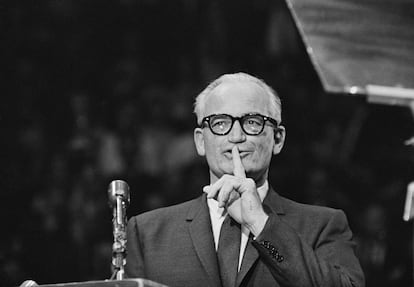 Senator and presidential nominee Barry Goldwater at an election rally in Madison Square Garden, New York City in October 1964. William Lovelace (Getty Images)
That scandal, amidst the fervor for Freudian psychoanalysis in the United States, led in 1973 to the establishment by the American Psychiatric Association of an ethical principle that prohibits offering professional opinions on the mental health of public figures without having personally examined them after obtained their consent.
Gartner defends himself by saying that “studies show that the clinical interview is the least reliable way to diagnose a patient, especially if that patient is the biggest documented liar in history.” “The Goldwater Rule doesn’t say that you can’t diagnose someone without treating them personally, but rather that it’s unethical to do so with someone famous,” he adds.
Vince Greenwood, founder of the Washington Center for Cognitive Therapy—who since 2020 has focused on studying Trump’s psychopathy, on which he plans to publish a book in August—says via videoconference that for that specific disorder, “one of the best-defined in the American psychiatric manual,” an interview is not necessary “if a large amount of data on the patient’s life history is available.” “It is, fundamentally, a disorder of long-standing behavioral patterns and traits, manifested over decades,” explains Greenwood. And the president of the United States, who has spent his entire life in the public eye and has hundreds of books about him or written by him, “probably has the most extensive record in history,” according to the expert.
Gartner preferred another principle: the duty to warn, which he used to name his association. It originated in a California Supreme Court ruling in the case of a psychiatrist who learned of one of his patients’ intentions to kill his girlfriend, a promise he carried out. The ruling concluded that the obligation to alert prevails in such a case over the mandate of confidentiality that governs the privacy of the therapist’s couch. “We believe that Trump, even if he isn’t going to kill anyone, is a danger to hundreds of millions of people, so we decided to speak out,” Gartner recalls. The objective was to activate Article 4 of the 25th amendment, which contemplates the replacement of the president if he is found to be “unable to discharge the powers and duties of his office.”
That “danger” has only worsened, according to Frank George, a psychologist, neuroscientist, and author of the popular substack Gaslight Report, in which he writes about Trump’s mental health. In a video conference interview, he explained that narcissism is a disorder that accompanies people from birth, and that it is “influenced by the patient’s circumstances, environment, or upbringing.” “It’s like heart disease; eating hamburgers every day doesn’t help. If you manage your narcissism, you may not end up being the most generous and empathetic person, but at least you’ll have it under control. That’s not the case with Trump: his parents didn’t help, nor did his time at military school, where he learned that being a bully worked for him. Becoming the most powerful person in the world did the rest, transforming him from a pathological narcissist into a malignant narcissist,” George explains.
The psychologist observes two fundamental differences in his second presidency. “On the one hand, he has surrounded himself with people from whom he doesn’t want advice, but rather a ‘yes.’ He acts without the barriers of the first term,” says George. The second difference is that he is showing “increasingly worrying symptoms of frontotemporal dementia (FTD).”
“When people hear the word dementia, they usually think of Alzheimer’s, but that’s not what’s happening to him,” he explains. “FTD affects the frontal and temporal lobes. The frontal lobes are where what makes us most human resides; thanks to that part of the brain, we can plan, make rational decisions, and think things through. With this type of dementia, it’s as if the neurological guardrails disappear.”
Among the symptoms of FTD is confabulation, which goes beyond simply making up stories. It’s not lying; it’s believing what one says, however implausible it may seem. Another symptom, George explains, is paraphasia: “making mistakes with words, mispronouncing them, or not knowing how to finish them.” “A third symptom is insistence: how many times has he listed the wars he’s won?” George asks, adding that FTD “makes his narcissism manifest itself more starkly.”
The White House responds to behavior that alarms these specialists with laughing emojis on social media, and reacts to their diagnoses by referring to the results of the medical tests Trump undergoes as part of his official duties. In the April 2025 report, the conclusion was that a “comprehensive neurological examination revealed no abnormalities in his mental status, cranial nerves, motor and sensory function, reflexes, gait, or balance.” “Cognitive function, assessed using the Montreal Cognitive Assessment (MoCA), was normal, with a score of 30 out of 30,” added the report, signed by the presidential physician, Sean Barbarella.
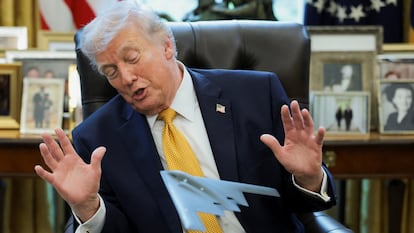 Donald Trump looks at a model of a B-2 bomber commemorating “Operation Midnight Hammer” on March 16, 2026. Jonathan Ernst (REUTERS)
A couple of issues ago, New York Magazine published an article they presented as “a good-faith attempt to find out the truth about Trump’s health,” titled “The Superhuman President.” The phrase comes from one of the Republican’s closest allies, Stephen Miller, who recommended it to the reporter for that purpose. The publication agreed to do so, perhaps because in the interview the president gave for the story, he threatened a lawsuit if the coverage was negative. In the article, in which the protagonist admits that his father had an illness whose name he can’t recall (“Alzheimer’s type”), but that he doesn’t suffer from it himself, one of the president’s doctors, James Jones, states that Trump, at almost 80, is in better shape than Barack Obama, whom he also treated when Obama was in the White House, until he left at age 55. The author concludes, after admitting that he is not a doctor, that Trump “might be quite healthy.”
The report was a reaction to the news that he returned in October to Walter Reed National Military Medical Center in Maryland. The reason given by the government for repeating his annual checkup, six months after his last one, was, following a previous diagnosis of chronic venous insufficiency, swelling in his ankles and a bruise or wound on one hand, and then on the other, which has sparked conspiracy theories dissatisfied with official explanations. These theories suggest that the injuries were caused by prolonged handshakes, the rings of women greeting him, or bumping his head against a table corner. New York Magazine, Trump points to another cause: his daily intake of 325 milligrams of aspirin, a dose he reportedly prescribed himself.
In his unexpected October checkup, Trump again underwent the MoCA, a test that assesses signs of dementia. Days later, he boasted of having scored exceptionally high on an “intelligence test,” which appeared to be a misunderstanding on his part: the MoCA is not that type of assessment. According to Gartner, whose insistence prompted Trump to first take the test in 2019, his doctors “aren’t telling the whole story,” and, at the same time, “are inadvertently revealing more than they appear to.” “No doctor repeats a dementia screening on a patient six months apart unless they have suspicions or are monitoring for some kind of decline,” the expert says.
Weeks later, Trump revealed, seemingly inadvertently, that he had also undergone an MRI, but that he had “no idea” what part of his body had been scanned. “It wasn’t the brain, because I took a cognitive test and aced it,” he said, before adding that he would make the results public. The next day, White House spokeswoman Karoline Leavitt read them during a press conference, as proof of the “transparency of the Administration.”
“Transparency” is one of the favorite words of the president’s defenders, who argue that everything has only one explanation –that Trump is Trump– and praise, for example, that he constantly accepts questions from the press or that in recent weeks he has been constantly taking the phone to Washington journalists to justify his war in Iran.
This constant presence in the spotlight contrasts sharply with the absence of his predecessor, Joe Biden, whose precipitous decline, covered up by his entourage and overlooked by a mainstream press that failed to investigate thoroughly, began around the same age Trump is now. According to the three professionals consulted for this story, the deterioration of the two men is not comparable. The argument essentially boils down to this: Biden was aging, very much and very quickly; Trump is developing dementia.
In the first year of his second term, he has broken speaking records, uttering, according to a calculation by The New York Times, 1.97 million words, 245% more than at the beginning of his first term. This logorrhea serves to prove several things at once: that he is not afraid of scrutiny of his abilities, that he plays at confusion by employing something we might call the “squid ink tactic,” and, as already noted, that no one in his inner circle seems capable of reining him in.
It all depends on who you ask in the debate over Trump’s mental health.
Sign up for our weekly newsletter to get more English-language news coverage from EL PAÍS USA Edition