
This article is a part of “Mental Health Snapshot,” a reporting collaboration between Tulsa Flyer, The Oklahoma Eagle, The Frontier, KOSU, La Semana and Focus Black Oklahoma on mental health and resources in Northeast Oklahoma.
All editorial decisions for this series are made by the participating newsrooms.
Major series support provided by: Healthy Minds Policy Initiative
As a child growing up in north Tulsa, Mikeal Vaughn felt a strong urge to “wash his brain.”
It was as if there was static in his head, and if he were to reach inside, he could massage it all away.
As a teenager, Vaughn felt his emotions with a lot more passion than his peers, experiencing sudden outbursts or moments of intense dissociation. It was during this time that he thought that he might be a little “different.”
He found out what that difference was all about during his first year at the University of Maryland. Vaughn was hanging out with an old friend, when he began talking with loose lips and bug eyes. The friend began to worry.
A story of trauma
At the same time Vaughn was seeking understanding of his challenges, a young Tim Newton was fortifying walls of repressed emotions on the other side of the country.
“Tim, no b— a—ness.” Newton’s grandfather would repeat the phrase any time he caught him crying or expressing emotion.
With one parent in prison and another suffering from substance abuse, Newton was raised by his grandparents in an impoverished neighborhood in south central Los Angeles.
Before turning 18, he lost seven of his peers to gun violence. With each death, he carried that grief on his own. There were no counselors, psychiatrists or therapists to turn to.
The idea of seeking professional help as a young Black man was not realistic or socially acceptable for someone like Newton.
Vaughn and Newton are Black Tulsans, now middle-aged, who initially faced mental health challenges in their adolescent years. They have gone on to successful careers, with Vaughn founding Tulsa’s Urban Coders Guild and Newton serving as executive director of Tulsa Dream Center.
Both shared the details of their struggles — crises, coping mechanisms and eventually treatments — with The Oklahoma Eagle. Their circumstances are anything but unique. Black Americans experience mental health challenges differently from other groups, with their access to treatment and stigma shaped by culture and community.
A manic episode
Back on the University of Maryland campus, Vaughn’s friend gave him some straight talk.
“She was like, ‘Hey, Mikeal, I know we’ve always been a little crazy,’” Vaughn recalls. “‘We’ve always had fun and been a little wild, but this is too far. I don’t know that you’re well.’’’
The world was fading behind him. When he moved it felt like he was going a million miles per hour. At a certain point, he said, his mind felt like it was moving faster than his body, faster than his own consciousness.
Something really was wrong, but he didn’t know what. The next day he searched for the student health center.
As he walked across campus, with his mind racing, he felt a sense of power — one that felt like electricity was being emitted from his fingertips.
Vaughn was undergoing his first manic episode.
“No two words are lined up,” he said. “It’s like being on a train that doesn’t have any brakes, or being caught in a tornado.”
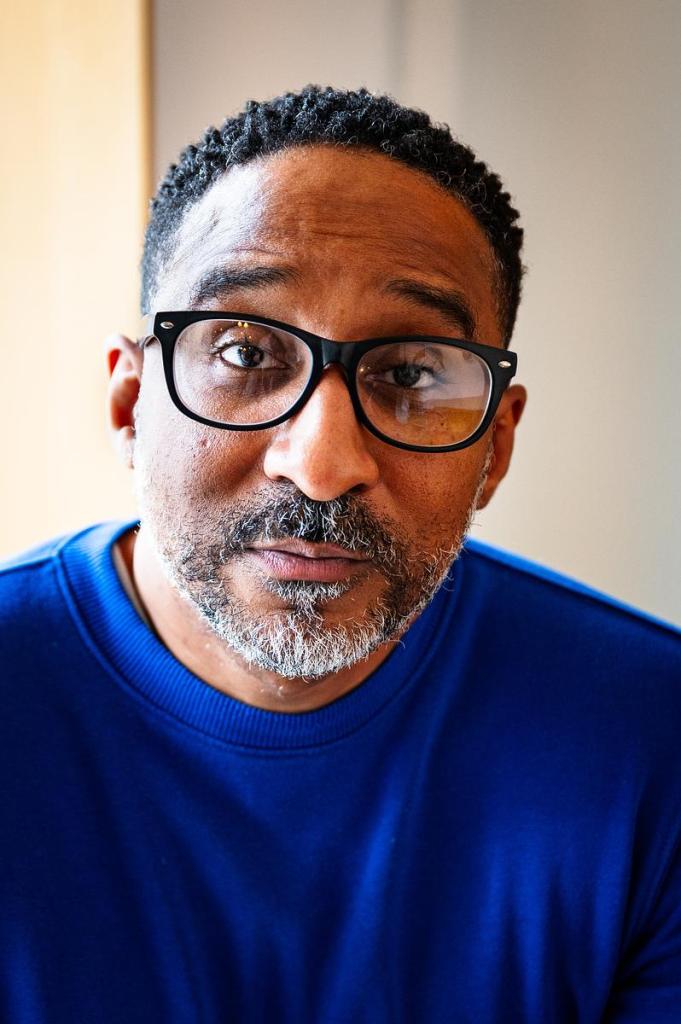 Mikeal Vaughn, founder of the Urban Coders Guild, said having access to a Black psychiatrist was crucial to managing his bipolar disorder. Credit: Milo Gladstein / Tulsa Flyer
A diagnosis
After a series of conversations at the university health center, Vaughn was diagnosed with bipolar disorder, a condition where a person experiences extreme shifts in mood and behavior that are often destabilizing. His manic episode was a symptom of the condition, where a person experiences a severe change in behavior. Over the years, Vaughn has had two more manic episodes since his first.
The exact cause of bipolar disorder is unknown, but it is highly likely to be a combination of genetic, biological and environmental conditions. There is no cure, but it is treatable.
“I think of neuronormative folks as experiencing life as waves, ups and downs like, not all good, not all bad, ups and downs, smooth waves, like a wind, like a gentle wind on the water,” Vaughn said. “But for me, there are strong spikes, like negative 10, positive 10 level spikes, and when I’m down, (I’m) down for days … like literal and figurative darkness.”
Over the next 25 years, Vaughn learned to manage his disorder — but the process was not smooth. When he was overmedicated, he felt like a “zombie.” At other times, his mood swings felt like they were making his mind spike.
Despite mental health being a foreign topic in his north Tulsa community, Vaughn said he had the necessary support group to manage his condition. He had two supportive parents and open-minded friends — a luxury he said not every Black person had growing up.
Nowhere to turn
Out in California, Newton was emotionally adrift.
“I cannot think of not one instance inside my life growing up that a church or an adult reached out and they said, ‘Hey, how do you feel about what happened this weekend? How you feel about what happened this Friday? How you feel about what happened last night?’” Newton shared with The Oklahoma Eagle. “They just expect you to show up at school and do your work and it’s another day, and that was my childhood.”
Newton’s grandmother was one of the only people he could confide in or express sadness. But if he were alone with her and his grandfather caught wind of any tears or screams of grief, he’d get an earful telling him to man up.
Newton began to internalize these words. His unresolved relationship with death crescendoed a few years ago, when he went in search of a Dream Center bus driver who he hadn’t seen for a few days.
The staff member gave Newton a key to his home, just in case he ever needed to find him. Upon entering his door, Newton discovered his lifeless body. The man had died of a heart attack.
“Years and years of grief that I’ve repressed just exploded,” Newton said.
Newton now had tools to deal with his emotions. He had been seeing a therapist for a few years, a practice that he continues today on a monthly basis.
Even at 42, the message Newton’s grandfather would tell him during times of sorrow or disappointment still echo in his mind. Sometimes the words motivate him. Other times they put up walls. It’s a double-edged sword.
“I think those words are always in my head,” Newton said.
‘Just pray about it’
Newton and Vaughn’s stories echo the experiences of many Black Americans who grew up in the 1980s and ‘90s and lacked access to professional help to respond to their mental health conditions.
In 2024, a Department of Health and Human Services survey found Black adults were 36% less likely than other adults to have received mental health treatment in the past year.
In Oklahoma, only 30% of Black adults with mental health conditions have sought treatment, according to the state Department of Mental Health and Substance Abuse Services.
Different outlets have often taken the place of medical treatment for emotional distress. Church in particular became a main form of dealing with complex emotions that may otherwise be taboo to discuss aloud.
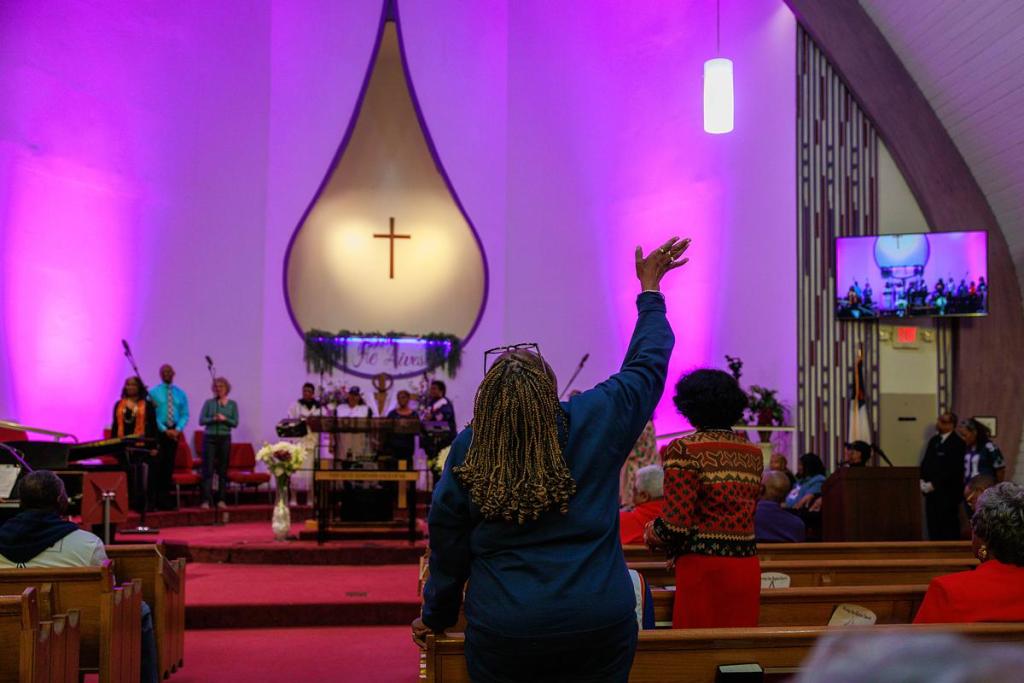 Congregants of Tulsa’s Morning Star Baptist Church gather for a Sunday morning service Feb. 8, 2026. Credit: Molly McElwain / Tulsa Flyer
“Unfortunately, people have used religion as a scapegoat to not address mental issues that they may be facing, and kind of use this kind of as a cloak,” Newton, who is also a pastor, said. ‘“I’m just gonna pray about it. I don’t need to talk to anybody about it. I’m just gonna talk to Jesus.”’
Lynn Page, a longtime north Tulsa resident and counselor at Mt. Zion Baptist Church, offered some insights into how faith has come to strongly impact how Black people approach mental health.
Mt. Zion Baptist Church, located in the Historic Greenwood District, is a place where hundreds of Black Tulsans congregate every week to hear sermons, pray and converse among their fellow churchgoers.
“Suggesting mental health treatment or medications or hospitalization, those things are sometimes looked at as unneeded or taboo or not for us,” Page said. “There’s just been a lot of history of Black people not being treated fairly, being taken advantage of, losing their lives with some of the practices that has happened over the course of years.”
Page has more than 20 years of experience in mental health services, serving as a member of Tulsa County’s mobile response crisis team COPES. The service features a 24/7 hotline for anyone experiencing suicidal or homicidal thoughts, psychosis, delusions, hallucinations, anxiety or depression.
Often when Black families call COPES on behalf of a family member, Page said, they are hesitant to discuss that person’s history with medication or any personal background information.
“They don’t want to talk about that. They don’t,” Page said. “‘That’s not important. You just need to come get them.’”
History of discrimination
This hesitancy to discuss mental disorders outside of the household is not without reason. Historically, Black Americans have found themselves victims of racism in the medical industry that dates back to slavery.
Dr. Nicole Washington, a Tulsa-based Black psychiatrist, provided another perspective. She pointed to Dr. Samuel Cartwright as one reason Black people shun medical solutions to mental health. Cartwright was a physician in the 1800s and considered one of the leading authorities on mental health of Black Americans.
In 1851, Cartwright diagnosed enslaved Black Americans with a term called “draptomania,” concluding that only mentally ill slaves sought to escape from slavery. He invented the term dysaesthesia aethiopica, which argued that enslaved people experienced a dullness of the mind, and skin which affected their duties and made them immune to the pain of being physically punished. His suggestion to “cure” dysaesthesia aethiopica was to physically punish enslaved people even more due to their supposed high tolerance of pain.
As medicine advanced, Black people continued to bear the brunt of racist ideologies and misdiagnosis, resulting in Black men being diagnosed with schizophrenia at higher rates than their counterparts.
Over the years, Washington said, these misdiagnoses have persisted.
“I do 100% believe that people of color, Black people, have absolutely every reason to be skeptical of the mental health system,” Washington said. “They literally gave a diagnosis to a slave who wanted to run away and be free. They labeled it a mental health disorder.”
In 2021, the American Psychology Association issued an apology for its complicity and contributions to systemic inequities, racial discrimination and denigration of people of color over the course of its existence.
Since the medical industry was seen as an untrustworthy place for people of color, confiding in God was not only an alternative, but the preferred option for those facing mental strife.
While Vaughn is a person of faith, his experience has taught him that more than faith is needed to treat most mental health issues. Based on the ups and downs of managing his bipolar disorder over the quarter century since his diagnosis, Vaughn echoed the importance of having access to a Black psychiatrist.
“When I share a feeling or an experience, it’s not something that I’m translating, and that really just makes the space feel safer. It feels more comfortable. I feel like I know that I can be more open, more authentic,” Vaughn said. “I feel like the responses, the feedback that I give, is also honest and open and authentic. It feels real. It resonates because it comes from a familiar place and that, for me, is super important.”
Ismael Lele is a Report for America corps member and writes about business in Tulsa for The Oklahoma Eagle. Your donation to match our Report for America grant helps keep him writing stories like this one; please consider making a tax-deductible gift of any amount today by visiting this link.
We put together a comprehensive list of mental health resources in Tulsa and across Oklahoma.
Additional series support by: Oklahoma Women in Technology
Related
Related Articles