
ANN ARBOR, MI — Ann Arbor officials say they want to launch a new unarmed crisis response program called SPROUT as quickly as possible, but further discussion and collaboration is needed to fully develop a co-response model.
A model for SPROUT, a new Supportive Resources and Outreach Team for the city, was laid out at City Council’s annual planning session in December. The idea is to have city social workers, rather than armed police, handle certain 911 calls such as nonviolent mental health crises.
Other times, there could be co-response scenarios where social workers and police respond together, officials said.
Council is now tasking City Administrator Milton Dohoney with talking to Washtenaw County Community Mental Health, the Ann Arbor Police Department and other stakeholders to gain further insight as the city continues to explore, design and eventually pilot launch a co-response model called CO-SPROUT.
City Council voted unanimously Monday, March 16, to direct Dohoney to meet with CMH to determine whether partnership opportunities exist. He’s asked to report back within 90 days with findings, implementation options and any recommended agreements or budget considerations.
Council wants to know whether an ongoing collaborative partnership with CMH is prudent.
The city is committed to advancing trauma-informed, community-based public safety strategies that effectively respond to behavioral health and mental health crises, council stated in a resolution sponsored by Council Member Cynthia Harrison, D-1st Ward.
“For too long, we’ve treated mental health crises like a crime by sending the police on their own and cycling people through emergency rooms and jails instead of connecting them to care,” she said. “Ann Arbor has committed to doing better.”
She expressed hopes of finding a real path forward with CMH, noting Ann Arbor residents already fund the county agency.
“Before we build something new with taxpayer dollars, we have a responsibility to ask what are we already paying for and why aren’t we building on it?” she said.
 Council Member Cynthia Harrison, D-1st Ward. MLive file photo.Ryan Stanton | The Ann Arbor News
Felicia Brabec, CMH board chair, spoke in support of Harrison’s resolution.
“Washtenaw County CMH stands ready to support your efforts to strengthen services for our residents, particularly in those emergent situations,” she said.
CMH has extensive experience providing 24-hour crisis response, mobile crisis response and ongoing behavioral health stabilization services, Brabec said.
“We appreciate all of your collective commitment to this, particularly the trauma-informed, the community-centered and the collaborative crisis response,” she said. “We welcome any opportunities to explore what might be in this collaboration.”
CMH provides behavioral health crisis response and clinical care coordination for Washtenaw County. It serves Ann Arbor residents through a 24-hour crisis line and through direct field response, including responses conducted within the city in partnership with AAPD, the council resolution states.
During fiscal year 2025, CMH received over 4,800 crisis service requests involving Ann Arbor residents, resulting in more than 2,000 unduplicated crisis responses, demonstrating sustained and significant demand for behavioral health crisis services within the city, the resolution states.
Of those crisis responses, 555 originated from AAPD calls for service, indicating sufficient volume to support a dedicated city-based co-response team, the resolution states.
In 2024, 1,692 CMH clients resided in Ann Arbor, underscoring the importance of crisis response models that maintain continuity of care and access to existing clinical relationships when it best serves clients, the resolution states. It states CMH can provide crisis assessments, residential placement, inpatient and partial hospitalization referrals and crisis stabilization services.
CMH crisis response data indicates about 73% of community outreach encounters were resolved without hospitalization, reducing emergency department utilization and unnecessary institutionalization, the resolution states.
CMH also reports 100% of crisis contacts resulted in followup and linkage to services, with people receiving repeated outreach for stabilization following a crisis event.
CMH crisis teams conducted an average of 14.4 contacts per person referred, compared to about two contacts in peer counties, demonstrating a high-intensity stabilization model focused on long-term outcomes rather than single-incident response, the resolution states.
“Unarmed crisis response is a central goal for the city of Ann Arbor, but certain situations require limited law enforcement involvement for public safety purposes, making a coordinated co-response model with trained officers necessary,” it states.
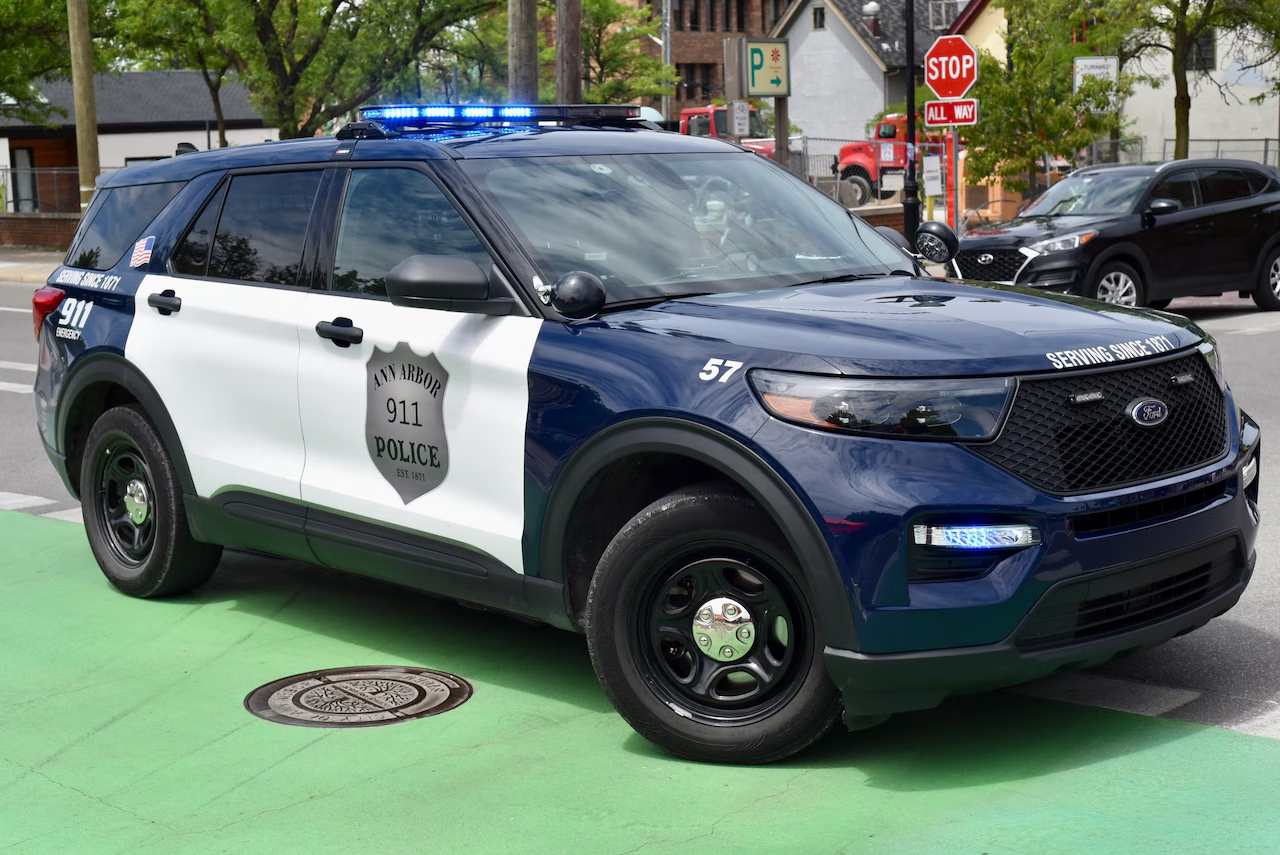 An Ann Arbor Police Department vehicle parked in the Catherine Street bikeway next to a street closure for the African American Downtown Festival. MLive file photo.Ryan Stanton | The Ann Arbor News
Harrison said she supports exploring a co-response model, but she wants the city to get it right.
“A co-response model works best if the behavioral health clinician on that job, on that team, is an expert in co-response rather than someone learning the job alongside a police officer while the person in crisis pays a price,” she said.
The good news is the city doesn’t have to start from scratch, Harrison said, pointing to CMH’s experience and calling it “deflection and diversion in practice” — deflecting and diverting people in need of treatment away from the criminal legal system.
“When someone is at one of the most vulnerable moments of their life, they deserve a response that is coordinated, compassionate and connected to care,” she said.
Want more Ann Arbor-area news? Bookmark the local Ann Arbor news page.