
Major changes for how Cuyahoga County provides care for people in mental health crises could be underway, after a deal was struck this month to fund a new crisis center.
The move, which still needs to be approved by the county’s Alcohol, Drug Addiction and Mental Health Services (ADAMHS) Board, is one piece of a larger shift that could result in fewer longer-term residential beds and the addition of more short-term crisis “chairs” instead.
Many times, people in mental health crises end up in jail or emergency rooms — whether they’re brought by police, driven by a family member or walk in themselves.
For years, Cuyahoga County, local agencies and mental health advocates have been searching for more effective alternatives to get people help for mental health, behavioral and substance use issues. They supported a diversion center, a psychiatric emergency department and a crisis unit on the city’s West Side.
A new behavioral health center would likely replace some or all of these facilities.
Proponents say that it will streamline mental health crisis care by offering one entry point with fewer barriers to care, while existing residential beds rarely reach full capacity. Meanwhile, funding is growing scarcer and scarcer.
“We are right-sizing the crisis continuum based on what the demand is and what the services are that are most needed,” said Eric Morse, the CEO of The Centers, the nonprofit health system that will be running the new crisis center.
Leaders of the facilities that could close worry that the shift means fewer beds for a population that can’t afford long wait times.
“To decrease the number of mental health residential beds in the county is a disservice to the community and is the exact opposite of what we were trying to achieve years ago when the discussion began about diversion and crisis stabilization,” said Allyse Hawkins, vice president of Behavioral Health with Oriana House, which has operated the county’s diversion center since it opened in 2021.
The new crisis center is already under construction and is slated to open this fall. The State of Ohio, Cuyahoga County and the local mental health and addiction board all committed millions to getting the space built and running.
The challenge is that some of the dollars for the new center’s operations are expected to come at the expense of existing mental health facilities. The new center’s operations hinge on expected commitments from the county’s opioid settlement funds, which would be rerouted from the diversion center that is expected to close after the crisis center opens. And the county’s mental health board laid out a plan last August to shift funding away from a crisis center run by FrontLine Services on the West Side and a psychiatric emergency department run by MetroHealth in Cleveland Heights.
(The emergency department closed at the end of last year. MetroHealth pointed to the funding decision by ADAMHS and a county vote to fund construction of the new crisis center. Cuyahoga County rejected that assessment and said that the facility had already been struggling financially.)
Shift from residential beds to crisis chairs
The major change underway for the mental health crisis system is regarding the type of beds and “chairs” available.
The current diversion center and the Stricklin Crisis Center, the West Side facility run by FrontLine, primarily offer what are called residential beds or crisis stabilization beds.
These are beds where people experiencing a mental health crisis can stay, voluntarily, for more than one day and receive medication, therapy and other treatment.
At the diversion center, patients stay on average a little over five days at a time. At the Stricklin Crisis Center, the average was closer to 12 days in 2025.
Between the two facilities, there are up to 50 residential beds for people in a mental health crisis.
The new crisis center will have 16 residential beds, where patients can stay for days at a time. Advocates like Hawkins, with Oriana House, say that’s a loss of residential beds if the diversion center and Stricklin Crisis Center close.
At the same time, the new crisis center will add 40 crisis receiving chairs to the system — an increase of a different type of service. The chairs are essentially recliners for patients to stay and receive medication and services for up to 23 hours. The chairs can also accommodate “pink-slipped” patients, or those seen involuntarily. The diversion center and the Stricklin Crisis Center don’t accept pink-slipped patients.
Eric Morse, CEO of The Centers, gave members of Cuyahoga County Council a virtual tour of the proposed new crisis center and the crisis receiving chairs during a meeting last September.
A spokesperson for Cuyahoga County wrote in a statement that the center is a new national model that prioritizes centralizing resources in one location and assessing patients quickly. Morse, with The Centers, said crisis chairs are the intervention that helps keep people out of emergency rooms and the criminal justice system.
“A lot of people get stabilized in those 23 hours and you’re able to discharge them back into the community,” Morse said.
Jason Joyce, CEO of the ADAMHS board, said there’s nothing like the new crisis receiving center within Cuyahoga County. But there are other residential mental health services in town, such as the ORCA House, he and Morse pointed out. Hawkins said ORCA House is a good resource, but it often takes more than 23 hours for a patient to get a bed there.
Another challenge with residential beds is that the ones at the diversion center are rarely used to their full capacity. Joyce said that the average daily population at the diversion center was about 14 in 2025. Oriana House disputed this number, saying the average number of daily patients in 2025 was 20. (The diversion center is licensed for 40 residential beds but is typically staffed for 25 to 35. It also has 8 short-term spots available.) At the Stricklin Crisis Center, about nine out of 15 beds were typically in use each day last year.
Even at the low-end of daily use, the average number of residential beds in use in 2025 at those two facilities combined exceeded the number of residential beds at the new facility.
In an email to ADAMHS board members, Dr. Megan Testa, the medical director at FrontLine Service, said most clients need more than 23 hours to get stabilized.
“It is unrealistic to assume that additional ‘chairs’ providing 23-hour observation will meet the complex needs of individuals who are amidst mental health and substance use crisis,” she wrote.
The other piece of the puzzle is finances, Joyce said, because residential crisis beds often need recurring subsidies to operate. The county currently pays for the beds at the diversion center with opioid settlement funds, and those are running low.
But Joyce said that he believes the new crisis center will be able to sustain the residential crisis beds without needing a large subsidy. The center will have a pharmacy on-site, which can funnel profits back into the smaller number of residential beds, he said.
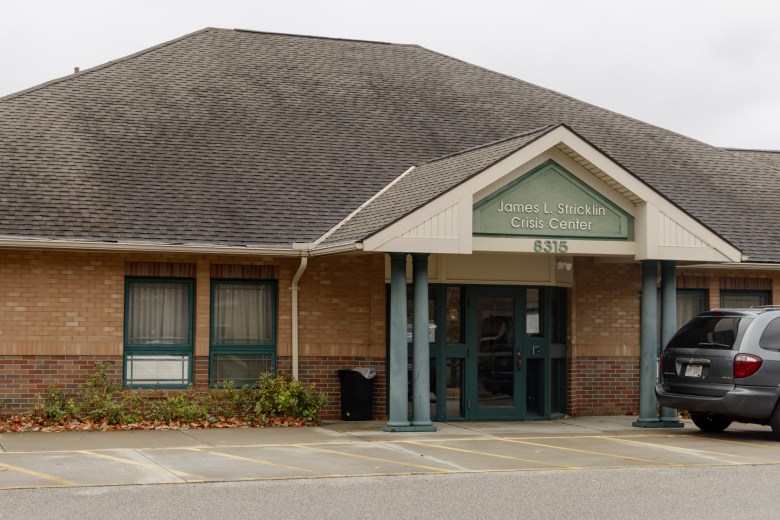 The Stricklin Crisis Center on the city’s West Side has 15 residential beds, where residents experiencing mental health challenges stayed an average of nearly 12 days in 2025. (Celia Hack/Signal Cleveland)
How do the numbers break down?
So, will the shift to the new crisis center add or subtract places for a person in crisis to go?
It depends on how you look at it.
If the closure of the diversion center, the Stricklin Crisis Center and MetroHealth’s psychiatric emergency department are all considered, then the new center will net a loss of 15 spots.
But whether MetroHealth’s psychiatric emergency department should be included is up to interpretation. That’s because the 13 beds at MetroHealth’s psychiatric emergency department, which were located adjacent to the hospital’s Cleveland Heights medical emergency department, were not licensed like other crisis centers. Instead, they were licensed as an emergency department staffed with behavioral health specialists, wrote Rita Andolsen, a spokesperson from MetroHealth, in an email.
While the hospital closed its psychiatric emergency department, the medical one next door still operates and still accepts psychiatric patients, according to Andolsen. However, the staff dedicated to the psychiatric emergency department were redeployed throughout the hospital system and are not necessarily still on-site. How the 13 beds will be utilized going forward is still under consideration by MetroHealth, Andolsen said.
Ignoring MetroHealth, the deficit between the current system and new system shrinks to two spots.
There’s a potential for the deficit to be even larger in the first year of the crisis center’s existence, though. A recent report commissioned for the ADAMHS board studied the operational feasibility of the new crisis center. It recommended that the new center staff just 20 short-term crisis chairs in the first year of existence – half its capacity – and ramp up after that. Doing so would help The Centers establish relationships with agencies that would drop off patients without hiring too many staff on the front end.
If the new crisis center operated at half-capacity after the diversion center and the Stricklin Crisis Center closed, the gap in spots for people in mental health crises would be even larger.
Hawkins, with Oriana House, said the county informed them that it might fund the diversion center if needed into 2027 to help transition residents from one facility to the next. The agency has not received any formal confirmation so far.
Signal Cleveland asked Cuyahoga County about its plans. A spokesperson for the county wrote in an email that “any decisions about the timing of the Diversion Center’s services being permanently migrated over to the Crisis Center will be made in close consultation with all parties involved and based on community need and utilization.”
Want the numbers? Here’s how we analyzed the shifting emergency mental health care
Existing mental health facilities that closed or are at risk of losing fundingNew behavioral health crisis centerCuyahoga County Diversion Center has four beds and four chairs where residents can stay for up to 23 hours. After the short-term stay, patients can be admitted into the center’s residential unit.
The residential unit can hold up to 35 people but is typically staffed for 25, said Hawkins with Oriana House. The average length of stay is a little over five days. It is licensed to hold 40 people and can only do so in unique circumstances.
Stricklin Crisis Center has 15 residential beds where people in mental health crises stay about 12 days on average.
MetroHealth’s Psychiatric Emergency Department closed at the end of 2025.
It had 13 beds, which were staffed with behavioral health specialists and could handle acute behavioral health crises.
Unlike the Diversion Center and the Crisis Center, the psychiatric emergency department beds were not licensed by the state’s department of behavioral health.
The Stricklin Crisis Center and the Diversion Center cannot accept patients who need to be seen involuntarily. The MetroHealth psychiatric emergency department could accept pink-slipped patients.
The first floor will ultimately have 40 crisis chairs, in which residents with mental health crises can stay for up to 23 hours. After the short-term stay, patients can be admitted into the center’s residential unit.
The second floor will have up to 16 residential beds for psychiatric stabilization. The Centers hope to see stays range from seven to 10 days, Morse, with The Centers, previously said in a county meeting.
The first floor will able to accept “pink-slipped” patients, or those who need to be seen involuntarily.
Signal Cleveland added the numbers in bold above to understand the net change in spots for people in crisis to go. Signal Cleveland added the numbers in bold above to understand the net change in spots for people in crisis to go.